Apprenticeships in the UK: Pay, Levels and How to Apply
An apprenticeship is a real job with training. You work for an employer, earn a wage, learn on the job and study towards a recognised qualification, usually without paying tuition fees. Apprenticeships exist in hundreds of careers, from construction, care and hospitality to engineering, finance, IT and even law, and they can lead all the way to a degree. This guide explains how apprenticeships work, what levels there are, what apprentices are paid in 2026, who can apply and how to find and win a place.
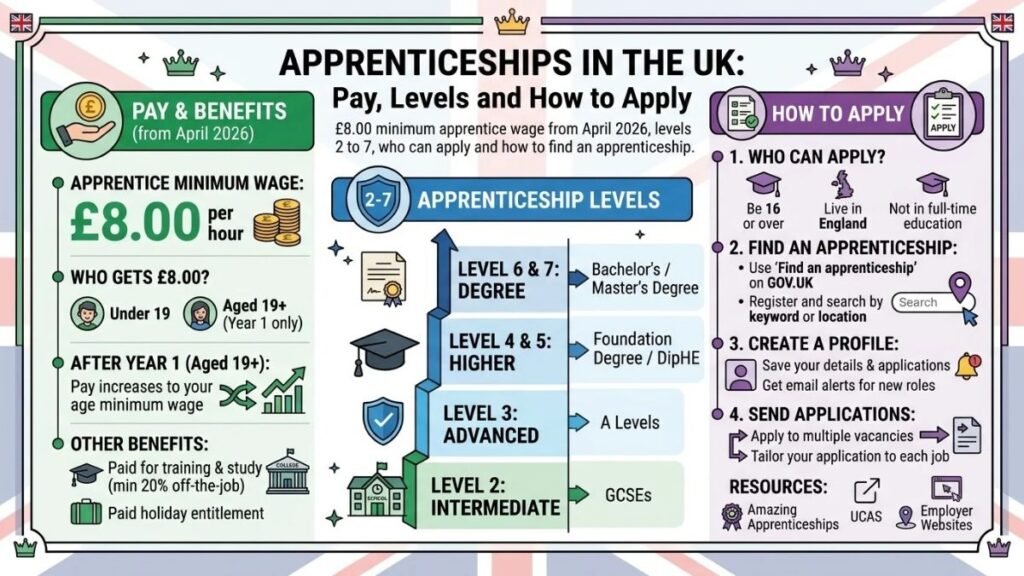
Quick answer: The legal minimum wage for apprentices is £8.00 an hour from April 2026. It applies to apprentices under 19 and to those aged 19 or over in their first year. After that, apprentices aged 19 and over must receive at least the National Minimum Wage for their age (£10.85 for 18 to 20, £12.71 for 21 and over). Training is paid time, and you do not pay course fees.
What is an apprenticeship?
An apprenticeship combines:
- A paid job with a real employer, with a contract of employment and holiday pay
- On-the-job training, learning practical skills from experienced colleagues
- Off-the-job training, such as classroom, college, online or workplace study with a training provider, which counts as paid working time. The standard rule is that at least 20% of your paid working hours should be spent on off-the-job training, though the Department for Education has been developing fixed minimum hours for each apprenticeship standard, so check the position with your provider
- An end-point assessment or exam at the end, which confirms you can do the job
Apprenticeships last from about eight months to several years, depending on the level and the job. Many take between one and four years.
You are an employee, so you have the same employment rights as other staff, including paid holiday, sick pay, notice and protection from discrimination. See our guides to holiday entitlement and holiday pay and Statutory Sick Pay 2026.
Apprenticeship levels explained
Apprenticeships are grouped by level, which shows the standard of qualification you work towards.
| Level | Name | Equivalent to | Typical examples |
|---|---|---|---|
| Level 2 | Intermediate | 5 good GCSE passes | Hospitality team member, customer service, retail, early years assistant |
| Level 3 | Advanced | 2 A level passes | Electrician, plumber, business administrator, lead adult care worker, accounts assistant |
| Level 4 and 5 | Higher | Foundation degree and above | Junior management, IT technician, assistant accountant, nursing associate (Level 5) |
| Level 6 | Degree | Bachelor’s degree | Chartered manager, software developer, registered nurse, solicitor routes in some cases |
| Level 7 | Degree | Master’s degree | Senior leader, advanced professional roles, architect and some law routes |
The level you choose depends on your qualifications, your career goals and what is on offer. Many people start at Level 2 or 3 and progress to higher levels with the same employer or a new one. The legal minimum pay does not depend on the level, only on your age and how far through the apprenticeship you are.
Types of apprenticeship
- Intermediate and advanced apprenticeships (Levels 2 and 3) are open to school leavers and adults, and often lead to a skilled trade or entry-level professional job.
- Higher apprenticeships (Levels 4 and 5) let you earn a qualification above A level while working.
- Degree apprenticeships (Levels 6 and 7) let you earn a full bachelor’s or master’s degree, with tuition paid by your employer and the government, so you graduate without tuition debt.
- Apprenticeships for adults and career changers. There is no upper age limit, and people retrain through apprenticeships at any age.
In Scotland, apprenticeships are called Modern Apprenticeships (alongside Foundation and Graduate Apprenticeships), run by Skills Development Scotland. Wales and Northern Ireland run their own schemes. This guide focuses on England, so check the relevant government sites for other nations.
How much do apprentices get paid in 2026?
The legal minimum
| Apprentice situation | Minimum hourly pay from April 2026 |
|---|---|
| Under 19 (any year of the apprenticeship) | £8.00 |
| Aged 19 or over, in the first year | £8.00 |
| Aged 18 to 20, after the first year (if 19 or over) | £10.85 |
| Aged 21 or over, after the first year | £12.71 |
The apprentice rate has risen from £7.55 to £8.00 in April 2026. See our National Minimum Wage 2026 guide for the full rates.
Examples:
- A 17-year-old apprentice must be paid at least £8.00 an hour in every year.
- A 21-year-old in their first year can legally be paid £8.00 an hour, but in their second year must be paid at least £12.71.
- A 19 or 20-year-old who has finished the first year must be paid at least £10.85.
What that looks like in a week
For a 37.5-hour week, before tax:
| Rate | Weekly pay | Approx. yearly pay |
|---|---|---|
| £8.00 (apprentice rate) | £300 | £15,600 |
| £10.85 | About £407 | About £21,158 |
| £12.71 | About £477 | About £24,785 |
Apprentices normally work at least 30 hours a week, and many work full time. Check your contract.
Many apprentices earn more
The £8.00 is only the legal floor. Many employers pay considerably more, especially for higher and degree apprenticeships and in sectors that compete for talent, such as engineering, technology, finance and professional services. Some large firms advertise apprentice salaries well above the minimum, and some pay a full graduate-style salary from day one. Always check the advertised wage, and compare it with the minimum for your age.
Do you get paid for training time?
Yes. Your employer must pay you for the hours you spend on off-the-job training and study, at least at the apprentice rate or the rate that applies to you. Training should be during your paid working hours. If you are asked to study unpaid in your own time, raise it with your employer or contact Acas.
Tax, National Insurance and payslips
Most apprentices pay little or no Income Tax, because the personal allowance is £12,570 in 2026/27. National Insurance applies above about £242 a week. Check your payslip carefully. See our guide to payslips, tax codes and National Insurance.
Your rights as an apprentice
- Employment contract and written terms. See our guide to understanding your employment contract.
- At least the minimum wage for your age and stage, and a payslip.
- Paid holiday (at least the statutory minimum of 5.6 weeks, which may include bank holidays), and paid time for your training.
- Sick pay. Since April 2026, SSP is payable from the first day for eligible employees.
- A safe workplace, with proper supervision and training. If you are under 18, extra protections on hours and night work apply. See our guide to jobs for 16 and 17 year olds in the UK.
- Time to learn. Your employer must give you the time and support to complete your training, including on-the-job coaching.
- No fees. You should not be charged for your apprenticeship training.
If you have a problem, contact your training provider, your employer’s HR team, the National Apprenticeship Service helpline or Acas.
Who can do an apprenticeship?
In England, you can usually start an apprenticeship if you:
- Are aged 16 or over
- Are not in full-time education
- Live in England and have the right to work in the UK. See our guide to right to work checks in the UK
There is no upper age limit. Entry requirements depend on the apprenticeship and the employer. For Level 2 and 3, there are often no formal requirements beyond an interest in the job, though some ask for GCSEs or equivalent. For Level 4 and above, they often ask for A levels or a Level 3 qualification. Many apprentices who do not have GCSE English and maths work towards them as part of the programme.
Apprenticeships for 16 to 18 year olds count as meeting the requirement to stay in education or training until 18.
How to find and apply for an apprenticeship: step by step
- Decide what you want to do. Think about subjects you enjoy, careers you are curious about and what the local job market offers. Your school, college or the National Careers Service can help.
- Search the official service. In England, use the Find an apprenticeship service on GOV.UK. You can search by job type, location and level, and set up alerts.
- Look at employer websites. Large employers, councils, the NHS and the armed forces have their own apprenticeship pages. Many close early because of high demand, so check the dates.
- Contact colleges and training providers. They often work with local employers and can help match you to a vacancy.
- Contact local employers directly. Many small firms take on apprentices but do not advertise widely. Ask whether they would consider an apprentice and who would provide the training.
- Prepare your CV and personal statement. Highlight your reliability, interests and any relevant school, volunteering or work experience. See our guides to writing a UK CV with no experience and writing a cover letter in the UK.
- Apply to several vacancies. Apprenticeships are competitive, particularly at well-known employers, so do not rely on one application.
- Prepare for the selection process. It may include an online application, tests, a phone interview, an assessment day and a final interview. Our guide to common interview questions and answers in the UK will help.
- Check the offer. Make sure it includes the wage, hours, training provider, level, qualification, duration and the name of the employer. Ask for a written contract and an apprenticeship agreement.
- Start work and training. You will usually be given an induction, a mentor and a training plan.
You can also browse current vacancies on our UK jobs board.
Where apprenticeships are popular
| Sector | Example apprenticeships | Related guides |
|---|---|---|
| Construction | Bricklayer, carpenter, groundworker, site supervisor | CSCS card and construction jobs |
| Health and care | Healthcare support worker, nursing associate, adult care worker | NHS jobs and care worker jobs |
| Education | Teaching assistant, early years educator | Teaching assistant jobs |
| Hospitality and catering | Commis chef, hospitality team member | Hospitality jobs |
| Retail and customer service | Retailer, customer service practitioner | Supermarket jobs |
| Business, finance and IT | Business administrator, accounts assistant, software developer, cyber technician | Check employer sites |
| Engineering and manufacturing | Engineering technician, machinist | Check employer sites |
| Logistics and driving | Warehouse operative, driver | Warehouse jobs and HGV driver jobs |
Apprenticeship or university?
| Apprenticeship | University degree | |
|---|---|---|
| Pay | You earn a wage from day one | You usually pay tuition fees and living costs |
| Debt | No tuition fees to pay | Usually student loan debt |
| Experience | Years of real work experience | Often limited, unless there is a placement |
| Qualification | Nationally recognised qualifications, up to degree level | Bachelor’s or higher |
| Flexibility | Tied to one employer and role | Wider choice of subjects and a student lifestyle |
| Competition | Can be very competitive for top employers | Depends on grades and the course |
Both routes can lead to successful careers, and they are not mutually exclusive. Some apprentices later go to university, and some graduates later take apprenticeships. Degree apprenticeships combine both.
Money and practical points
- Apprentices can access discounts. Many apprentices can apply for an Apprentice discount card or student-style discounts. Check the Apprentice discount schemes on GOV.UK.
- Costs to plan for. Travel to work or college, work clothes or tools and, in some cases, accommodation. Ask your employer what they pay for. Some training providers offer support funds for learners who need help.
- Benefits. If you are on a low wage, you may be able to claim Universal Credit, and your family may be able to keep claiming certain benefits while you are an apprentice. Check GOV.UK, Citizens Advice or the benefit calculators.
- Existing staff. Employers can also offer apprenticeships to current employees to upskill them.
What happens when you finish?
Many apprentices stay with their employer in a permanent job, often with a pay rise and more responsibility. Others move to a new employer or take a higher apprenticeship. If you leave early or your employer closes, your training provider and the National Apprenticeship Service can help you find a new placement, so tell them quickly. If your job ends, check your notice rights. See our guide to notice periods in the UK.
Apprenticeship scams and warning signs
Apprenticeships are a target for fraud because many applicants are young and hopeful. Watch for:
- Anyone asking you to pay for an apprenticeship, a place, training or registration. You should never pay for an apprenticeship.
- Adverts that are really sales pitches for paid courses, sometimes labelled as “apprenticeships” or “traineeships”.
- Promises of guaranteed jobs or very high pay with no experience.
- Offers via social media, WhatsApp or text with no named employer or training provider.
- Unregulated or unknown training providers. Check a provider’s details on GOV.UK.
- Requests for your bank details or ID before you have a signed agreement.
- Fake adverts that copy real employers. Always apply through the employer’s own site or the official government service.
Read our guide to how to spot a fake job advert in the UK for more detail.
Frequently asked questions
How much do apprentices get paid in 2026? The legal minimum is £8.00 an hour for apprentices under 19 and for those aged 19 or over in their first year. After the first year, apprentices aged 19 and over must get at least the minimum wage for their age, which is £10.85 for ages 18 to 20 and £12.71 for 21 and over.
Do apprentices get paid for college and training time? Yes. Off-the-job training is paid working time.
Do I have to pay for an apprenticeship? No. The employer and the government fund the training, and you should not be charged tuition fees.
How old do you have to be to start an apprenticeship? You must be at least 16. There is no upper age limit.
How long does an apprenticeship take? From around eight months to several years, depending on the level and the job. Many take one to four years.
What are the apprenticeship levels? Level 2 (intermediate), Level 3 (advanced), Levels 4 and 5 (higher), Levels 6 and 7 (degree level).
Can I do an apprenticeship if I already have a degree? Often yes, if the apprenticeship teaches substantial new skills and you meet the employer’s and funding rules.
Do apprentices get holiday pay and sick pay? Yes. Apprentices are employees and get the same statutory rights, including paid holiday and Statutory Sick Pay.
Where do I find apprenticeships? On the Find an apprenticeship service on GOV.UK, employer careers pages, college and training provider sites and our jobs board.
Final thoughts
An apprenticeship is a way to earn, learn and build a career at the same time. Check the pay, the training provider and the qualification, apply to several places and never pay for a place. When you are ready, search the official apprenticeship service and browse the latest vacancies on our jobs board.
This article is general information, not advice. Apprenticeship rules, funding and pay change, and rules differ across England, Scotland, Wales and Northern Ireland. Check GOV.UK, the National Apprenticeship Service and the relevant devolved government for the latest guidance.