
Average UK Salaries by Region in 2026: A Realistic Guide
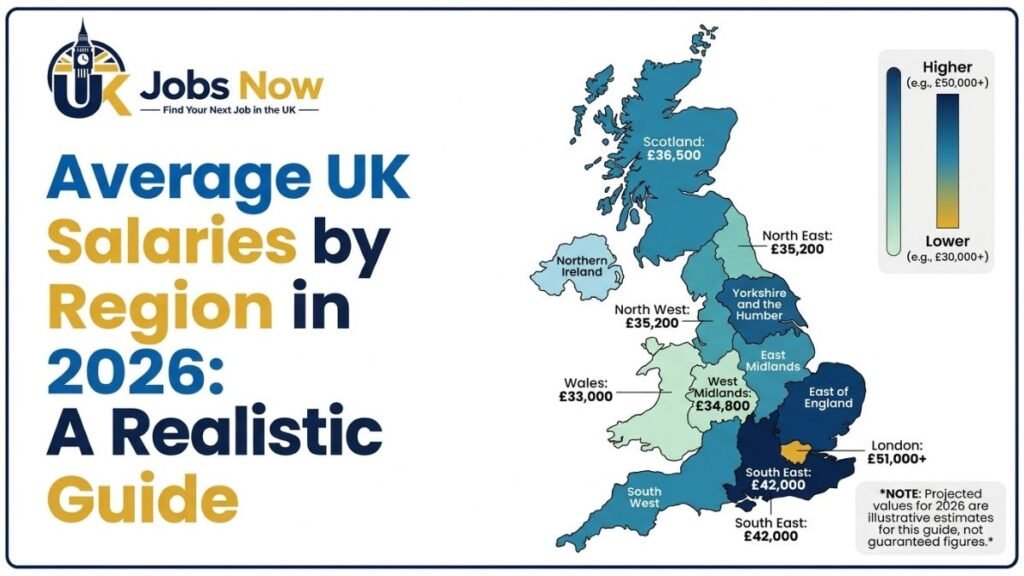
“What’s the average salary in the UK?” is one of those questions that sounds simple and isn’t, because the honest answer is: it depends enormously on where in the UK you mean. A national average figure, on its own, tells you almost nothing useful about what to expect or negotiate for in a specific city or region, because London alone pulls the national number in a direction that doesn’t reflect most of the country. This guide focuses on how and why pay varies by UK region, what actually drives that variation, and how to use regional context sensibly when you’re evaluating a job offer or deciding what to ask for.
Why we’re not going to give you a single national number and call it done
Official UK salary statistics — most reliably published by the Office for National Statistics (ONS) through its Annual Survey of Hours and Earnings — do break earnings down by region, and those figures update regularly. Because they change from year to year and because precise current figures are exactly the kind of thing that goes stale fast in a published article, we’d rather point you to the current official data than quote a specific number here that might already be outdated by the time you read it. What we can do reliably is explain the patterns behind the numbers — the “why,” which changes far more slowly than the “what” — so you understand what’s actually driving regional pay differences and can interpret current figures sensibly when you look them up.
The core pattern: London, the South East, and everywhere else
The single biggest driver of UK regional pay variation is the gap between London (and, to a lesser extent, the wider South East) and the rest of the country. London salaries are consistently and substantially higher than the UK average across almost every sector and role type. This isn’t random — it reflects London’s concentration of head offices, financial services, professional services, and technology roles, combined with a much higher cost of living, especially housing.
This matters practically in two directions. If you’re considering a role in London, don’t benchmark the salary against a national average figure — benchmark it against London-specific pay data, and factor in that a headline number which looks generous compared to the national average may not stretch as far once you account for rent, travel, and general cost of living in and around the capital. Conversely, if you’re comparing a London offer against a similar role outside London, a lower headline salary elsewhere doesn’t necessarily mean a lower standard of living — it often means the opposite, once housing costs are properly accounted for.
How the rest of the UK compares
Outside London and the South East, regional pay differences exist but are generally less dramatic, and they follow patterns tied to local industry concentration rather than a simple north-south divide:
Scotland
Edinburgh, as a major financial and professional services centre, tends to see higher salaries than the Scottish average, somewhat similar in character (though not scale) to London’s relationship with the rest of England. Aberdeen has historically had a distinct pay profile linked to the energy sector, particularly oil and gas, which has meant specialist engineering and technical roles commanding a premium there relative to other Scottish cities, though this has shifted as the sector itself has changed.
North West England
Manchester and Liverpool have both seen substantial growth in technology, media, and professional services employment, which has pushed salaries in those specific sectors upward in a way that isn’t uniform across the wider North West region — a tech role in central Manchester and a retail role in a smaller North West town can differ enormously, more due to sector than pure geography.
West Midlands
Birmingham’s status as a major commercial centre for the Midlands, combined with significant investment in its financial and business services sector in recent years, has narrowed — though not closed — the gap between Midlands salaries and those in London and the South East for comparable professional roles.
Yorkshire and the Humber, North East England
These regions generally see the largest gap versus London and the South East for equivalent roles, though this needs to be read alongside a correspondingly lower cost of living, particularly housing costs, which are dramatically lower than London’s in most towns and cities across these regions.
Wales and Northern Ireland
Both generally show salary patterns below the England average for equivalent roles, again alongside meaningfully lower housing and living costs, and both have seen targeted growth in specific sectors (technology and financial services in Cardiff, for instance) creating localised pockets of stronger pay that don’t reflect the regional average.
Why salary alone is the wrong way to compare job offers across regions
If you’re weighing up two offers in different parts of the UK, comparing headline salary figures directly is one of the most common — and most misleading — mistakes people make. The number that actually matters is closer to disposable income after housing costs, which shifts the picture substantially. A role paying meaningfully less in a smaller city can leave you with more disposable income at the end of the month than a higher-paying London role, once rent or mortgage costs are properly compared. There’s no single formula that works for everyone here — it depends on your specific circumstances, whether you’re renting or buying, whether you have dependents, and your personal priorities — but the principle holds broadly: always translate a regional salary comparison into a cost-of-living-adjusted comparison before deciding one offer is genuinely “better” than another.
Remote work and the regional pay question
Remote and hybrid working has complicated the traditional regional pay picture in a genuinely interesting way. Some employers, particularly larger companies with established London pay scales, have adopted location-based pay for remote roles — paying a London-based remote worker more than an otherwise identical role based outside London, on the reasoning that local cost of living should still factor into compensation even without a daily commute. Others have moved toward a single national pay band for a given role regardless of where the employee is based, treating the role itself, not the postcode, as the basis for pay. Neither approach is universal, and it’s genuinely worth asking directly, during the interview process, which approach a specific employer takes for remote roles — this is exactly the kind of detail that’s easy to assume rather than confirm, and assuming wrong can mean a real gap between your expectation and the actual offer.
How to research current, accurate figures for a specific role and location
Rather than relying on a single source, a sensible approach combines a few:
- ONS regional earnings data gives you the most authoritative, methodologically consistent picture of how pay varies by region and by broad occupation category, updated annually.
- Job listings themselves for the specific role and location you’re targeting are often the most directly useful signal, since they reflect what employers are actually offering right now, in that market, for that kind of role — you can browse current active UK job listings filtered by region and salary to build a real sense of the current range for a specific role type in a specific area.
- Industry-specific salary surveys, published periodically by professional bodies and recruitment firms in many sectors, can add detail on how experience level and specialisation affect pay within a given field, beyond what a broad regional average captures.
Cross-referencing a couple of these sources gives a far more reliable picture than relying on any single number, particularly a remembered or half-remembered “average salary” figure that might be several years out of date by the time you’re using it to make a decision.
Using regional context in salary negotiation
If you’re negotiating an offer, regional context is a legitimate and useful part of your case, but it works best combined with role-specific and experience-specific evidence, not as a standalone argument. Rather than simply asserting “the average salary in this region is X,” a stronger approach references what comparable current listings in your specific field and location are offering, alongside your own specific experience and what you’d be bringing to the role. Generic regional averages are a useful sanity check on whether an offer is broadly reasonable; they’re a weaker tool for making the specific case that you, personally, are worth more than what’s currently on the table.
Bringing it together
Regional salary variation in the UK is real, persistent, and driven by a combination of industry concentration, cost of living, and — increasingly — how individual employers handle location-based pay for remote roles. The most useful thing you can do isn’t memorise a single average figure, but understand these underlying patterns well enough to interpret current data sensibly and ask the right questions during a hiring process. If you’re actively job hunting across multiple regions, our guide on choosing between remote, hybrid, and on-site roles is a useful companion read, since working arrangement and regional pay are closely connected decisions.
Frequently Asked Questions
Where can I find current, accurate UK salary data by region?
The Office for National Statistics publishes the most authoritative regional earnings data through its Annual Survey of Hours and Earnings, updated annually. Current job listings for your specific role and location are also a genuinely useful, real-time source of what employers are actually offering right now.
Why is London pay so much higher than the rest of the UK?
It reflects a combination of factors: a concentration of head offices and financial, professional, and technology sector roles that tend to pay more generally, and a substantially higher cost of living, particularly housing, that pushes wages upward to compensate.
Should I always choose the job with the highest salary, regardless of location?
Not necessarily. What matters more than headline salary is disposable income after cost of living, particularly housing — a lower salary in a lower-cost region can leave you better off in practice than a higher salary somewhere with much higher living costs.
Do remote workers get paid the same regardless of where they live?
It depends entirely on the individual employer’s policy — some pay remote roles based on the employee’s location, others use a single national pay band regardless of location. This varies significantly, so it’s worth asking directly during the hiring process rather than assuming either approach.
How often does regional salary data get updated?
The main ONS regional earnings survey is published annually, though the underlying job market — and the salaries offered in live job listings — can shift more frequently than that, which is why checking current listings alongside official statistics gives the most accurate picture.