Networking for Introverts: Practical Ways to Build Job Leads
“Networking” tends to conjure a specific, dreaded image for a lot of people — a crowded room, forced small talk, business cards exchanged with strangers you’ll never think about again. If that image makes you want to skip networking entirely, it’s worth knowing that this loud, extroverted version is only one way to do it, and not obviously the most effective one even for extroverts. Genuinely useful professional networking can look quite different, and several of the more effective approaches actually suit an introverted style better than a room full of small talk ever would.
Why networking matters even if you’d rather avoid it
It’s worth being honest about why this is worth engaging with at all, even if it doesn’t come naturally: a meaningful proportion of roles are filled at least partly through referral, direct connection, or word of mouth, rather than purely through open, advertised applications. This doesn’t mean advertised roles aren’t worth pursuing — they clearly are — but it does mean that building even a modest professional network genuinely opens up opportunities that a purely application-based search on its own won’t surface. The goal isn’t to become someone you’re not; it’s to find approaches to building professional connections that don’t require pretending to be extroverted.
Reframing what “networking” actually means
The large-room, small-talk version of networking is a specific format, not the definition of the activity itself. At its core, networking is simply building and maintaining professional relationships over time — and that can happen through a single genuine one-to-one conversation, a thoughtful written message, or consistent, low-key engagement online, none of which require the specific skills (quick small talk, comfort working a crowded room) that a large networking event demands. If large events specifically drain you, it’s entirely reasonable to focus your energy on formats that don’t.
Approaches that tend to suit a quieter, more introverted style
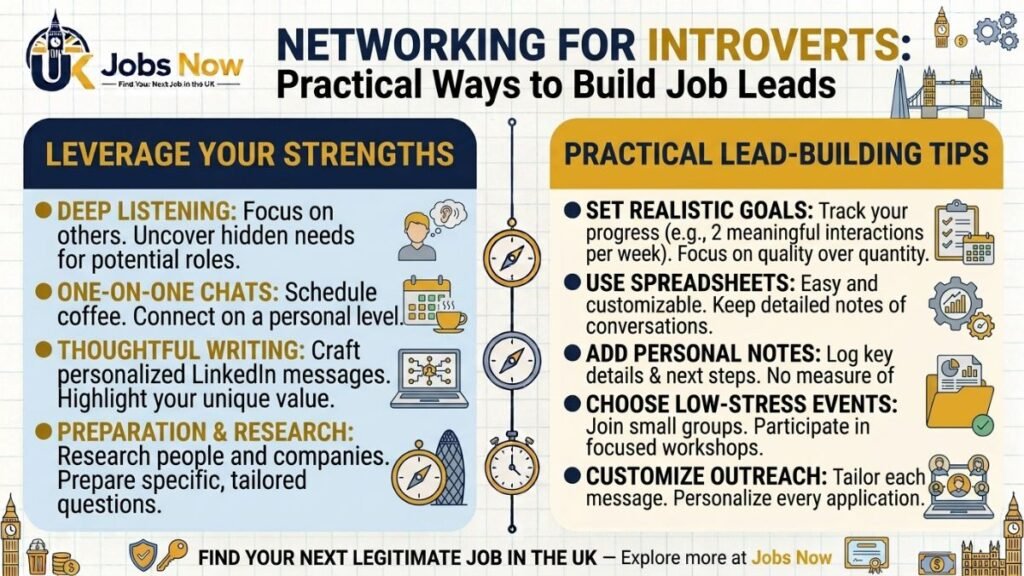
One-to-one conversations instead of group events
A single, focused coffee or video call with one person is a fundamentally different experience to a room of forty people, and it’s one many introverts find considerably more comfortable and more genuinely productive — a real conversation, rather than a series of brief, surface-level introductions. Reaching out directly to one person you’re genuinely interested in learning from, rather than attending a large event hoping for useful encounters, is often both less draining and more effective.
Written communication as a genuine networking tool
A thoughtful LinkedIn message, a well-considered comment on someone’s post, or a genuine follow-up email all count as real networking, and they play to a strength many introverts have — clear, considered written communication, without the pressure of thinking on your feet in real time. Our guide to using LinkedIn to find a job covers the mechanics of this kind of outreach in more depth.
Smaller, more structured events over large open ones
If in-person networking is something you want to build toward, a smaller, more structured event — a panel discussion with a defined Q&A, a workshop, a smaller professional meetup with a specific topic — tends to be considerably easier to navigate than a large, unstructured mixer, since there’s a natural shared focus and less pressure to generate conversation entirely from scratch.
Preparing specific questions or topics in advance
A lot of the anxiety around networking conversations comes from the pressure of improvising conversation in real time. Having two or three genuine, specific questions prepared in advance — about someone’s career path, their experience at a particular company, their view on a development in your shared field — removes a significant amount of that pressure and tends to produce more substantive, satisfying conversations than open-ended small talk anyway.
Following up in writing after a conversation
If an in-person or verbal conversation felt rushed or underdeveloped, a follow-up message afterward — thanking someone for their time and picking up on a specific point from the conversation — is a genuinely effective way to deepen a connection without needing another live, in-the-moment interaction, and it plays to the strength of written communication many introverts have.
Reducing the pressure of “using” every interaction strategically
A specific source of networking anxiety for a lot of people is feeling that every interaction needs to be transactional — that you need to extract something useful or “make the ask” quickly. In practice, genuine, longer-term professional relationships tend to develop from real interest in another person’s work and experience, not from immediately trying to secure a referral or job lead. Approaching a conversation with genuine curiosity, rather than an agenda, tends to feel considerably less draining and, somewhat paradoxically, tends to build stronger professional relationships over time than a more transactional approach.
A comparison of approaches
| Traditional networking | Introvert-friendly alternative |
|---|---|
| Large, open networking events | One-to-one coffee chats or video calls |
| Improvised small talk | Prepared, specific questions on a genuine topic of interest |
| In-the-moment verbal follow-up | A thoughtful written message afterward |
| Working a room, meeting as many people as possible | A smaller number of deeper, more genuine conversations over time |
Building consistency without it feeling exhausting
Networking tends to work best as a gradual, ongoing habit rather than an intensive burst of activity squeezed into an active job search. A modest, sustainable pace — one or two genuine outreach messages or conversations a week, rather than an overwhelming push all at once — tends to be both more sustainable and, over time, more effective than a short, intense period of networking activity that isn’t maintained afterward.
What to do if networking genuinely isn’t working for your search
It’s worth acknowledging honestly that networking is one channel among several, not a mandatory requirement for a successful job search — a strong application strategy through direct applications and well-targeted job board searching remains genuinely effective on its own, and it’s entirely reasonable to weight your effort more heavily toward the channels that suit you best. You can pair whatever networking approach genuinely works for you with browsing current active UK job listings directly, rather than treating networking as an obligatory activity that has to dominate your overall strategy.
Managing the anxiety of an unanswered outreach message
A genuinely common source of networking-related stress, particularly for introverts, is the anxious waiting period after sending a message — checking repeatedly for a reply, or interpreting silence as a personal rejection. It’s worth reframing this deliberately: a busy professional not responding, or responding briefly and generically, usually reflects their own workload and inbox volume rather than any judgement about you specifically. Sending a message and then genuinely moving on to other things, rather than monitoring for a response, tends to reduce this particular source of anxiety considerably.
Networking within your current workplace before you leave
If you’re job searching while still employed, it’s worth remembering that networking doesn’t only mean reaching outward to strangers — maintaining and nurturing relationships with former colleagues, previous managers, and people you’ve worked with on projects is a genuinely lower-pressure form of networking, since a real, existing relationship already provides the context a cold outreach message has to establish from nothing. These existing connections are often disproportionately valuable precisely because the relationship-building work is already done.
Frequently Asked Questions
Is networking really necessary if I’m uncomfortable with it?
It’s genuinely useful but not strictly mandatory — a strong direct application strategy remains effective on its own. If large-scale networking specifically doesn’t suit you, focusing on quieter, one-to-one approaches instead is a reasonable and often equally effective alternative.
What’s a low-pressure way to start networking if I’m introverted?
A single, genuine written message to someone specific — asking about their career path or experience at a company you’re interested in — is a low-pressure starting point that avoids the pressure of a live, improvised conversation entirely.
Do I need to attend large networking events to build a useful professional network?
No — one-to-one conversations, thoughtful written outreach, and consistent, low-key engagement on platforms like LinkedIn can build a genuinely useful network without ever attending a large, open networking event.
How do I network without feeling like I’m just asking people for favours?
Approach conversations with genuine curiosity about the other person’s experience and path, rather than an immediate agenda — this tends to feel less draining and builds stronger, more genuine professional relationships than a purely transactional approach.
How often should I be networking during a job search?
A modest, sustainable pace — one or two genuine outreach messages or conversations a week — tends to be more effective and sustainable than an intense, short burst of networking activity that isn’t maintained over time.