
A Realistic Guide to Starting a Career in Healthcare (Non-Clinical Roles)
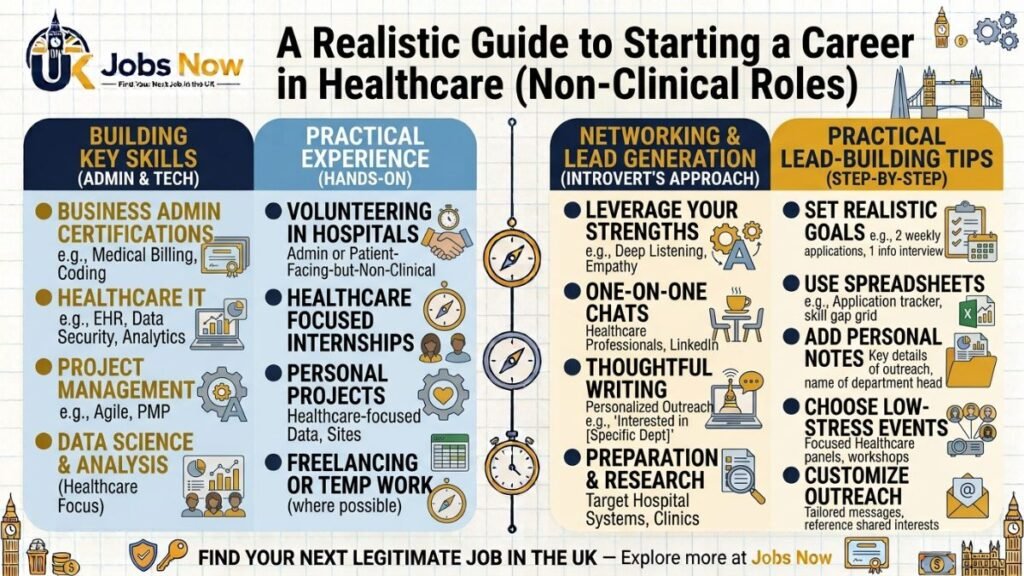
“Working in healthcare” tends to trigger an immediate assumption — nursing, medicine, a clinical degree, years of training. That’s true for clinical roles, but it leaves out a genuinely large part of how UK healthcare actually operates: administration, operations, data, HR, communications, project management, procurement, and technology roles, all essential to running hospitals, GP surgeries, and the wider health and social care system, and none of them requiring a clinical qualification to enter.
Why non-clinical healthcare roles are worth genuine consideration
Healthcare organisations, particularly larger ones like NHS trusts, function as genuinely large, complex organisations requiring the full range of professional roles any large organisation needs — finance, HR, IT, communications, project management, estates and facilities, procurement — alongside clinical care itself. For someone with relevant professional skills but no interest in or route into clinical training, this represents a substantial, often underappreciated part of the sector, offering the chance to work within healthcare and its genuine sense of purpose without needing a clinical qualification.
The main categories of non-clinical healthcare roles
Administration and operations
Roles managing the day-to-day running of healthcare settings — patient administration, scheduling, records management, general office and operational support. These roles are often accessible at entry level with relevant transferable administrative experience from any sector, and they provide a genuinely useful entry point into the wider healthcare system for anyone considering progression into more specialised non-clinical roles later.
Human resources and workforce planning
Healthcare organisations, particularly the NHS, employ a very large workforce, and HR roles within this context — recruitment, workforce planning, employee relations, learning and development — draw on standard HR skills applied within a sector with its own specific regulatory and workforce planning complexities.
Finance and procurement
Healthcare finance roles cover standard finance functions — budgeting, financial planning, procurement — within organisations managing genuinely substantial budgets and complex supply chains, particularly around medical equipment and pharmaceutical procurement, which adds sector-specific complexity to otherwise standard finance skills.
IT and digital roles
Healthcare technology is a genuinely significant and growing area — electronic patient records systems, healthcare data analysis, cybersecurity specific to sensitive patient data, and digital transformation projects all require IT professionals with standard technical skills applied to a sector with particularly high stakes around data security and system reliability.
Communications and engagement
Public-facing communications, internal staff communications, and community engagement roles exist across healthcare organisations, drawing on standard communications and marketing skills within a context that often carries genuine public interest and scrutiny.
Project and programme management
Healthcare organisations run substantial change and improvement programmes — service redesign, digital transformation, capital projects — requiring standard project management skills and, often, formal project management qualifications (PRINCE2 or similar), applied within a sector with its own particular stakeholder complexity.
How your existing experience likely transfers
| Your background | Relevant non-clinical healthcare roles |
|---|---|
| General office administration | Patient administration, healthcare operations support |
| HR generalist experience | NHS or private healthcare HR, workforce planning |
| Finance or accounting background | Healthcare finance, budgeting, procurement |
| IT support or software development | Healthcare IT, digital systems, health data roles |
| Marketing or communications experience | Healthcare communications, public engagement roles |
| Project management experience in any sector | Healthcare service improvement, digital transformation projects |
What’s genuinely different about working in a healthcare setting
It’s worth being realistic about a few things that differ from a similar role in another sector. Healthcare organisations, particularly the NHS, often have specific procurement, governance, and approval processes that can feel slower or more bureaucratic than a smaller private company — this reflects the genuine need for accountability and safety in a sector managing significant public resources and sensitive responsibilities, not simply organisational inefficiency. There’s also, in many non-clinical healthcare roles, a genuine proximity to the sector’s core purpose — even in a purely administrative or technical role, decisions and projects often connect, at some remove, to patient care, which many people find meaningfully motivating in a way that a similar role in an unrelated sector might not offer.
Do you need any specific qualifications for non-clinical roles?
Generally, no clinical qualification is required for these roles, and the entry requirements are typically the same as for the equivalent role in any other sector — relevant experience and, for some roles, standard professional qualifications (accountancy qualifications for finance roles, CIPD for HR, project management certifications for programme roles). Some healthcare-specific knowledge — understanding of NHS structure, familiarity with relevant regulatory requirements — is genuinely useful and can often be picked up on the job or through short induction training, rather than being a strict prerequisite for entry.
Where to find non-clinical healthcare roles
Non-clinical roles are advertised through the same broad channels as any professional role — direct employer job pages (NHS trusts each run their own recruitment, alongside a central NHS Jobs platform), general job boards, and recruitment agencies with healthcare specialisms. It’s worth searching specifically using both role-based terms (your specific function — “HR advisor,” “finance analyst”) combined with healthcare-specific terms, since a purely generic search for your function alone may not surface healthcare-specific opportunities prominently.
Framing your application for a healthcare-adjacent move
If you’re applying for a non-clinical healthcare role from a different sector, it’s worth briefly and genuinely addressing your motivation for the sector specifically in your cover letter or personal statement, alongside your core relevant professional experience — a hiring manager in this space is often genuinely interested in why you’re drawn to healthcare specifically, not just whether you have the functional skills for the role. Our guide to writing a UK cover letter covers this kind of tailoring in more depth.
Getting started
If this is a genuine area of interest, it’s worth researching a few specific healthcare employers or NHS trusts in your region to understand their current structure and typical non-clinical vacancies, alongside browsing current active UK job listings filtered by the healthcare category to see what’s currently being advertised across the sector more broadly.
What working within a large public sector organisation is actually like day to day
If you’ve spent your career in smaller or private-sector organisations, it’s worth being aware that working within the NHS or a similarly large public healthcare body carries some genuine structural differences — more formal governance processes, well-defined organisational hierarchies, and decision-making that sometimes involves more stakeholders and approval stages than a smaller, more agile organisation. This isn’t inherently a negative, but it’s a genuine adjustment worth anticipating rather than assuming your previous organisational experience will map across without any difference at all.
The wider health and social care sector beyond the NHS
It’s also worth knowing that non-clinical healthcare roles extend well beyond NHS trusts specifically — private healthcare providers, social care organisations, health charities, and health-focused technology companies all offer similar non-clinical functions within the broader health and care sector, often with different organisational cultures and structures than a large NHS trust. If NHS-specific bureaucracy is a genuine concern, these alternative settings within the wider sector are worth researching as well, since they can offer a similar sense of purpose within a different organisational environment.
Frequently Asked Questions
Do I need a clinical qualification to work in a hospital or NHS trust?
No — non-clinical roles in administration, HR, finance, IT, communications, and project management make up a substantial part of healthcare organisations’ workforce and don’t require clinical training or qualifications.
Can I move into healthcare from an unrelated sector?
Yes, this is common — most non-clinical healthcare roles require the same core professional skills and qualifications as the equivalent role in any other sector, with sector-specific knowledge often picked up on the job rather than being a strict entry requirement.
Are non-clinical healthcare roles lower paid than similar roles elsewhere?
This varies by organisation and specific role — NHS roles often follow structured national pay bands (Agenda for Change), which can differ from equivalent private-sector pay, in either direction depending on the specific role and level, so it’s worth researching the specific pay band for a role you’re considering.
What’s the easiest non-clinical healthcare role to move into?
This depends on your existing background — administration and operations roles are often the most accessible entry point with general transferable experience, while more specialised roles (finance, HR, IT, project management) generally expect the equivalent professional background you’d need for that function in any sector.
Where can I find NHS non-clinical job listings specifically?
NHS Jobs is the main national platform, alongside individual NHS trust career pages and general job boards — searching with both your specific professional function and healthcare-related terms together tends to surface these opportunities more effectively than a generic search alone.
