Recruitment Agencies vs Direct Applications: Which Is Right for You?
Working with a recruitment agency and applying directly to employers aren’t competing strategies you have to choose between — most effective UK job searches use both, in different proportions depending on your industry and career stage. But it’s worth understanding how each actually works, what a recruiter is genuinely doing for you (and where their interests align with yours and where they don’t quite), so you can use both channels deliberately rather than by accident.
How recruitment agencies actually work
It’s worth understanding the basic economics first, because it explains a lot of how the relationship actually functions. A recruitment agency is paid by the employer, not by you — typically a fee calculated as a percentage of the placed candidate’s first-year salary, paid once a placement is successfully made and, in many contracts, only if the candidate stays beyond a certain probationary period. This means a recruiter’s genuine incentive is to place you successfully in a role you’ll actually stay in, but it also means their client relationship is fundamentally with the employer, not with you — worth keeping in mind as useful context, not as a reason for suspicion.
What a good recruiter genuinely does for you
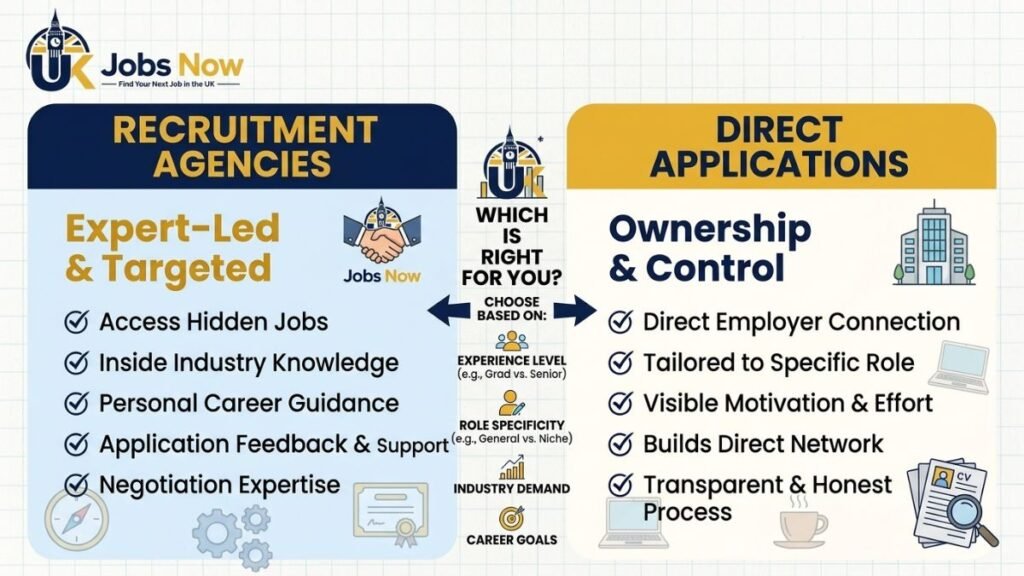
- Access to roles not always advertised publicly. Some employers, particularly for more senior or specialist roles, work exclusively or primarily through agencies rather than posting openly, meaning a good recruiter relationship can surface opportunities you wouldn’t otherwise see.
- Market knowledge specific to your field. An experienced recruiter working in your specific sector often has genuinely useful, current knowledge of typical salary ranges, which employers are actively hiring, and what specific skills are in particular demand right now.
- Application and interview preparation support. Many recruiters will help refine your CV for a specific application and give you genuinely useful context ahead of an interview — company culture, what the hiring manager tends to prioritise, format of the interview — that you wouldn’t have access to applying cold.
- Negotiation on your behalf. Because the recruiter is financially motivated to see a successful, well-matched placement, they’re often willing to negotiate salary and terms on your behalf in a way that can feel less awkward than negotiating directly yourself.
Where the incentives don’t perfectly align — and what to watch for
A recruiter’s fee generally depends on a successful placement happening, which creates a mild but real incentive toward encouraging you to accept an offer, even one that’s not perfectly aligned with what you actually want. This doesn’t mean recruiters are generally acting against your interests — most build their reputation and repeat business on genuinely good matches — but it’s reasonable to maintain your own judgement rather than deferring entirely to a recruiter’s enthusiasm about a specific role. If something about an opportunity doesn’t sit right for you, it’s entirely appropriate to say so directly and ask further questions, rather than assuming the recruiter’s confidence in the role should override your own reservations.
When agencies are particularly worth using
Recruitment agencies tend to add the most value in a few specific situations: for roles genuinely difficult to find through open advertising (senior, highly specialist, or confidential searches), in industries or sectors where agency relationships are the dominant hiring channel (this varies significantly by field — some sectors rely on agencies heavily, others rarely use them), when you’re changing industries or locations and would benefit from someone with genuine local or sector-specific market knowledge, or simply when you want additional support and structure alongside your own direct search efforts.
When direct applications tend to work better
Direct applications — through a job board, a company’s own careers page, or a direct approach to an employer — tend to work particularly well when you have a specific, well-researched target list of employers you’re genuinely interested in, for roles that are openly and widely advertised (where an agency relationship adds less unique value), or when you want full, direct control over how your application and communication with a prospective employer are handled, rather than a relationship mediated through a third party.
A comparison of the two approaches
| Aspect | Recruitment agency | Direct application |
|---|---|---|
| Access to unadvertised roles | Often stronger, particularly for senior or specialist roles | Limited to what’s openly advertised or found through your own network |
| Control over communication | Mediated through the recruiter | Full direct control |
| Support and preparation | Often includes CV feedback, interview context, negotiation support | You manage this yourself, or with your own network |
| Speed and volume | A recruiter may put you forward for several roles at once within their client base | Requires actively searching and applying to each opportunity individually |
| Cost to you | Free — the agency is paid by the employer | Free |
Working with multiple agencies — is that a problem?
It’s generally fine and common to register with more than one agency, particularly early in a search, though it’s worth being upfront with each about this and, importantly, keeping track of which agency has put you forward for which specific roles. Being unintentionally put forward for the same role by two different agencies can create genuine confusion and occasionally frustrate an employer — a brief, direct conversation with each recruiter about which roles they’re actively submitting you for helps avoid this.
Questions worth asking a recruiter early in the relationship
- Will you ask my permission before submitting my CV to a specific employer, or is it submitted automatically as part of a wider search?
- What’s your typical experience with this specific employer or role type — do you have genuine, current insight into their process and expectations?
- What’s the realistic salary range you’d expect for a role like this, based on your current market knowledge?
A good recruiter will answer these directly and specifically; a vague or evasive response, particularly to the first question about permission before submission, is worth treating as a genuine flag — your CV shouldn’t be circulated to employers without your explicit knowledge and consent.
Using both channels together, deliberately
The most effective approach for most UK job seekers isn’t choosing one channel exclusively, but using both with clear intent: direct applications for roles you’ve specifically identified and researched, and one or two genuinely good agency relationships for broader market access and additional support, particularly in sectors where agencies play a significant role. You can pair agency conversations with browsing current active UK job listings directly, and our guide to using LinkedIn effectively covers a third channel worth combining with both.
How to spot a recruitment agency worth avoiding
Most UK recruitment agencies operate professionally and ethically, but it’s worth knowing the specific patterns that suggest otherwise: pressure to accept a role quickly without adequate time to consider it, reluctance to disclose which specific employer a role is with until surprisingly late in the process, vague or evasive answers about salary and terms, or any request for payment from you directly — legitimate agencies are paid by employers, never by candidates. If an agency exhibits several of these patterns together, it’s reasonable to disengage and focus your effort elsewhere, including direct applications or a different agency entirely.
What happens once an agency puts you forward for a role
Once a recruiter submits your application, the process generally continues much like a direct application from that point — interviews, and potentially an offer, are typically handled directly between you and the employer, with the recruiter coordinating scheduling and sometimes providing preparation support along the way. It’s worth clarifying with your recruiter early on what their specific role will be at each stage, so you know whether to expect their involvement in salary negotiation, for instance, or whether that conversation will happen directly with the employer.
Frequently Asked Questions
Do I have to pay a recruitment agency to help me find a job?
No — legitimate UK recruitment agencies are paid by the employer, not the candidate. Any agency asking you directly for payment to access job opportunities should be treated as a serious red flag.
Will using an agency mean I have less control over my job search?
To some extent, since communication is mediated through the recruiter, but a good agency will always ask your permission before submitting your CV to a specific employer — this is worth confirming directly and treating as a baseline expectation, not a favour.
Can I register with more than one recruitment agency at once?
Yes, this is common and generally fine, though it’s worth being upfront with each agency and keeping track of which roles each is putting you forward for, to avoid duplicate submissions to the same employer.
Is it better to apply directly or through a recruiter for the same job listing?
If you’ve found a specific listing yourself and can apply directly, that’s often the more straightforward route. If a recruiter has genuine, specific insight into that employer’s process or an existing relationship with them, going through the recruiter can sometimes add real value — it depends on the specific situation.
How do I know if a recruiter is genuinely acting in my interest?
Look for transparency — do they ask permission before submitting your CV, do they give specific and honest answers about salary and role expectations, and do they respect it if you say a particular opportunity isn’t right for you, rather than continuing to push it.