How to Spot a Fake Job Listing or Recruitment Scam
Job scams have become more sophisticated in recent years, and the ones that catch people out aren’t usually the obviously fake ones — they’re the ones that look almost entirely legitimate until one specific detail doesn’t add up. This is a practical guide to the actual warning signs worth knowing, based on the patterns that show up consistently across genuine reports, so you can evaluate a listing or an unexpected job offer with a clear, specific checklist rather than just a vague sense that something feels off.
Why job scams specifically target job seekers
It’s worth understanding the basic logic, because it explains why this category of scam is so persistent. Someone actively job searching is, by definition, motivated, often under some financial or time pressure, and used to the genuine oddities and inefficiencies of real hiring processes — a slightly unusual request doesn’t always stand out the way it might in another context, because real job applications do sometimes involve unfamiliar steps. Scammers rely specifically on this combination of motivation and unfamiliarity.
The clearest, most reliable warning sign: any request for payment
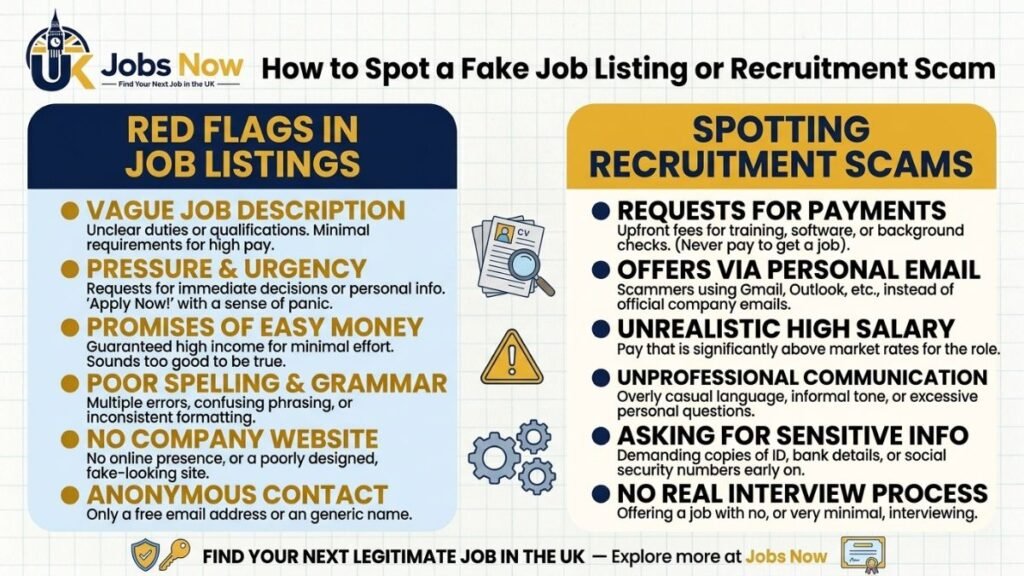
This is the single most important rule, and it has essentially no legitimate exceptions in UK hiring: a genuine employer does not ask you to pay money at any stage of a legitimate job application — not for training materials, not for a “processing fee,” not for background check costs, not for equipment you’ll supposedly be reimbursed for later. Any request for payment, in any form, at any stage of an application process, should be treated as a firm and immediate red flag, regardless of how convincing the surrounding communication looks.
Other warning signs worth knowing
Unusually high pay for minimal qualifications or effort
A listing promising substantial pay for vague, minimal-effort work — particularly around “remote data entry,” “package reshipping,” or “mystery shopping” roles — is one of the most common scam patterns. Genuine roles paying significantly above market rate for a given level of experience and effort are the exception, not the norm, and it’s worth treating an offer that seems disconnected from realistic market pay with real scepticism.
Communication exclusively through informal messaging apps
Legitimate UK employers generally communicate through proper company email addresses and, at later stages, phone or video calls — not exclusively through WhatsApp, Telegram, or similar messaging apps from the very first contact. This isn’t an absolute rule (some genuine informal or small-business hiring does use these channels), but it’s a pattern worth treating with more caution, particularly combined with other warning signs.
Interviews conducted entirely via text chat, with no video or voice contact at all
A genuine interview process, even an informal one, typically involves some form of live conversation — a call or video interview — at some point before an offer is made. A “job offer” following only a text-based chat interview, with no live conversation ever taking place, is a well-documented scam pattern, particularly common in fake remote work schemes.
Urgency and pressure to act immediately
Language designed to create artificial urgency — “apply within the hour,” “limited spots remaining today,” pressure to accept an offer or provide personal details immediately without time to consider — is a common manipulation tactic. Legitimate employers generally allow reasonable time for a genuine decision, even in a fast-moving hiring process.
Requests for sensitive personal or financial information too early in the process
Bank details, a copy of your passport or driving licence, your National Insurance number, or similar sensitive information should not be requested before a formal offer stage, and even then, through a proper, secure, verified process — not casually over email or a messaging app. Legitimate right-to-work and background checks do happen in UK hiring, but at the appropriate stage and through appropriate channels, not as an early, casual request.
A generic or unofficial email domain for a supposedly established company
An email claiming to be from a well-known company but sent from a generic address (a free email provider rather than the company’s own domain) is a straightforward, easily checkable warning sign. It’s worth cross-referencing the sender’s domain against the company’s actual, official website before taking any communication at face value.
A job description that’s vague, generic, or doesn’t match the supposed company’s actual business
Genuine job listings, even brief ones, typically describe specific, coherent responsibilities that make sense for the stated company and industry. A vague description that could apply to almost any role at almost any company, or one that doesn’t logically match what the supposed employer actually does, is worth treating with suspicion.
A practical verification checklist
| Check | How to verify |
|---|---|
| Does the company actually exist? | Search for it independently, check Companies House for UK registration, and look for a genuine, professional website and social media presence |
| Does the sender’s email match the company’s real domain? | Compare the email address against the company’s official website, not just the display name shown |
| Is the listing also posted on the company’s own official careers page? | Cross-check directly on the employer’s own site rather than relying solely on a third-party listing |
| Has any payment or sensitive financial information been requested? | Treat any request for payment, at any stage, as an immediate and firm red flag |
| Does the pay and effort level seem realistic for the role described? | Compare against genuine current listings for similar roles in the same field and region |
What to do if you think you’ve encountered a scam listing
Don’t provide any further personal or financial information, and don’t send any payment under any circumstances, even a small “processing fee” that seems minor. If you’ve already shared sensitive information, it’s worth taking protective steps promptly — contacting your bank if financial details were shared, and reporting the incident to Action Fraud, the UK’s national reporting centre for fraud and cybercrime. If you spot a scam listing on a job board (including this one), reporting it directly to the platform helps get it removed before it catches someone else.
Why legitimate job boards can still occasionally host a scam listing
It’s worth understanding that even carefully moderated job boards can occasionally have a fraudulent listing slip through, particularly one that’s initially well-disguised — this is a genuine, ongoing challenge across the entire industry, not a sign that verification processes don’t work at all. A well-run job board should have a clear verification process and an easy way to report a suspicious listing, and should act promptly once something’s flagged, but no verification process can guarantee 100% detection before publication, which is exactly why knowing these warning signs yourself remains genuinely important, regardless of which platform you’re using.
Staying appropriately cautious without becoming overly suspicious of every opportunity
It’s worth striking a reasonable balance here — the vast majority of job listings and hiring processes are genuine, and becoming excessively suspicious of every normal quirk of a real hiring process (a slightly unusual interview format, a recruiter using WhatsApp for scheduling convenience) can cause you to miss out on legitimate opportunities unnecessarily. The warning signs above are most meaningful in combination, or when the core rule — any request for payment — is triggered outright, rather than any single minor oddity in isolation.
Frequently Asked Questions
Would a genuine UK employer ever ask me to pay for training or equipment upfront?
No, essentially never — this is one of the clearest and most reliable scam indicators, and it should be treated as a firm red flag regardless of how legitimate the rest of the communication appears.
Is it a red flag if an interview is conducted entirely over text chat?
It’s a genuine warning sign, particularly if there’s never any live voice or video contact throughout the entire process before an offer is made — legitimate hiring almost always involves at least one live conversation at some stage.
What should I do if I’ve already given a scam listing my personal details?
Contact your bank promptly if any financial information was shared, and report the incident to Action Fraud. Also report the listing itself to whichever platform hosted it so it can be removed.
Can a job scam happen on a legitimate, well-known job board?
Occasionally, yes — even carefully moderated platforms can have a fraudulent listing slip through, particularly a well-disguised one. This is why understanding the warning signs yourself remains important regardless of which site you’re using.
Is it suspicious if a recruiter wants to communicate over WhatsApp?
Not automatically, since some legitimate recruiters do use messaging apps for scheduling convenience — but it’s worth treating this as one factor among several, and being more cautious if it’s combined with other warning signs like urgency, payment requests, or a vague role description.