
How to Start a Career in Construction and Skilled Trades
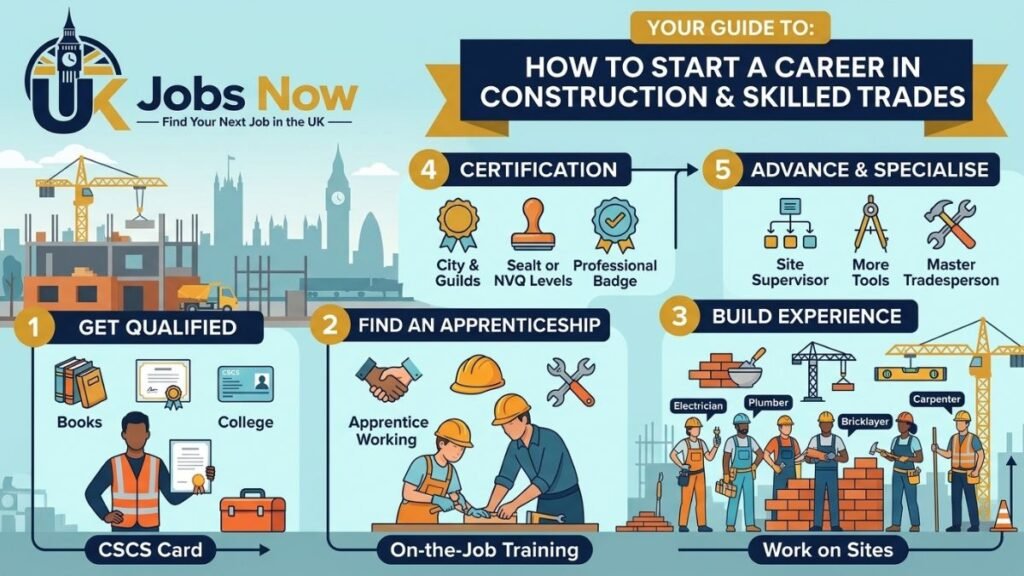
UK construction and skilled trades have a genuine, persistent demand problem that works in favour of anyone considering entering the sector — an ageing existing workforce combined with ongoing housing and infrastructure need means skilled tradespeople are consistently sought after across the country. This is a practical guide to the actual entry routes into construction and skilled trades, what different paths look like, and how to think about which trade or route might suit you.
Why construction and trades are worth serious consideration
Beyond straightforward demand, skilled trades offer something genuinely distinct from many other career paths: a clear, structured qualification route that leads directly to recognised, portable competence — once qualified, your skills and certification are broadly recognised across employers and, for many trades, allow for genuine self-employment as a realistic long-term option, which isn’t available in the same way across most other sectors. The combination of strong demand and a well-defined path to genuine independence is a significant part of what makes trades attractive as a deliberate career choice, not just a fallback option.
The main entry routes
Apprenticeships
This is the most common and generally most recommended entry route into a skilled trade — combining paid, on-the-job training under a qualified tradesperson with structured off-the-job study, typically over two to four years depending on the specific trade, leading to a recognised qualification (often an NVQ alongside trade-specific certification). Apprenticeships are open to school leavers and career changers of any age, and the earn-while-you-learn structure is a genuine practical advantage over routes requiring full-time unpaid study.
College courses combined with work placement
An alternative or complementary route to a formal apprenticeship, particularly useful if you’re not immediately able to secure an apprenticeship placement with an employer — college-based trade courses build foundational knowledge and practical skills, often alongside work placement opportunities that can lead toward employment or a formal apprenticeship afterward.
Labouring roles as an entry point
Starting as a general labourer on a construction site, without a specific trade qualification yet, is a genuine and common way to gain direct exposure to the industry, build relevant contacts, and in some cases transition into a formal apprenticeship with an employer you’ve already demonstrated reliability and genuine interest to.
Choosing a specific trade
“Construction” and “trades” cover genuinely distinct specialisms with different day-to-day work, different physical demands, and somewhat different demand and pay patterns by region — electrical, plumbing, carpentry and joinery, bricklaying, plastering, painting and decorating, and heating and ventilation (HVAC) engineering are among the most common. It’s worth researching the specific day-to-day reality of a few trades that interest you before committing to a specific apprenticeship route, since the qualification process represents a genuine, multi-year commitment.
| Trade | General characteristics |
|---|---|
| Electrical | Strong, consistent demand; a genuinely technical trade with meaningful ongoing learning as regulations and technology evolve |
| Plumbing and heating | Strong demand, including growing need connected to renewable heating system installation and maintenance |
| Carpentry and joinery | Broad range of specialisms from structural work to fine finish carpentry, with varied working environments |
| Bricklaying | Physically demanding, strong demand tied closely to new housing construction activity |
| Plastering | Specific, in-demand finishing trade with a relatively contained, focused skill set to master |
Qualifications and certification worth understanding
Most UK trades involve a combination of an NVQ (National Vocational Qualification) at the appropriate level for your trade and experience, alongside trade-specific certification — for example, electricians typically need specific electrical qualifications and registration with a relevant competent person scheme to carry out certain work independently. It’s worth researching the specific certification pathway for your chosen trade directly through the relevant trade body or awarding organisation, since requirements and structures differ meaningfully between trades.
Physical demands and safety
Construction and trades work is genuinely physically demanding for most roles — regular lifting, extended periods of physical activity, and work in a range of weather and site conditions depending on the specific trade and project. Safety training and awareness (site safety inductions, appropriate personal protective equipment, and for many roles, a valid CSCS card confirming you’ve completed recognised health and safety training) are a standard, non-negotiable part of working on most UK construction sites, and it’s worth understanding this as a serious, structured part of the industry rather than an optional add-on.
Progression once qualified
Once qualified in a trade, common progression paths include taking on more senior or specialist work within your trade, moving into site supervision or management (site foreman, site manager), or — for many tradespeople — building toward self-employment, running your own business and taking on your own clients directly rather than working for a single employer. This latter path is one of the more distinctive features of trades compared to many other career routes, and it’s worth considering as a genuine long-term goal from early in your training if independence and running your own business appeals to you.
Career changers entering a trade later in life
It’s worth being direct: starting a trade apprenticeship later in your career, after some years in a different field, is a genuine, viable, and increasingly common path — there’s no upper age limit on apprenticeship eligibility, and many career changers bring valuable maturity and work discipline that employers genuinely value in an apprentice. It’s worth being realistic about the practical adjustment of an apprentice-level wage during training if you’re coming from a more senior role in a different field, but the earn-while-you-learn structure means this is typically a defined, time-limited period rather than an indefinite one. Our broader guide to changing careers in the UK covers this kind of transition more generally.
Finding an apprenticeship or entry-level role
Apprenticeship vacancies are advertised through the national UK apprenticeship service, directly by individual employers and trade contractors, and through construction-specific training providers and colleges. Labouring and entry-level site roles are commonly advertised more broadly, including through general job boards. You can browse current active UK job listings filtered by the construction category to see current openings across trades and entry-level roles.
Regional variation in construction demand
Construction and trades demand isn’t uniform across the UK — it tends to track closely with local housing development activity, infrastructure projects, and broader regional economic conditions, meaning opportunity and typical pay can vary meaningfully between regions and even between specific towns and cities. It’s worth researching current demand and typical rates in your specific area directly, rather than assuming national patterns apply uniformly everywhere, particularly if you’re weighing whether to relocate for stronger opportunities in a specific trade.
Balancing structured qualifications with practical, on-site learning
It’s worth understanding that formal qualifications and genuine practical competence, while connected, aren’t identical — a lot of real skill in most trades is built through sustained, hands-on experience under an experienced tradesperson, which is exactly why the apprenticeship model (structured study combined with substantial on-the-job time) tends to produce more genuinely job-ready tradespeople than a purely classroom-based qualification alone would. If you’re weighing different training providers or routes, it’s worth specifically asking how much genuine hands-on, supervised practical time each option actually includes, not just the classroom or theoretical component.
Frequently Asked Questions
What’s the best way to start a career in a skilled trade?
A formal apprenticeship is generally the most recommended route, since it combines paid work with structured training leading to a recognised qualification. College courses and entry-level labouring roles are viable alternative or complementary starting points if an apprenticeship placement isn’t immediately available.
Is it too late to start a trade apprenticeship if I’m already in my 30s or 40s?
No — there’s no upper age limit on UK apprenticeship eligibility, and career changers entering a trade later are increasingly common, often bringing valuable maturity that employers genuinely value in an apprentice.
How long does it typically take to qualify in a trade?
Most trade apprenticeships take roughly two to four years, depending on the specific trade and qualification level, combining on-the-job training with structured off-the-job study.
Can I eventually become self-employed after qualifying in a trade?
Yes — self-employment is a genuine, common long-term path for many qualified tradespeople, running their own business and taking on clients directly rather than working solely for a single employer, and it’s worth considering as a long-term goal from early in your training if it appeals to you.
What safety qualifications do I need to work on a UK construction site?
Most sites require a valid CSCS card confirming completion of recognised health and safety training, alongside a site-specific safety induction — this is a standard part of the industry, and requirements can vary slightly depending on the specific role and site.