Your Payslip, Tax Code and National Insurance Explained for New Starters
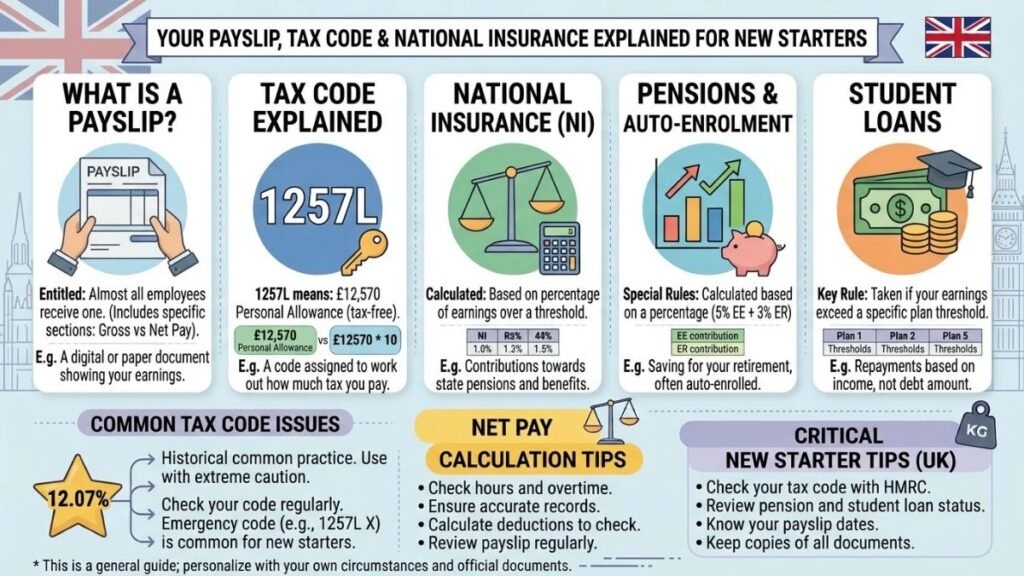
Your first payslip can feel like a puzzle. Why is your take-home pay lower than you expected? What does the code on your payslip mean? Why is a deduction called National Insurance? And what should you do if you think you have paid too much tax? This guide explains, in plain English, how a UK payslip works, what your tax code means, how National Insurance, pensions and student loan repayments are taken from your pay, and what to check when you start a new job.
Quick answer: For 2026/27, most people can earn £12,570 a year before paying Income Tax, which is what the standard tax code 1257L represents. Above that, the basic rate of Income Tax is 20% (in England, Wales and Northern Ireland) up to £50,270. Employees also pay National Insurance at 8% on earnings between about £12,570 and £50,270 a year (roughly £242 to £967 a week).
What your payslip must show
Every employee and worker has the right to an itemised payslip, on or before payday. It can be on paper or online. A payslip must show:
- Gross pay, the amount you earn before anything is taken off
- Deductions, such as Income Tax, National Insurance, pension contributions and student loan repayments
- Net pay, the amount actually paid into your bank account (your “take-home pay”)
- The hours you worked, if your pay depends on them, or the pay for each part of your hours if you are paid different rates
- Any fixed deductions, such as a union subscription or a charitable giving scheme
If your payslip does not show the details clearly, ask your employer to explain. If you are paid cash in hand with no payslip, you have no record of your earnings, holiday or sick pay. Our guide to holiday entitlement and holiday pay explains how holiday pay should appear on your payslip.
What a typical payslip looks like
| Item | What it means |
|---|---|
| Tax code | The code your employer uses to work out your Income Tax |
| Gross pay | Your pay before deductions |
| Income Tax (PAYE) | Tax taken before you are paid |
| National Insurance (NI) | A contribution that builds your state pension and other benefits |
| NI category letter | A letter that tells your employer which NI rate applies to you. Most employees are category A |
| Pension | Your workplace pension contribution |
| Student loan | A repayment if your income is above your plan’s threshold |
| Net pay | What you receive |
| Year to date (YTD) totals | The running total of pay and deductions this tax year |
The UK tax year runs from 6 April to 5 April.
How Income Tax works
You only pay Income Tax on income above your personal allowance. In 2026/27, the standard personal allowance is £12,570 a year. For earnings above that:
| Band | Taxable income (England, Wales and Northern Ireland) | Rate |
|---|---|---|
| Personal allowance | Up to £12,570 | 0% |
| Basic rate | £12,571 to £50,270 | 20% |
| Higher rate | £50,271 to £125,140 | 40% |
| Additional rate | Over £125,140 | 45% |
Scotland sets its own Income Tax bands and rates for most income, so the amounts differ if you live and work in Scotland. Check the Scottish Government and GOV.UK for current figures.
If you work part time or you are a student, you may pay little or no Income Tax. See our guide to part-time jobs for students in the UK.
Most people pay tax through PAYE (Pay As You Earn): your employer takes the tax from your pay and sends it to HMRC.
Your tax code explained
Your tax code tells your employer how much tax-free pay you get, so they can work out how much tax to deduct. You can find it on your payslip, on a P45 or P60, or in your personal tax account on GOV.UK.
The standard code: 1257L
- 1257 is your tax-free allowance divided by 10 (£12,570 becomes 1257).
- L means you are entitled to the standard personal allowance.
Most employees with one job and no complicating factors are on 1257L.
Other common codes
| Code | What it usually means |
|---|---|
| 1257L W1 or M1 (emergency basis) | You are on a temporary “emergency” tax code because your employer does not yet have your details. The tax is worked out as if each pay period stands alone |
| BR | All your pay from this job is taxed at the basic rate of 20%, usually because you have a second job or pension and your allowance is used elsewhere |
| D0 and D1 | All your pay is taxed at the higher (D0) or additional (D1) rate |
| 0T | You have no tax-free allowance, and all your pay is taxed from the first pound. Often used when HMRC does not have enough information |
| K code | Your untaxed income or benefits are worth more than your allowance. An example is a company car, so you pay extra tax through your code |
| NT | No tax is taken, which is rare |
| S or C prefix | Used for Scottish (S) or Welsh (C) taxpayers |
If your code has a letter other than L, or looks unusual, check it. Wrong codes are one of the most common causes of overpaid or underpaid tax.
Emergency tax: why it happens and how to fix it
If you start a job without a P45, or you are starting your first job, your employer may need to put you on an emergency code until HMRC sends the correct one. This is common for seasonal and part-time work, including Christmas jobs. See our guide to Christmas jobs in the UK 2026.
To avoid or fix it:
- Give your employer your P45 from your last job, if you have one.
- Fill in the starter checklist your new employer gives you, and answer the questions carefully. It asks whether this is your first job, whether you have another job or a pension, and whether you receive a student loan.
- Check your payslip. If the code ends in W1, M1 or X, you are on an emergency basis.
- Check your tax code online through your personal tax account on GOV.UK or the HMRC app.
- Contact HMRC if the code is wrong. Your code will normally be corrected on your next payslip, and any overpaid tax is refunded through your pay or by HMRC.
National Insurance explained
National Insurance (NI) contributions build your entitlement to the state pension and certain benefits. Employees normally pay Class 1 National Insurance through payroll.
For 2026/27 the main employee rates are:
| Earnings | NI rate |
|---|---|
| Up to about £242 a week (£12,570 a year) | 0% |
| About £242 to £967 a week (£12,570 to £50,270 a year) | 8% |
| Above about £967 a week | 2% |
Your employer pays a separate employer contribution on top of your pay. It does not reduce your take-home pay.
Key points:
- Your National Insurance number is a personal number you keep for life. You usually receive it by letter before you turn 16. If you do not have one, you can apply through GOV.UK. You can usually start work while you wait.
- It is not proof of your right to work. See our guide to right to work checks in the UK.
- Gaps in your NI record can affect your future state pension. You can check your record on GOV.UK.
- Self-employed people pay NI differently, through Self Assessment. See our guides to delivery driver jobs and CSCS cards and construction jobs for the self-employed and CIS rules.
Workplace pensions
Under automatic enrolment, your employer must put you into a workplace pension if you:
- Are aged 22 or over and under state pension age
- Earn more than £10,000 a year from that employer
- Work in the UK
Workers aged 16 to 21, or those earning less, can often ask to join. The minimum contributions are normally:
- 5% from you (some of which is tax relief), and
- 3% from your employer, on a band of your earnings
Your pension contribution shows on your payslip. You can opt out, but you would lose your employer’s contribution, so think carefully. Check the details of your employer’s scheme, and our guide to understanding your employment contract for what your contract says.
Student loan repayments
If you have a UK student loan, your employer takes repayments through payroll once your pay goes above the threshold for your repayment plan. For 2026/27 the annual thresholds are:
| Plan | Annual threshold | Rate on the amount above it |
|---|---|---|
| Plan 1 | £26,900 | 9% |
| Plan 2 | £29,385 | 9% |
| Plan 4 (Scotland) | £33,795 | 9% |
| Plan 5 (England, courses starting from August 2023) | £25,000 | 9% |
| Postgraduate Loan | £21,000 | 6% |
You repay only on the part of your pay above the threshold. For example, on a £35,000 salary, a Plan 2 borrower repays about £505 a year, and a Plan 5 borrower about £900. Plan 5 repayments start from April 2026. Check GOV.UK for your plan and current thresholds, because they change.
Tell your employer which plan you are on, using the starter checklist or your payslip, so the right amount is deducted. If you think the wrong plan is being used, contact the Student Loans Company or HMRC.
A worked example
Suppose you earn £26,000 a year (about £2,167 a month), are on tax code 1257L, are in the standard NI category and have no student loan or pension for this example:
| Item | Approximate monthly amount |
|---|---|
| Gross pay | £2,167 |
| Income Tax (20% on pay above £1,048 a month) | £224 |
| National Insurance (8% on pay above £1,048 a month) | £89 |
| Take-home pay | About £1,853 |
If you also paid a 5% workplace pension contribution and a student loan repayment, your take-home pay would be lower again. These figures are examples only, so use the official tax calculator on GOV.UK or your payslip for your own situation.
For hourly workers, remember the legal minimum is £12.71 an hour for workers aged 21 and over from April 2026, £10.85 for ages 18 to 20 and £8.00 for under-18s and apprentices. See our National Minimum Wage 2026 guide.
Statutory Sick Pay and other pay on your payslip
- Statutory Sick Pay (SSP) appears on your payslip if you are off sick and qualify. Since April 2026 SSP is payable from the first day for those who qualify. See our guide to the Employment Rights Act 2025.
- Holiday pay should be clearly shown, particularly if you are on a zero-hours contract and your employer uses rolled-up holiday pay. See our guides to holiday entitlement and holiday pay and zero-hours contracts.
- Tips, tronc and service charge in hospitality should appear separately. See our hospitality jobs guide.
- Notice pay and redundancy pay are shown separately and taxed in particular ways. See our guides to notice periods in the UK and redundancy rights in the UK.
Documents you will receive
| Document | What it is |
|---|---|
| P45 | Given to you when you leave a job. Shows your pay and tax so far this tax year. Give it to your new employer |
| P60 | An end-of-year summary your employer gives you after 5 April, showing your total pay and tax for the year. Keep it |
| P11D | Shows taxable benefits, such as a company car or private medical insurance, if you receive them |
| Payslip | Shows each pay period’s pay and deductions |
Keep your payslips, P45 and P60 safe. They are useful for mortgages, loan applications and checking your tax.
How to check that your pay is right
- Check your tax code on your payslip. Compare it to 1257L, and ask why if it is different.
- Check your gross pay. Does it match the hours, rate or salary in your contract?
- Check the deductions. Do tax, NI, pension and student loan look reasonable for your pay?
- Check the year-to-date figures to make sure the totals are growing as you would expect.
- Check holiday and sick pay are shown if they apply.
- Use your personal tax account. Sign in to GOV.UK or the HMRC app to see your tax code, employment history and estimated tax for the year.
- Keep records of your hours, rotas and messages if you think something is wrong.
If you think you have paid too much tax
This happens often with emergency tax, a second job, or a change of job during the year.
- Contact HMRC through your personal tax account, the HMRC app or by phone, and ask for your code to be checked.
- Your employer can correct the code once HMRC sends the update, and refund overpaid tax through your pay.
- If you stopped working, you may be able to claim a refund by completing an online form on GOV.UK or by waiting for HMRC to send a calculation after the tax year ends.
- Never use a third-party “tax refund” company that charges high fees to do what you can do free. Some are scams.
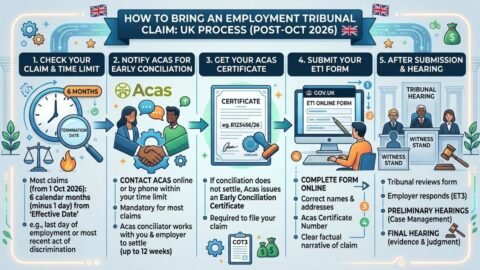
If your employer is not paying you properly or there are errors on your payslip, raise it with your payroll or HR team in writing, and contact Acas if the problem is not resolved. The time limit for most employment tribunal claims is six months for events on or after 1 October 2026, and you must go through Acas early conciliation first.
Beware of scams about tax and pay
- Fake HMRC emails, texts and calls that say you are owed a refund or owe money. HMRC does not ask for payment by gift card or threaten arrest. You can forward suspicious emails to report@phishing.gov.uk and texts to 7726.
- Fake employers who ask for your bank details, National Insurance number or passport before you have a signed contract. Read our guide to how to spot a fake job advert in the UK.
- “Pay” through your own account for money you must pass on, which can be money laundering.
Frequently asked questions
What does 1257L mean? It is the standard tax code for 2026/27. The number 1257 means a tax-free allowance of £12,570, and the L means you are entitled to the standard personal allowance.
Why am I paying more tax than I should? You may be on an emergency or incorrect tax code, especially in a new job. Check your code and contact HMRC to correct it.
How much National Insurance do I pay? Employees pay 8% on earnings between about £242 and £967 a week, and 2% above that. Below £242 a week you pay none.
What is the difference between gross and net pay? Gross pay is what you earn before deductions. Net pay is what is paid into your bank account after tax, National Insurance, pension and any other deductions.
Do I have to join my employer’s pension? You are usually put in automatically if you are 22 or over and earn more than £10,000 a year. You can opt out, but you would lose your employer’s contribution.
When do student loan repayments start? Once your income is above the threshold for your plan, for example £26,900 for Plan 1 or £29,385 for Plan 2 in 2026/27. You repay 9% of the amount above it.
What is a P45? A form your old employer gives you when you leave. It shows your pay and tax to date this tax year. Give it to your new employer.
Can I start work without a National Insurance number? Usually yes. Apply for one through GOV.UK, and give it to your employer when you have it.
Final thoughts
You do not need to be an expert, but checking your payslip each month, especially in your first job, can save you money and stress. Know your tax code, check your deductions and keep your documents safe. When you are ready for your next role, browse the latest vacancies on our jobs board and read your contract before you sign.
This article is general information, not tax advice. Tax rates, thresholds and codes change, and Scotland has different Income Tax bands. Check GOV.UK and HMRC for the latest figures, and speak to HMRC, Citizens Advice or a qualified adviser about your own situation.