How to Get an Airport Job in the UK (Requirements, Security Checks)
Airports are some of the largest employers in the UK, and many of their jobs need no previous experience. What puts some people off is the vetting: the background checks and the airside pass. This guide explains the jobs available, the requirements, how the security checks work, what you can expect to be paid, and how to apply.
Quick answer: To work airside at a UK airport you generally need a full five-year employment and address history, a criminal record check, identity and right-to-work checks, and security awareness training. Roles that only need landside access have a shorter check, often two years.
Types of airport jobs
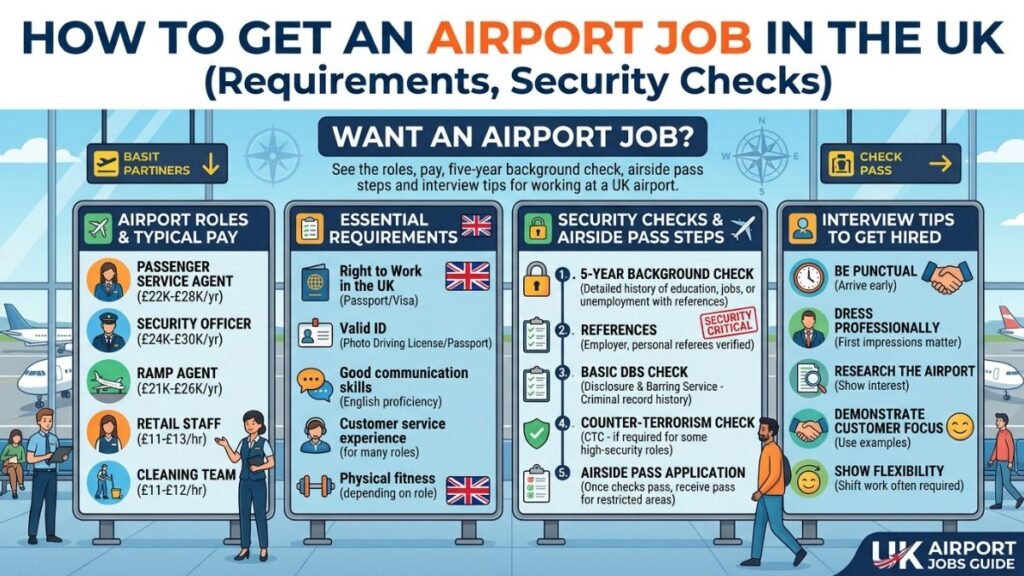
The airport itself employs only some of the people who work there. Many staff are employed by airlines, ground handling companies, security contractors, retailers and caterers. Common entry-level roles include:
- Aviation security officer: screening passengers, staff and baggage, and searching aircraft.
- Baggage handler and ramp agent: loading and unloading luggage and cargo. This is physical work, often outdoors and on shifts.
- Check-in and passenger service agents: helping passengers at desks, gates and self-service areas.
- Cargo and warehouse operatives: handling freight.
- Retail, food and drink staff: working in shops, cafes and restaurants in the terminal.
- Cleaners and terminal operations staff: keeping the airport running and presentable.
- Customer service and passenger assistance: helping passengers who need extra support.
- Technical and professional roles: engineering, operations management, finance, IT and air traffic control, which need specific qualifications.
Cabin crew and pilots are employed by airlines and have their own entry routes, so they are not covered in detail here.
Browse current airport and aviation vacancies, including roles at Bournemouth Airport, on our UK jobs board.
Airside and landside: why it matters
The type of check you need depends on where you will work.
- Landside areas are open to the public or to people with a legitimate reason to be there, such as check-in halls and car parks.
- Airside areas are beyond security. The most sensitive are the security restricted areas, sometimes called the critical part, where passengers and baggage have been screened.
Manchester Airport’s published vetting policy shows the difference clearly: airside roles need a five-year background check, and landside roles need a two-year check. Other airports follow the same framework set by UK aviation security rules, though details vary, so always read the instructions from the airport or employer you are applying to.
Requirements for an airport job
Basic requirements
- Right to work in the UK. Some employers ask for an unrestricted right to work for a minimum period, such as 12 months, for security roles.
- UK residence. Some security job adverts require three years of UK residence, which is a requirement of the particular employer. If you have lived abroad, you will usually need an overseas criminal record certificate (see below).
- A complete five-year history. This is the biggest practical hurdle for airside jobs.
- Flexibility. Airports run 24 hours a day, so early starts, nights, weekends and bank holidays are common.
- Physical fitness for roles such as baggage handling.
For entry-level roles, employers often say no experience is needed and they provide the training. A friendly manner and reliability matter more.
Your five-year history
For an airside pass you need to account for the last five years. That means:
- Employment history: every job, period of study, unemployment, travel or career break, with dates. References may be taken for employers.
- Address history: proof of where you have lived for five years.
The key rule is that there should be no unexplained gaps. Being unemployed, in education, caring for family or travelling is fine. You just need to state it and, where asked, support it. Write your CV with exact start and end dates (month and year) for everything in the past five years.
The security checks explained
The exact process depends on the airport and employer, but these are the main steps.
1. Employment references
The vetting team contacts referees to confirm your history. Gather the names and contact details of past employers or other people who can verify what you were doing, such as a college.
2. Basic criminal record check
You will need a basic criminal record check, which shows unspent convictions only. In England and Wales this is a Basic DBS check, in Scotland it comes from Disclosure Scotland, and in Northern Ireland from AccessNI. Airports publish a list of offences that disqualify you from holding an airside pass, and the result depends on the type of offence and how recent it is. If you have a conviction, check the airport’s pass standard or ask the recruiter before you apply. Don’t assume you will be rejected, but don’t hide anything either.
Basic checks can take days or a few weeks, depending on the route and how busy the service is.
3. Overseas criminal record checks
If you have spent time outside the UK in the last five years, you may need a criminal record certificate from each of those countries. One airport, for example, asks for one for each country where the applicant spent at least six continuous months in the last five years. Start this early, as overseas certificates can take weeks.
4. Counter Terrorism Check (CTC)
Some roles, especially security officer jobs, require a Counter Terrorism Check on top of the basic check. Several recruiters say they pay for and arrange it, so check the advert.
5. Accreditation check
Since 1 January 2022, anyone who needs unescorted access to the critical part of a UK airport must also pass an accreditation check carried out by the UK Government. This is arranged through your employer or sponsor company as part of the pass application, so you are not usually expected to do it yourself.
6. Identity and right-to-work checks
You will need to show original identity documents, such as a passport, and proof of your right to work.
7. Security awareness training (GSAT)
General Security Awareness Training is an online course that many pass holders need before the pass application is submitted. Some airports only let you take it after your references and criminal record checks are complete, and expect it to be done within a set time of applying, for example within ten weeks.
8. The airside pass appointment
Once the checks are complete and your employer sponsors you, the airport pass office issues your pass. You usually attend in person with your identification. Passes are time limited and need renewing, often every few years, and some airports also require fire safety training after the pass is issued.
How long does it take?
There is no single answer. A straightforward UK-based applicant with a complete history may be cleared within days to a couple of weeks, but delays are common if you have gaps, overseas time, or referees who are slow to respond. Plan for several weeks between a job offer and starting airside, and avoid handing in notice at another job until you have a confirmed start date.
How much do airport jobs pay?
Pay depends on the employer and role. Examples from 2026 job adverts:
| Role and employer type | Example pay |
|---|---|
| Aviation security officer (contractor, Manchester) | £12.71 to £12.85 per hour |
| Security agent (ground handling, London area) | around £13 per hour |
| Airport security officer employed directly by airport group (Stansted) | £18.42 per hour including a 20% shift allowance (£16.62 during probation) |
The legal minimum for workers aged 21 and over is £12.71 an hour from April 2026, so contractor roles often start at or just above it, while jobs employed directly by an airport operator can pay noticeably more. Shift allowances, night premiums and training costs paid by the employer all affect your real earnings, so compare the full package. See our guide to the National Minimum Wage 2026 for the legal rates.
Some roles are part-time with low guaranteed hours, such as 12 hours a week with extra shifts offered. Check the contract hours before you accept, and read our guide to understanding your employment contract.
How to apply: step by step
- Decide what you want to do. Security, baggage, customer service and retail all have different shifts and physical demands.
- Prepare your five-year history. List all jobs, study, unemployment and travel with dates, and collect referee details and proof of address.
- Find vacancies. Check airport careers pages, airline and ground handler sites, security contractors and our UK job listings. Be wary of any advert that charges a fee for a job or an airside pass.
- Apply with a tailored CV. Highlight customer service, teamwork, reliability, and any experience of shift work.
- Attend the interview or assessment. See the tips below.
- Start your checks as soon as you get an offer. Respond quickly to vetting emails and upload documents promptly.
- Complete training and collect your pass. Your employer will guide you through GSAT and the pass appointment.
Interview tips for airport jobs
- Show you understand security. Airports value people who follow procedures carefully and speak up about concerns.
- Be honest about availability. Employers want to know you can handle early mornings, nights and weekends.
- Give customer service examples. Many airport jobs involve dealing with stressed or tired passengers.
- Talk about teamwork under pressure. Flights run to tight schedules.
- Expect questions about your history. Be ready to explain gaps and give dates confidently.
Common questions include:
- Why do you want to work at an airport?
- How would you deal with a passenger who becomes angry or upset?
- Tell me about a time you worked in a team to meet a deadline.
- Are you comfortable with shift work, including nights?
- Why is attention to detail important in this role?
Use the STAR method for examples: describe the Situation, your Task, the Action you took and the Result.
Common reasons applications stall
- Gaps in your five-year history that aren’t explained.
- Missing documents, such as proof of address or identity.
- Overseas certificates requested late.
- Unspent convictions that are on the airport’s disqualifying list.
- Slow referees. Warn people that they may be contacted.
Frequently asked questions
Do I need experience for an airport job? Not for many entry-level roles such as security, baggage handling or retail. Employers usually give training.
How long is the background check for an airside pass? The check covers five years. How long it takes to complete varies from days to several weeks.
Can I work at an airport with a criminal record? It depends on the offence, how long ago it was and whether it is unspent. Airports publish a list of disqualifying offences, so check before applying.
What is the difference between a landside and airside pass? Airside passes give access beyond security and need a five-year check. Landside passes cover public and controlled areas and may need a shorter check, such as two years.
Do I have to pay for my airside pass or checks? Practice varies. Many employers pay for the pass and some pay for the checks. Never pay a recruiter a fee to get a job.
Can I get an airport job if I have lived abroad? Often yes, but you may need criminal record certificates from the countries where you lived, and you must still account for your full five-year history.
Final thoughts
An airport job can be a good way into steady, shift-based work with real training. The vetting process is thorough but it is also predictable: have your five-year history ready, respond promptly to every request and be honest about anything unusual. Browse the latest airport and aviation roles on our jobs board and start preparing your history now so you can move quickly when you find the right vacancy.
This article is general information. Security requirements are set by individual airports and employers and may change, so always follow the instructions in your job advert and from the airport pass office.