How to Ask for a Pay Rise or Negotiate Salary in the UK
Most people in the UK feel uncomfortable asking for more money, and many never do. But employers rarely hand out raises unprompted, and the pay you agree when you start a job tends to set your earnings for years. Whether you want a rise in your current job or you are negotiating an offer for a new one, preparation makes a big difference. This guide explains what is realistic in 2026, when to ask, how to build your case, what to say, how to handle a no and what your legal position is.
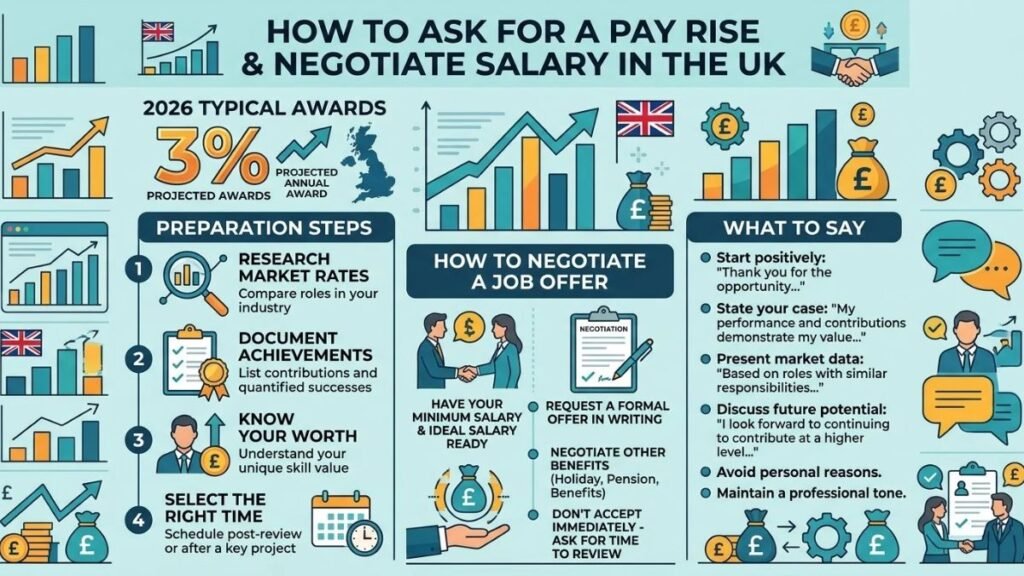
Quick answer: There is no general legal right to a pay rise, so you need a clear case. The typical UK pay award in autumn 2026 is around 3%, so asking for more usually needs evidence of results, extra responsibility or market pay. Research what others earn, list your achievements with numbers, ask for a meeting, state a specific figure and have a plan for what you will do if the answer is no.
The state of UK pay in 2026
Knowing where pay is heading helps you set realistic expectations.
| Measure | Latest figure |
|---|---|
| Annual growth in regular pay (ONS, June to August 2026) | 3.7% |
| Regular pay growth in the private sector | About 3.0% |
| Regular pay growth in the public sector | About 6.3%, affected by the timing of some pay awards |
| Typical pay award (Brightmine, three months to August 2026) | 3.0% median, with 3% the most common |
| CPI inflation (August 2026) | 3.1% |
| Pay growth after inflation (CPIH measure) | About 0.6% |
| What employers expect for the next 12 months (Bank of England survey) | About 3.4% |
The message is that pay rises are modest and barely ahead of inflation, so a standard annual increase may only keep you level. Bigger rises usually come from a promotion, a change in responsibilities, strong evidence that you are paid below the market rate or a move to a new employer. You can see how pay is changing in your sector from adverts on our UK jobs board.
Do you have a right to a pay rise?
Generally, no. Your pay is set by your contract, and an employer does not have to increase it unless:
- Your contract provides for it, such as an annual review, a pay scale or automatic increments. Check your contract and staff handbook. Our guide to understanding your employment contract explains where to look.
- The legal minimum rises. Your pay cannot fall below the National Minimum Wage or National Living Wage for your age. From April 2026 that is £12.71 an hour for workers aged 21 and over, £10.85 for 18 to 20 and £8.00 for under-18s and apprentices. The Low Pay Commission expects the National Living Wage to rise above £13 in April 2027, subject to government confirmation. See our National Minimum Wage 2026 guide.
- A collective agreement or union deal applies. If you are in a union, pay may be negotiated for everyone. Public sector jobs often have fixed pay scales, such as NHS bands. See our guide to NHS jobs.
- You are being paid unequally for equal work. The Equality Act 2010 gives you the right to equal pay for equal work regardless of sex, and discrimination in pay on other protected grounds is also unlawful. Contract terms that stop you discussing your pay in order to find out whether you are being treated unequally can be unenforceable. If you suspect unequal pay, contact Acas or the Equality Advisory and Support Service.
Outside those situations, your pay rise depends on persuasion, timing and what your employer can afford.
When to ask for a pay rise
Good moments include:
- At your annual or performance review, when pay is already on the agenda. Raise it early, because budgets are often set months in advance.
- After a clear achievement, such as winning a client, finishing a big project, hitting a target or saving the company money.
- When your role has grown, because you have taken on extra duties, staff or responsibility without extra pay.
- When the market has moved, and similar jobs are advertised at higher salaries than you earn.
- After you pass probation or complete training that raises your skills.
- Before budget planning, which in many organisations happens a few months before the new financial year.
Less helpful moments include during redundancies or a crisis at the company, straight after a mistake, or in the middle of a busy period when your manager has no time. Avoid asking in a corridor or by message. Book proper time.
If you have only just started, check your contract first. Many employers expect you to wait until you have completed a probation period or a year in the job, though that is not a legal rule.
How to prepare: step by step
1. Research what you are worth
- Look at current job adverts for similar roles in your area, in your sector and at your level. Note the pay ranges.
- Use salary guides and official data, such as the National Careers Service and ONS earnings tables.
- Ask recruiters what comparable roles pay. They know the market.
- Check what colleagues in similar roles earn, where you can do so legitimately. Pay transparency is increasing but not universal.
- Compare your pay with the typical increase of about 3%. If you are well below the market rate, you have a stronger case than if you only want a cost-of-living rise.
The cost of living alone is a weak argument, because every employee faces it, so base your case on your value to the employer.
2. List your achievements
Write down what you have done since your last pay rise or since you started:
- Results with numbers, such as “reduced complaints by 20%”, “processed 30% more orders” or “trained five new starters”
- Extra responsibilities, such as covering for a colleague, supervising others or taking on new systems
- Positive feedback from customers, colleagues and managers, including emails you can show
- New skills and qualifications that benefit the employer
- Cost savings or income you have generated
Be specific and honest. Examples work far better than general statements such as “I work hard”. If you are not sure how to describe your achievements, our guide to common interview questions and answers in the UK explains the STAR method, which also works for pay conversations.
3. Decide your numbers
- Your target. The figure you would be happy with, based on your research.
- Your minimum. The lowest increase you would accept before you consider other options.
- Your opening ask. Often slightly above your target, leaving room to compromise.
Think in terms of an annual salary figure, not just a percentage. Be realistic: a request for a few percent above the typical award is easier to justify than a request for a large jump, unless you are moving up to a bigger role or are clearly underpaid.
4. Understand your employer’s position
Consider the organisation’s finances, budget cycles and pay structure. A struggling company may be unable to offer money but may offer other benefits. A pay scale may limit the manager’s flexibility. Knowing this helps you propose realistic options.
5. Plan your alternatives
Think about what you would do if the answer is no. Would you stay, wait for a review, or look for another job? Updating your CV and checking the market before the meeting gives you confidence and options. See our guides to writing a UK CV with no experience (the layout tips apply to any CV) and writing a cover letter in the UK.
How to ask: step by step
- Request a meeting. Email your manager and ask for a private conversation to discuss your pay and development. This gives them time to prepare, and avoids ambushing them.
- Start positively. Say that you enjoy the job and want to grow with the organisation.
- Present your case. Summarise your achievements and the value you have added, and link them to the employer’s goals.
- State your request clearly. Give a specific figure or range, and say when you would like it to start.
- Stop talking and listen. Silence after your request is normal. Let your manager respond.
- Handle questions and objections calmly. Stay professional, and keep returning to evidence.
- Agree next steps. If your manager needs to speak to HR or senior managers, ask for a timescale.
- Follow up in writing. Send an email thanking them, summarising what was discussed and the agreed next steps.
Example wording
Opening the conversation
“Thanks for meeting me. I’ve really enjoyed the past year here, and I’d like to talk about my salary and how it reflects the role I’m doing now.”
Making the case
“Since my last review I’ve taken on [extra responsibility], I’ve [achievement with numbers] and I’ve received positive feedback from [customers or colleagues]. Based on my research, similar roles in our area are paying around £X to £Y.”
Stating the ask
“Given that, I’d like to discuss increasing my salary from £A to £B, starting from [date].”
If they say they can’t do it now
“I understand there are budget constraints. Could we agree a timeline to review this again in three months, and set out what I’d need to achieve to reach £B?”
How managers may respond
| Response | What to do |
|---|---|
| Yes | Thank them and ask for confirmation in writing, with the new salary and start date. Check your next payslip. |
| Yes, but less | Consider whether it meets your minimum. Ask whether it can be reviewed again in six months, or whether other benefits can make up the difference. |
| Not now, maybe later | Ask for a specific date and targets for the next review, and get them in writing. |
| No | Ask for feedback on why, what would change the answer and whether there are alternatives. Then decide your next step. |
| “There’s no budget” | Ask what the employer can offer instead, such as bonuses, flexibility, training or a promotion path. |
| “You’re paid fairly for the role” | Show your market research, and ask whether your role could be regraded to reflect extra duties. |
Alternatives to a salary increase
If the employer cannot or will not raise your pay, consider asking for:
- A bonus or one-off payment
- A promotion or new job title that leads to higher pay later
- Flexible working, such as hybrid, compressed hours or a four-day week. Employees have a right to request flexible working from day one. See our guide to flexible working in the UK.
- More holiday or time off. See our guide to holiday entitlement and holiday pay.
- Training, qualifications or professional fees paid
- Pension contributions above the minimum, or salary sacrifice arrangements, which can be tax-efficient
- Other benefits, such as private medical insurance, a travel allowance or a better enhanced sick pay scheme
- A clear development plan with set review dates and targets
Think about the total package, not only the headline salary.
What if the answer is no?
- Stay professional. Do not threaten to resign unless you are prepared to do so. Employers may call your bluff.
- Ask for feedback and a plan. Set a date to review your progress.
- Keep a record of your achievements and the conversation.
- Look at the market. Browse vacancies on our jobs board and speak to recruiters. A new job is often the quickest way to raise your pay significantly.
- Think about your notice period and your contract before you decide to move. See our guide to notice periods in the UK.
- Be careful with counteroffers. If you resign and your employer offers more money to stay, think carefully about why you wanted to leave, and whether the underlying problems will remain.
- If you believe you are paid unequally or unfairly, take advice from Acas, your union or Citizens Advice.
Negotiating salary for a new job
A job offer is the strongest moment to negotiate, because the employer has already chosen you.
- Do your research first. Check adverts, salary guides and recruiters to set a realistic range.
- Delay salary talk early on if you can. Say you would like to learn more about the role and the whole package first. If asked for your expectations early, give a researched range.
- Be careful about giving your current salary. You are not legally required to disclose it. Focus on what the role is worth and what you are looking for.
- Wait for the offer. Once you have a formal offer, thank them and say you are keen. Ask for time to consider it.
- Negotiate the whole package. Pay, bonus, holiday, pension, flexibility, start date, notice period, training and progression.
- Make a reasonable counter. Explain your case with evidence, and make a specific request.
- Get the final offer in writing. Read the contract, check the pay, hours, probation and notice before you sign. See our guide to understanding your employment contract.
- Accept graciously, and do not withdraw once you have agreed.
If the employer sets pay by grade or scale, such as many public sector roles, there may be little room to negotiate pay, but you can sometimes negotiate the starting point on the scale, your start date or other benefits. For a role in the NHS, see our guide to NHS jobs.
If you are early in your career, your options may be more limited, but it is still reasonable to ask politely. Our guides to admin and office jobs and call centre jobs show typical starting pay.
Special situations
- Hourly, shift and retail workers. Pay is often set by grade or seniority, so ask about the pay scale, how to move up, and whether extra responsibilities such as team leader duties attract higher pay.
- Zero-hours and agency workers. Ask whether your rate rises after a set period, for example after 12 weeks in the same role for agency workers, and whether holiday pay is included. See our guide to zero-hours contracts.
- Apprentices. Ask about the pay scale at each stage, and remember the legal minimum rises with age and after the first year. See our guide to apprenticeships in the UK.
- Returning from family leave. You should receive any general pay rise you missed during leave. See our guide to maternity, paternity and shared parental leave and pay.
- After redundancy or a career break. Be realistic about your starting point but show the value of your skills. See our guide to redundancy rights in the UK.
- Self-employed and freelance. The same principles apply: know your market rate, set your prices and negotiate with each client.
What a pay rise means for your take-home pay
A raise is taxed, so your net gain will be smaller than the gross figure. Higher earnings can also push you over thresholds, such as the point where higher-rate tax starts (above £50,270 in England, Wales and Northern Ireland), where student loan repayments begin or where some benefits change. Check your payslip after a raise and use official calculators. See our guide to payslips, tax codes and National Insurance.
Common mistakes to avoid
- Asking without evidence. “I need more money” is weak. “I’ve taken on X and achieved Y” is strong.
- Comparing yourself with colleagues or complaining about others. Keep the focus on your own contribution.
- Making threats you are not prepared to carry out.
- Asking at a bad time, such as during redundancy talks or immediately after a mistake.
- Accepting the first offer without considering the whole package.
- Not following up in writing, or forgetting the agreed review date.
- Being too apologetic or vague. Be polite, confident and specific.
- Ignoring your contract. Check for clauses about pay reviews, bonuses and notice before you negotiate.
Frequently asked questions
How much of a pay rise should I ask for? There is no set figure. The typical annual award in 2026 is about 3%, so asking for more usually needs evidence such as increased responsibility, a promotion or proof you are paid below the market rate. Base your figure on research.
Do I have a legal right to a pay rise? No, unless your contract, a collective agreement or a pay scale provides for one. You do have the right to at least the minimum wage for your age, and to equal pay for equal work.
When is the best time to ask for a pay rise? At your annual review, after a clear achievement, when your role has grown or before budgets are set.
Can I be dismissed for asking for a pay rise? An employer should not treat you unfairly for asking, but there is no general protection for simply requesting more money, so be professional. If you think you have been treated unfairly, contact Acas.
Should I tell my employer I have another job offer? It can strengthen your position, but only if it is genuine and you would be prepared to accept it. Be careful with counteroffers.
What if my employer says there is no budget? Ask about alternatives, such as a bonus, flexible working, training or a firm date to review your pay again.
Do I have to say what I currently earn when applying for a job? No. You are not legally required to disclose your salary, and many people prefer to discuss the pay expectations for the role instead.
Is it OK to negotiate a job offer? Yes. Most employers expect some negotiation, particularly on pay, start date and benefits, as long as you are polite and have evidence.
Final thoughts
Asking for more money is easier when you have done your homework. Research the market, list your achievements, choose your numbers, ask for a meeting and follow up in writing. If the answer is no, you will at least know where you stand, and you will have options. When you are ready to see what else is out there, browse the latest vacancies on our jobs board.
This article is general information, not legal or financial advice. Pay data comes from the ONS, Brightmine and other published sources and changes monthly. Check GOV.UK, Acas and your contract for the latest guidance, and seek advice about your own situation.