Holiday Entitlement and Holiday Pay in the UK: How It Works
Holiday rules are one of the most common sources of confusion for UK workers. How many days are you entitled to? Do bank holidays count? What if you work part time, on a zero-hours contract or through an agency? And how is holiday pay worked out when your hours or pay change from week to week? This guide explains the legal minimum, how to calculate your entitlement, how holiday pay is worked out, and what to do if your employer gets it wrong.
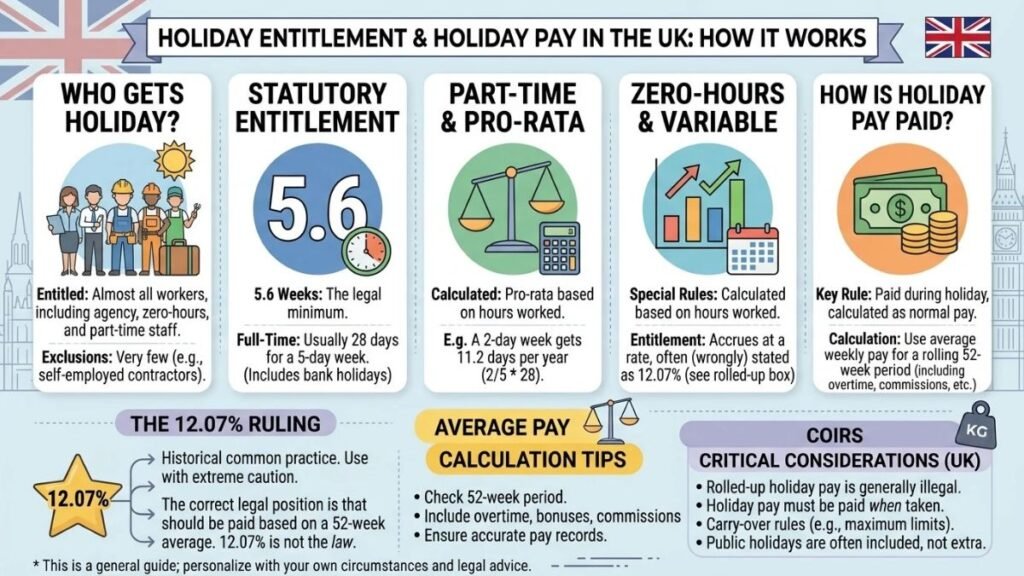
Quick answer: Almost all workers in Great Britain are entitled to at least 5.6 weeks of paid holiday a year, which is 28 days for someone working five days a week. Part-time workers get the same 5.6 weeks pro rata. For irregular-hours and part-year workers, holiday builds up at 12.07% of the hours they work.
How much holiday are you entitled to?
The legal minimum is 5.6 weeks of paid holiday a year, including bank holidays if your employer chooses to count them. The entitlement is capped at 28 days.
| How you work | Statutory minimum holiday |
|---|---|
| 5 days a week, full year | 28 days (5.6 x 5) |
| 4 days a week | 22.4 days (5.6 x 4) |
| 3 days a week | 16.8 days (5.6 x 3) |
| 2 days a week | 11.2 days (5.6 x 2) |
| Irregular hours or part-year | 12.07% of the hours you work |
These are the legal minimums. Your contract may give you more, and many employers do. Check your contract for your total entitlement, and whether it includes bank holidays. Our guide to understanding your employment contract explains where to look.
Who is covered?
The right to paid annual leave applies to workers, which includes employees, most agency workers, zero-hours workers and many casual staff. It does not usually cover the genuinely self-employed. If you are unsure of your status, ask Acas. The main rules are the same across Great Britain. Northern Ireland has its own regulations with broadly similar rules, so check Labour Relations Agency guidance if you work there.
Do bank holidays count?
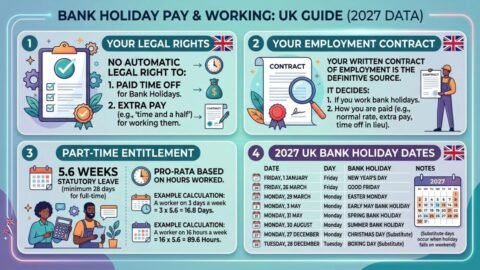
There is no automatic legal right to time off on bank holidays. Your employer can:
- Include bank holidays within your 28 days (a contract that says “28 days including bank holidays”, which leaves 20 days plus the 8 bank holidays in England and Wales), or
- Give bank holidays on top of the 28 days, making a total of 36 days in England and Wales
Check the wording in your contract. If you are required to work on a bank holiday, you only get extra pay or time off if your contract says so. In hospitality, retail and care, bank holiday rules are often set out in the contract or staff handbook.
Part-time workers
Part-time workers have exactly the same right to 5.6 weeks of holiday as full-time workers, calculated in proportion to how much you work. The simple formula is:
Entitlement = days (or hours) you work in a week x 5.6
For example:
- Three days a week gives 3 x 5.6 = 16.8 days
- 20 hours a week gives 20 x 5.6 = 112 hours
Employers cannot treat part-time workers less favourably, for example by giving them fewer weeks of leave than their working pattern deserves.
Zero-hours, casual and irregular-hours workers
Workers with irregular hours and those who only work part of the year (such as term-time or seasonal staff) still get holiday. For leave years starting on or after 1 April 2024, the rules changed:
- Holiday accrues at 12.07% of the hours you actually work in each pay period.
- This rate comes from 5.6 weeks divided by the 46.4 weeks left after holiday is taken out of the 52-week year.
- The entitlement is still capped at 28 days.
Example: If you work 100 hours in a pay period, you build up 12.07 hours of holiday. If you work 40 hours, you build up about 4.8 hours.
Rolled-up holiday pay
Employers can pay holiday pay as you go to irregular-hours and part-year workers. This is called rolled-up holiday pay. Instead of paying you when you take leave, the employer adds 12.07% to your pay each time you are paid, and shows it as a separate line on your payslip.
Example: If your hourly rate is £12.71 and your employer uses rolled-up pay, the holiday element is about £1.53 per hour (12.07% of £12.71), so you receive about £14.24 for every hour worked, with the £1.53 clearly labelled as holiday pay.
Important points:
- Rolled-up pay is only allowed for irregular-hours and part-year workers, not for regular-hours workers.
- It must be clearly itemised on your payslip, not hidden within the hourly rate.
- You are still entitled to take time off. Rolled-up pay just changes how the holiday pay is paid.
- The minimum wage still applies. Your basic rate must meet the minimum for your age without the holiday element. See our National Minimum Wage 2026 guide.
If you are on a zero-hours contract, read our guide to zero-hours contracts for your other rights, including the reforms expected in 2027.
How is holiday pay calculated?
Your holiday pay should reflect your normal pay, meaning what you would usually earn, not just your basic pay.
If you have fixed pay and hours
You receive your normal pay while you are on holiday. A salaried employee simply carries on being paid their usual salary.
If your pay varies
If your pay changes from week to week because of overtime, commission, shift allowances or irregular hours, holiday pay is based on your average pay over the previous 52 paid weeks. This 52-week reference period replaced a shorter 12-week period in April 2020, to give a fairer average for people whose earnings vary through the year. Weeks in which you were not paid are left out, and you look back further to find 52 paid weeks.
The things that normally count toward holiday pay include:
- Regular overtime (whether compulsory or voluntary, if it is regular)
- Commission and bonuses linked to your work
- Shift premiums and allowances that are part of your normal pay
- Regular payments such as regular on-call or standby allowances
Occasional overtime and genuine expenses do not usually count, though details can be complicated. Ask your employer or Acas if you think your holiday pay is too low.
A simple example
If your average weekly pay is £300, your holiday pay for one week is £300, and your statutory holiday pay over a full year is 5.6 x £300 = £1,680.
Starting and leaving a job
New starters
In your first year, your entitlement normally builds up as you work, usually at a twelfth of your annual entitlement for each month you have been employed. Check your contract for how your first-year holiday is worked out and whether you can take holiday before it has built up.
Leaving a job
When your employment ends, your employer must pay you for any accrued but untaken statutory holiday. If you have taken more holiday than you have earned, your employer may be able to deduct the extra from your final pay, if your contract allows it. You normally cannot be paid instead of taking holiday during your employment, except when it ends.
This also applies if you are made redundant. See our guide to redundancy rights in the UK. If you are working your notice, see our guide to notice periods in the UK for how holiday can be used during notice.
Booking holiday: who decides?
- You request leave. Your employer can set rules about how and when to book, such as a minimum notice period or a staff holiday system.
- Statutory notice. To take statutory holiday, you generally give notice at least twice as long as the leave you want (for example, two weeks’ notice for one week off), unless your contract sets a different rule.
- Your employer can refuse, but must give notice at least as long as the leave you asked for, and they cannot refuse in a way that stops you taking your minimum holiday in the year.
- Your employer can require you to take leave, for example during a Christmas shutdown, if they give proper notice (at least twice the length of the leave). That leave is taken from your entitlement.
- You cannot normally cancel or change approved leave without your employer’s agreement, unless your contract allows it.
Carrying over holiday
As a general rule, you must take your statutory holiday in the leave year, and unused leave is lost at the end unless your contract says otherwise. There are important exceptions. If you could not take your leave because you were on sick leave or family leave, you may be able to carry it over. Check your contract and Acas guidance, because the rules depend on your circumstances.
Many employers allow a limited carry-over, for example up to five days, as a contract term. Ask your employer for their policy in writing.
Holiday and sickness
- If you fall ill before or during your holiday, you may be able to take the days as sick leave and keep the holiday, depending on your employer’s policy and the law. Tell your employer promptly and follow the sickness reporting rules.
- Since April 2026, Statutory Sick Pay is payable from the first day of sickness for those who qualify. See our guide to the Employment Rights Act 2025.
- You continue to build up holiday while you are off sick.
What the Employment Rights Act 2025 changes
According to employment law guides, from 6 April 2026 employers must keep records showing they follow the holiday entitlement and holiday pay rules, and keep them for six years. The new Fair Work Agency, launched in April 2026, can also enforce holiday pay alongside the minimum wage and statutory sick pay. These changes are aimed at helping workers whose holiday pay is wrongly calculated. Check GOV.UK for the details, because several guides describe the changes slightly differently.
Common problems and what to do
Your payslip shows no holiday pay. Ask your employer how holiday pay is paid. If you are on zero hours, check whether it is rolled up and shown as a separate line.
Your holiday pay is lower than your normal pay. Ask whether regular overtime, commission and shift allowances are included, using the 52-week average.
Your employer says you are not entitled because you are casual, agency or zero hours. Most workers in these categories are entitled to paid holiday. Check with Acas.
Your employer refuses all holiday or insists you work during your leave. Raise it in writing, referring to your contract and your statutory rights, and contact Acas.
Your final pay does not include holiday. Ask for a breakdown of how your accrued holiday was calculated. If it is wrong, raise it in writing.
You are in a sector with unpredictable hours. In sectors such as cleaning, hospitality, care and warehouses, holiday is often underpaid. See our guides to cleaning jobs, hospitality jobs and warehouse jobs, and keep records of your hours and payslips.
If the problem continues, you can contact Acas for free advice and early conciliation. The time limit for most employment tribunal claims is six months for events on or after 1 October 2026, and you must go through Acas early conciliation first.
Seasonal and temporary workers
Seasonal and temporary workers, including Christmas staff, still build up paid holiday. Unused holiday should be paid when the job ends, or built into your pay through rolled-up holiday pay. If you are working over the festive period, check your payslip. See our guide to Christmas jobs in the UK 2026.
Frequently asked questions
How many days holiday am I entitled to in the UK? At least 5.6 weeks a year, which is 28 days for someone working a five-day week. Part-time workers get 5.6 times the number of days they work each week.
Do bank holidays count as part of my 28 days? They can. Your employer can include bank holidays in the 28 days or give them on top, depending on your contract.
Do part-time workers get the same holiday as full-time workers? Yes, pro rata. They get the same 5.6 weeks, based on their working pattern.
Do zero-hours workers get holiday pay? Yes. Zero-hours workers build up holiday at 12.07% of the hours they work, and it should be paid either when they take leave or as rolled-up holiday pay on each payslip.
What is 12.07%? The rate at which irregular-hours and part-year workers build up holiday. It comes from 5.6 weeks divided by 46.4 weeks (52 weeks minus 5.6 weeks).
How is holiday pay calculated if my hours change? Usually as your average weekly pay over the previous 52 paid weeks, including regular overtime, commission and similar payments.
Can my employer refuse my holiday request? Yes, but they must give notice at least as long as the leave you asked for, and you must still be able to take your minimum holiday in the year.
Do I get paid for unused holiday when I leave? Yes. Your employer must pay you for any accrued but untaken statutory holiday when your employment ends.
Can I be paid instead of taking holiday? Not normally during your job. Payment instead of leave is allowed only when your employment ends.
Final thoughts
Holiday pay is one of the easiest rights to get wrong, so check your contract, your payslips and your entitlement, especially if your hours or pay change. Keep records, and raise any problems in writing. When you are ready for your next job, browse the latest vacancies on our jobs board and ask about holiday before you accept.
This article is general information, not legal advice. Holiday rules are detailed and depend on your contract and circumstances. Check GOV.UK and Acas for the latest guidance, and seek advice about your own situation.