Flexible Working in the UK: Your Right to Request and What Is Changing
More people want jobs that fit around childcare, caring, study, health or simply a better balance. In the UK you have a legal right to ask your employer for flexible working, and since April 2024 that right starts on your first day in a job. But it is a right to request, not a right to get what you ask for, and further changes are due in 2027. This guide explains what flexible working is, how the statutory request process works, how employers can say no, what the Employment Rights Act 2025 will change and how to make a successful request.
Quick answer: Every employee can make a statutory flexible working request from day one. You can make two requests in any 12 months, your employer must decide within two months and must consult you before refusing, and they can only refuse on one of eight business grounds. From autumn 2027 employers will also have to show that a refusal is reasonable.
What is flexible working?
Flexible working means a working arrangement that differs from your standard hours, days or location. Common types include:
| Type | What it means |
|---|---|
| Part-time | Working fewer hours or days than full time |
| Job share | Two people share one full-time job |
| Flexitime | You choose your start and finish times within agreed limits, often around core hours |
| Compressed hours | The same hours over fewer days, such as four 10-hour days |
| Annualised hours | Your hours are counted over the year, so you work more in busy periods and less in quiet ones |
| Staggered hours | Different start, finish and break times from colleagues |
| Term-time working | Working during school terms and having the school holidays off, often unpaid or pro rata |
| Remote or hybrid working | Working from home or another location for some or all of your hours |
| Phased retirement | Gradually reducing your hours before you retire |
Some of these suit particular jobs better than others. Remote working does not work for a role that has to be done in person, but a change to start and finish times might.
Your right to request flexible working
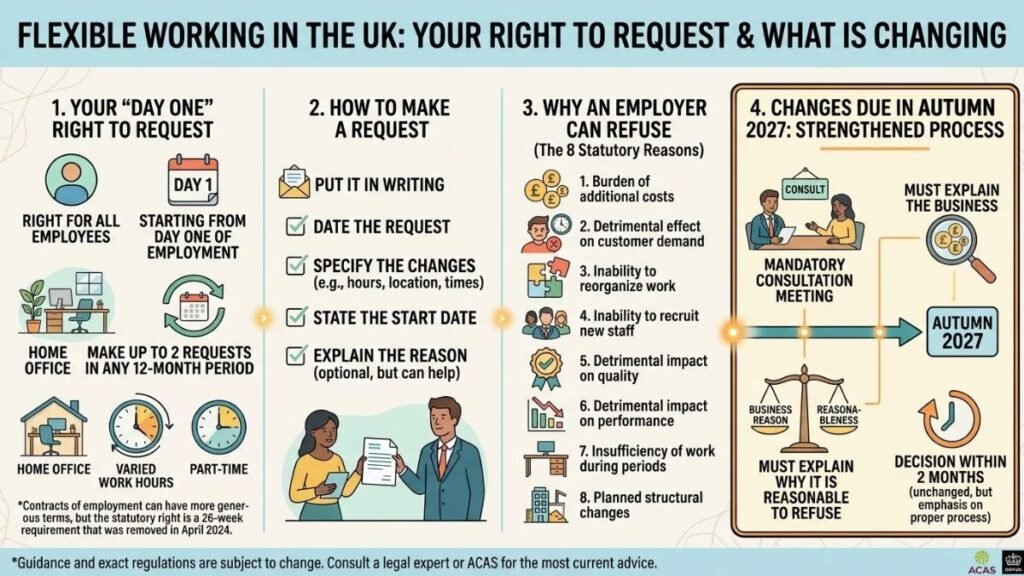
Since 6 April 2024, the rules are:
- A day-one right. You do not need any minimum length of service. Before April 2024 you needed 26 weeks’ continuous employment.
- Employees only. The statutory right applies to employees. Agency workers have a more limited right, and the genuinely self-employed are not covered. If you are unsure of your status, ask Acas.
- Two requests in any 12 months. You can only have one request in progress at a time.
- A decision within two months. Your employer must decide, including dealing with any appeal, within two months of receiving your request, unless you agree a longer period.
- No need to explain the effect on the business. You no longer have to say how your request might affect your employer, though it often helps to address it.
- A duty to consult. Your employer must discuss your request with you before refusing it, and consider alternatives.
- A right to be dealt with reasonably. Employers must follow the Acas Code of Practice on flexible working requests, which sets out how to handle them.
This is the law now. Employers should already have policies that reflect these rules.
How to make a statutory request: step by step
- Decide what you want. Be specific about the change: new hours, days, location or pattern, and when you want it to start.
- Think about the employer’s view. Consider how the work will still get done and how your team will cover. A practical plan makes it easier to say yes.
- Put it in writing. A statutory request must be in writing, dated and say that it is a statutory flexible working request. It should explain the change you want, the date you want it to start and whether you have made a previous request in the last 12 months. Many employers have a form, so ask HR or check the staff handbook.
- Send it and keep a copy. Email is fine. Keep a record of when you sent it.
- Attend the meeting. Your employer should invite you to discuss it, and you can usually bring a colleague or trade union representative. Be prepared to talk about alternatives, such as a trial period.
- Wait for the decision. The employer must give you the outcome within two months of receiving the request, and should confirm it in writing.
- If it is agreed, ask for your contract to be updated in writing, including pay, hours and holiday entitlement. A change is normally permanent, unless you agree it is temporary or a trial.
- If it is refused, ask for the reason in writing and see below.
Tips for a successful request
- Make a business case. Show how the new arrangement could work for your employer, for example by keeping customers served, or by working in the hours that suit the team.
- Be flexible. Offer a trial of three or six months, or be open to a compromise.
- Think about your colleagues and whether tasks can be shared.
- Choose your moment. Talk to your manager informally first if you feel comfortable, but follow up with a written statutory request so the legal timetable starts.
- Check the effect on pay. Part-time hours and term-time work mean lower pay, and may affect pension and holiday. See our guides to holiday entitlement and holiday pay and payslips, tax codes and National Insurance.
Why employers can refuse
Your employer can only refuse a statutory request for one or more of eight business reasons:
- The burden of additional costs
- A detrimental effect on the ability to meet customer demand
- An inability to reorganise work among existing staff
- An inability to recruit additional staff
- A detrimental impact on quality
- A detrimental impact on performance
- Insufficient work during the periods you propose to work
- Planned structural changes to the business
If your employer refuses, they should tell you which ground they are relying on and why. They must have consulted you first. Employers cannot refuse for other reasons, and they should not simply say “it is company policy”.
What if your request is refused?
- Ask for the reasons in writing, and check whether the employer followed the right process.
- Ask about alternatives. A different pattern, a trial period or a temporary arrangement might work.
- Check your employer’s appeal process. The law does not give a right to appeal a refusal, but many employers allow one and the Acas guidance encourages it.
- You can raise a grievance if you think the process was unfair.
- Contact Acas for free advice and early conciliation.
- Consider a tribunal claim in limited circumstances. You can claim if your employer failed to follow the procedure, refused for a reason that is not one of the eight, or based its decision on incorrect facts. A tribunal cannot normally order the employer to give you the arrangement you asked for, but may order it to reconsider and can award compensation. The time limit for most tribunal claims is six months for events on or after 1 October 2026, and you must go through Acas early conciliation first.
- Think about discrimination. If a refusal disadvantages you because of your sex, disability, age or another protected characteristic, you may have a separate claim. For example, refusing flexible hours for a disabled employee might breach the duty to make reasonable adjustments, or a refusal could be indirect sex discrimination for a parent. Take advice from Acas or the Equality Advisory and Support Service.
You can make another statutory request once your current one has been dealt with, up to two in a 12-month period.
What is changing in 2027?
The Employment Rights Act 2025 will strengthen the flexible working rules. The government has confirmed that the main changes will take effect in autumn 2027, after the regulations and the updated Acas code are finalised.
The new reasonableness test
At the moment, an employer can refuse if it fits one of the eight grounds. From 2027, employers will also have to show that refusing is reasonable in the circumstances. They will need to state which ground applies and explain why refusal is reasonable. If you think a refusal was not reasonable, you will be able to bring a claim.
A set process for refusals
New regulations will set out a process that employers must follow before they reject a request:
- A meeting with the employee to discuss the request, held within the two-month decision period
- Fair notice of the meeting and its purpose
- The outcome and decision confirmed in writing
The government has also said it will not introduce a statutory right to appeal as part of this process. The Acas Code of Practice will be updated to match.
What stays the same
The eight business grounds for refusal remain the same, as do the day-one right, the two requests a year and the two-month decision period.
The details may change as the regulations are drafted, so check GOV.UK and Acas for the latest. Our guide to the Employment Rights Act 2025 covers the other changes.
Related rights: other types of time off and flexibility
Flexible working is not the only option. Depending on your situation, you may also be entitled to:
- Carer’s leave. From April 2024, employees can take up to one week of unpaid carer’s leave a year to provide care for a dependant with a long-term care need, from their first day.
- Unpaid parental leave. Up to 18 weeks per child until the child turns 18, a day-one right since April 2026. See our guide to maternity, paternity and shared parental leave and pay.
- Time off for dependants. Reasonable unpaid time off to deal with an emergency involving someone who depends on you.
- Reasonable adjustments. If you have a disability or long-term health condition, your employer must consider adjustments, which can include changes to hours or location. This is separate from a flexible working request, and you can ask for both.
- Part-time workers’ rights. If you work part time, you are entitled to be treated no less favourably than comparable full-time colleagues, including pro rata pay, holiday and benefits.
- Right to return after family leave. If you want to return part time after maternity or other leave, you can make a flexible working request.
Flexible working and your pay, pension and benefits
Before asking, think through the effects:
- Pay. Fewer hours or days usually mean lower pay. Check how your salary will be calculated pro rata.
- Holiday. Your entitlement is calculated by your working pattern. See our guide to holiday entitlement and holiday pay.
- Pension. Contributions may fall if your earnings fall.
- Sick pay. Statutory Sick Pay is based on average earnings and qualifying days. See our guide to Statutory Sick Pay 2026.
- Benefits. Reduced income may affect eligibility for benefits such as Universal Credit.
- Your contract. Make sure any agreed change is recorded in writing. Our guide to understanding your employment contract explains what to look for.
Flexible working when you are looking for a job
The right to request flexibility starts on day one, so you do not have to wait. But it makes sense to check the position before you accept an offer.
- Look for flexible roles. Many adverts mention part-time, hybrid, remote, term-time or flexible hours. Browse our UK jobs board and read each advert carefully.
- Ask at the right time. Many people raise flexibility once they have an offer, when their bargaining position is strongest, rather than at the first interview. Employers should not discriminate against you for asking.
- Know what sectors offer. Some sectors have more flexibility, such as retail, hospitality and care, which often use part-time and shift work, and many office roles offer hybrid arrangements. See our guides to call centre jobs, teaching assistant jobs (often term-time only) and work from home jobs.
- Be careful with flexible but insecure work. Zero-hours and agency roles give flexibility but little security. Read our guide to zero-hours contracts for your rights, including the reforms expected in 2027.
- Prepare your answers. If you are asked why you want flexibility, explain how you will do the job well. Our guide to common interview questions and answers in the UK can help.
- Beware of scams. Be wary of any “flexible” job that promises high pay for little work or asks you to pay. Read our guide to how to spot a fake job advert in the UK.
Informal flexibility
You do not have to use the statutory process. Many employers will agree informally to occasional changes, such as leaving early for an appointment, swapping shifts or working from home one day. Informal arrangements are quicker, but are less secure and not legally binding unless recorded. If you want a lasting change, a statutory request gives you a clear process and legal protection.
Common questions and problems
My employer ignored my request. If your employer does not reply within two months, that can be treated as a refusal and you may have a claim. Chase in writing and contact Acas.
My employer says they only consider requests after a probation period. The statutory right applies from day one, whatever your probation. See our guide to notice periods in the UK if your role is not working out.
I have already made two requests this year. You cannot make another statutory request until 12 months have passed since the first, but you can still ask informally or ask for reasonable adjustments.
I was made redundant after asking for flexible working. It is unlawful to dismiss or treat you unfairly because you made a statutory request. Contact Acas. See our guide to redundancy rights in the UK.
Frequently asked questions
Do I have a right to work flexibly? You have a right to request it, from day one of your job. Your employer must consider the request properly, but can refuse for one of eight business reasons.
How many flexible working requests can I make? Two in any 12-month period, one at a time.
How long does my employer have to respond? Two months from receiving your request, including any appeal, unless you agree a longer time.
Do I have to explain how my request affects the business? No, since April 2024. But explaining how it can work often helps.
Can my employer refuse flexible working? Yes, but only on one of the eight statutory grounds and only after consulting you. From autumn 2027 they will also have to show the refusal is reasonable.
Do agency workers and the self-employed have the right to request? The statutory right is for employees. Agency workers have a more limited right, and the self-employed are not covered.
Is working from home a legal right? No. You can request it, but employers can refuse on business grounds, subject to the rules above.
Can I take my employer to a tribunal if they refuse? Only in limited cases, such as a failure to follow the procedure or a refusal based on a wrong reason or incorrect facts. Contact Acas first.
What changes in autumn 2027? A reasonableness test for refusals and a set process for consulting employees, including a meeting and written outcome.
Final thoughts
The right to request flexible working is yours from day one, and it is worth using if it would improve your working life. Put your request in writing, think about how it can work for your employer and be ready to compromise. When you are ready for your next role, browse the latest vacancies on our jobs board and ask about flexibility before you accept.
This article is general information, not legal advice. Flexible working rules are changing, and details of the 2027 reforms depend on regulations not yet published. Check GOV.UK and Acas for the latest guidance, and seek advice about your own situation.