Employment Rights Act 2025: What Job Seekers Need to Know
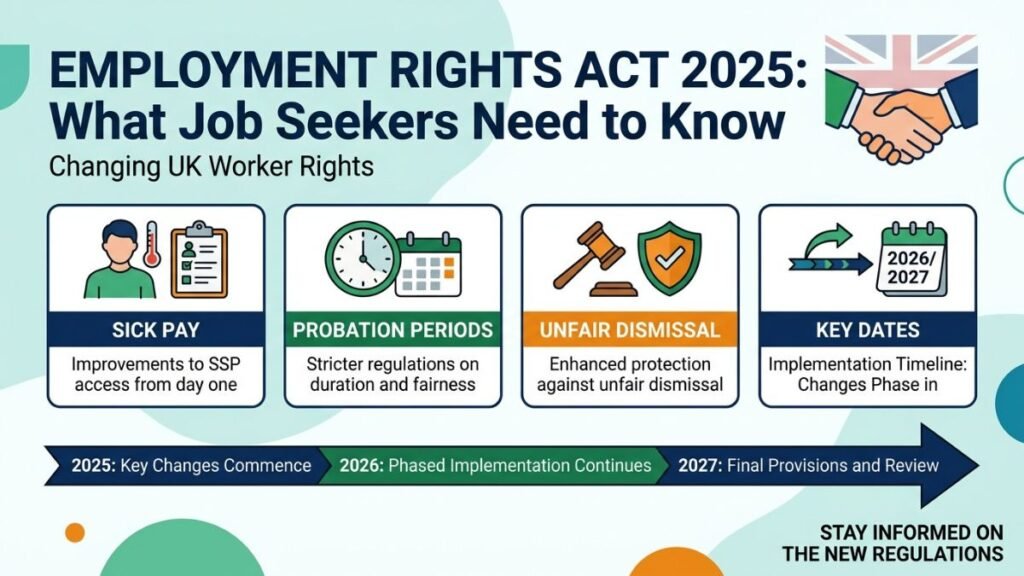
If you are looking for work in the UK right now, the rules about your rights at work are changing. The Employment Rights Act 2025 received Royal Assent on 18 December 2025 and is being switched on in stages through 2026 and 2027. Some changes are already in force, some start this month, and the biggest one for new starters arrives in January 2027.
This guide explains, in plain English, what has changed, what is coming next, and what it means when you apply for, accept and start a new job.
Quick answer: From January 2027 you are expected to need only six months in a job (instead of two years) before you can claim ordinary unfair dismissal, and the cap on compensation is due to be removed. Statutory Sick Pay, paternity leave and unpaid parental leave already apply from your first day.
What is the Employment Rights Act 2025?
The Act is a large package of reforms to UK employment law. It covers sick pay, family leave, dismissal, tribunal claims, harassment, trade union rights, zero-hours contracts and flexible working. Because it is being introduced in phases, different parts have different start dates, and the government has already adjusted some of them. This article reflects the timetable as of mid-October 2026. Always check GOV.UK for the latest dates.
The rules described here apply to employees and workers in England, Scotland and Wales. Northern Ireland has its own employment law system, so check Labour Relations Agency guidance if you work there.
Already in force: changes from April 2026
On 6 April 2026 several rights became available from day one of a job:
- Statutory Sick Pay (SSP) from the first day of sickness. The old three-day waiting period was removed, and the lower earnings limit was abolished, so more low-paid workers qualify. Check GOV.UK for the current weekly rate.
- Paternity leave and unpaid parental leave from day one. You no longer need to build up length of service before you can request them.
- Stronger enforcement. A new Fair Work Agency was launched to enforce workers’ rights, and the maximum protective award for failures to consult on collective redundancies was doubled from 90 to 180 days’ pay.
What this means for job seekers: you do not need to wait through a qualifying period to be paid sick pay or to ask for family leave. If a new employer tells you otherwise, ask them to check the current rules or contact Acas.
Changes now: October 2026
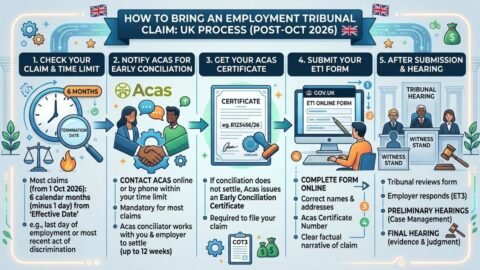
Longer time to bring a tribunal claim (from 1 October 2026)
The time limit for most employment tribunal claims, including unfair dismissal, discrimination and whistleblowing, has increased from three months to six months. It applies where the key date (for example, the date you were dismissed) falls on or after 1 October 2026. Breach of contract claims in Scotland follow a separate date of 9 November 2026.
You still need to go through Acas early conciliation first, so do not leave things to the last minute. Evidence is easier to gather while events are fresh.
Stronger protection from harassment (from 30 October 2026)
Employers must already take reasonable steps to prevent sexual harassment. From 30 October 2026 the standard rises to taking all reasonable steps. Employers also become liable for harassment of staff by third parties, such as customers, clients or contractors. This matters in customer-facing work like retail, hospitality, healthcare and transport.
The same date brings new trade union measures, including a duty on employers to tell workers about their right to join a union and a right for unions to access workplaces.
Tipping law (by the end of 2026)
Further reforms to tipping law have been pushed back and are now expected by the end of 2026. If you work in hospitality, keep an eye out for guidance.
The big one: unfair dismissal after six months (January 2027)
At the moment, most employees need two years of continuous service before they can bring an ordinary unfair dismissal claim. Under the Act, that qualifying period is due to fall to six months from January 2027. The government originally promised a true day-one right, but dropped that before the Act became law.
At the same time, the cap on unfair dismissal compensation is due to be removed. The current cap is the lower of one year’s pay or a fixed limit of around £118,000. Without a cap, awards for high earners could be much larger.
The exact start date within January 2027 had not been confirmed at the time of writing. Employment lawyers expect that anyone who started a job on or before 1 July 2026 and is still employed on 1 January 2027 will have the six-month protection from the start of the new regime. Anyone starting later will reach it once they pass six months of service.
What it means for you
- Probation periods become more important. Employers can still dismiss during probation, but they will need a fair reason and a fair process much sooner than before. Expect clearer targets and more documented reviews.
- Some protections never needed any service. You can already claim for discrimination, and for dismissal connected to things like whistleblowing, pregnancy or asserting a statutory right, from day one. Those routes are unchanged.
- Employee status matters. Unfair dismissal protection applies to employees, not to genuine self-employed contractors, and generally not to casual workers. Check your contract and your real working arrangement.
If you want to understand how probation works in practice, see our guide to probation periods and your rights as a new employee.
Fire and rehire: new limits from January 2027
“Fire and rehire” is when an employer dismisses staff and re-engages them on worse terms, such as lower pay or different hours. From January 2027, dismissing someone for refusing a defined set of contract changes is due to be treated as automatically unfair in most circumstances. For job seekers this means your agreed pay and core terms get stronger protection once you are in the job.
More changes expected during 2027
Further reforms are planned across 2027, with details still being settled through consultation. These include:
- Reform of zero-hours and low-hours contracts, with guaranteed-hours rights
- Improved flexible working rules
- Bereavement leave
- Changes to the trigger for collective redundancy consultation
- Limits on non-disclosure agreements in harassment and discrimination cases
- Greater regulation of umbrella companies
Dates may move, so treat anything listed for 2027 as provisional until it is confirmed.
Practical checklist for job seekers
- Read the contract before you sign. Check your start date, pay, hours, notice period and probation length. Our guide to understanding your employment contract explains the key terms.
- Keep a record of your start date. Length of service decides which rights you have, so keep your offer letter and first payslip.
- Ask about sick pay and family leave. Day-one SSP and day-one paternity and parental leave are now the legal baseline, though your employer may offer more.
- Note any promises made at interview. Written confirmation of pay, hours and location protects you if things change later.
- Save evidence if something goes wrong. Emails, messages, appraisal notes and dates all help if you later need to raise a grievance or contact Acas.
- Know where to get help. Acas offers free, impartial advice, and GOV.UK has the official guidance on every change in this article.
Frequently asked questions
Is unfair dismissal now a day-one right? No. The government dropped the day-one proposal before the Act became law. The qualifying period is due to fall from two years to six months from January 2027.
Do I get sick pay from my first day in a new job? Yes, if you meet the eligibility conditions. Since April 2026, Statutory Sick Pay is payable from the first day of sickness absence and the lower earnings limit no longer applies.
How long do I have to make an employment tribunal claim? For most claims where the key date is on or after 1 October 2026, you have six months, rather than three. Early conciliation with Acas is required first.
Do these changes cover agency workers and zero-hours staff? Some do and some do not, because rights depend on whether you are an employee or a worker. Zero-hours reforms are expected in 2027. Check your status with Acas if you are unsure.
Will my employer be allowed to dismiss me during probation? Yes, but once the six-month rule starts, a dismissal after six months of service will need to be fair, with a valid reason and a reasonable process.
Final thoughts
The Employment Rights Act 2025 shifts the balance towards earlier and stronger protection for people starting new jobs. Most of the headline changes are either already in force or due within months, so it is worth understanding them before your next interview or job offer.
Browse the latest UK job vacancies and keep an eye on our career advice section for updates as the remaining dates are confirmed.
This article is general information, not legal advice. Employment law is changing and individual circumstances differ. For advice on your situation, contact Acas, Citizens Advice or a qualified employment solicitor. Check GOV.UK for the latest implementation dates.