Disability and Work in the UK: Reasonable Adjustments, Access to Work and Disability Confident
If you have a disability or long-term health condition, you have legal protection at work and access to practical support. Employers must make reasonable adjustments, the government’s Access to Work scheme can pay for specialist help, and many employers have signed up to the Disability Confident scheme. But the rules are not always well explained, and many people do not know what to ask for. This guide explains who is protected, what reasonable adjustments are, how Access to Work works, what Disability Confident means, how to talk to an employer, and what to do if things go wrong.
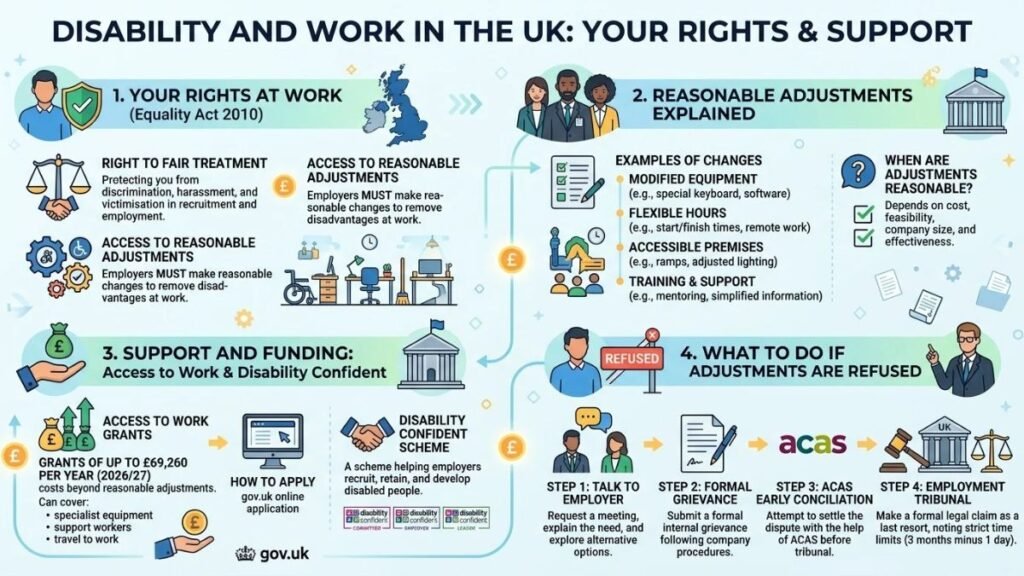
Quick answer: Under the Equality Act 2010, employers must make reasonable adjustments so that disabled job applicants and employees are not put at a substantial disadvantage, and they cannot charge you for them. Access to Work is a separate government grant of up to £69,260 a year that can fund support beyond what employers normally provide. You apply for Access to Work yourself, and it does not replace your employer’s duty.
Who is protected? What counts as a disability
Under the Equality Act 2010, you are disabled if you have a physical or mental impairment that has a substantial and long-term negative effect on your ability to do normal day-to-day activities.
- Substantial means more than minor or trivial.
- Long-term usually means it has lasted, or is likely to last, 12 months or more, or it is likely to recur or is progressive.
- Normal day-to-day activities include things like walking, reading, concentrating, using a computer, remembering, socialising and personal care.
- Medication and aids are ignored when deciding whether an effect is substantial. The question is what the effect would be without them.
- Some conditions are covered automatically, including cancer, multiple sclerosis and HIV infection, from diagnosis.
- You do not need a formal diagnosis or a medical label, though evidence can help.
This can include conditions that many people do not think of as disabilities, such as diabetes, epilepsy, long-term mental health conditions such as depression and anxiety, dyslexia, ADHD, autism, chronic fatigue, long Covid and chronic pain, if they meet the definition.
The protection applies to job applicants, employees, apprentices, many agency and contract workers, and casual and zero-hours staff. It does not depend on how long you have worked for the employer. Any worker can claim for disability discrimination from day one.
What is disability discrimination?
The Equality Act covers several types of unlawful treatment:
| Type | What it means | Example |
|---|---|---|
| Direct discrimination | Treating you worse because of your disability | Refusing to shortlist you because you use a wheelchair |
| Indirect discrimination | A rule that applies to everyone but puts disabled people at a disadvantage, without good reason | Requiring all staff to work a fixed late shift that someone with a medical condition cannot do |
| Discrimination arising from disability | Treating you unfavourably because of something that results from your disability, such as sickness absence, without a good reason | Disciplining you for absence caused by your condition |
| Failure to make reasonable adjustments | Not making changes that would remove a substantial disadvantage | Refusing a screen reader for a blind employee |
| Harassment | Unwanted conduct related to disability that violates your dignity or creates a hostile environment | Mocking comments about a condition |
| Victimisation | Treating you badly because you complained or supported someone who did | Dismissing someone for raising a discrimination complaint |
These protections apply at every stage: recruitment, pay and benefits, training, promotion, conditions, discipline and dismissal.
Reasonable adjustments
What the duty is
Employers must take reasonable steps to remove or reduce the substantial disadvantage a disabled person faces because of:
- A provision, criterion or practice (such as working hours, tests or procedures)
- A physical feature of the workplace (such as steps or lighting)
- A lack of an auxiliary aid or service (such as specialist software, equipment or a support worker)
The duty applies to job applicants as well as employees. An employer must make reasonable adjustments if it knows, or could reasonably be expected to know, that you are disabled and likely to be at a disadvantage. You are not legally required to tell an employer about your disability, but if you do not, the employer may not be able to help.
You cannot be charged for reasonable adjustments. The employer pays.
What counts as “reasonable”?
There is no fixed list. A tribunal looks at factors such as:
- How effective the adjustment would be in removing the disadvantage
- How practical it is to make
- The cost, and the employer’s financial and other resources (a large employer is expected to do more than a small one)
- The availability of outside help, such as Access to Work funding
- The disruption to the employer’s activities
- The health and safety implications
An employer that refuses an adjustment should be able to explain why it is not reasonable.
Examples of reasonable adjustments
| Area | Examples |
|---|---|
| Hours and flexibility | Flexible or reduced hours, later start times, extra breaks, a phased return after illness, time off for medical appointments |
| Location | Working from home or hybrid working, a parking space, a quiet space, a ground-floor desk |
| Equipment and software | Screen readers, voice recognition, a specialist keyboard, a sit-stand desk, noise-cancelling headphones, a different chair |
| Duties | Reassigning minor tasks, adjusting targets, changing how work is done, providing a job coach or mentor |
| Communication | Written instructions, an interpreter, extra time on tests, accessible formats, a clear structure for meetings |
| Recruitment | A different interview format or extra time, receiving questions in advance, a trial instead of an interview, accessible application forms |
| Redeployment | Moving you to a suitable alternative role if you cannot do your current one |
See our guide to flexible working in the UK for the separate statutory right to request flexible working, which any employee can use from day one. You can ask for a reasonable adjustment and make a flexible working request at the same time, and the rules are different.
Disability and recruitment
- Adjustments for applicants. If you need changes to the application, test or interview, tell the employer and ask. Examples include extra time, a different format, a quiet room, an interpreter or being given the questions in advance.
- Questions about health. Before offering you a job, employers are generally not allowed to ask about your health or disability, with limited exceptions, such as asking whether you need adjustments for the selection process, or monitoring equal opportunities. Once you have an offer, they can ask health questions, but cannot withdraw the offer simply because of your disability without considering reasonable adjustments.
- Positive action. Employers are allowed to take positive action to support disabled applicants, for example by encouraging applications or offering guaranteed interviews, in certain circumstances.
- Interview support. Access to Work can provide support for job interviews (see below).
For interview preparation, see our guides to common interview questions and answers in the UK, writing a UK CV with no experience and writing a cover letter in the UK.
Access to Work
Access to Work is a government grant scheme run by the Department for Work and Pensions (DWP) that gives practical and financial support to disabled people who are in work, starting work or going to a job interview. It does not need to be repaid, and it is not means-tested or a benefit.
What it can pay for
Support can include:
- Specialist equipment or software, and adaptations
- Support workers, such as a job coach, a note-taker, a reader or an interpreter
- Travel to work costs if you cannot use public transport because of your disability
- Communication support at interviews, for example a British Sign Language interpreter
- Mental health support services, including a confidential support service for people with mental health conditions
- Help to start or keep work, including for apprentices and self-employed people, if you meet the eligibility rules
What it cannot pay for
- Reasonable adjustments your employer must make under the Equality Act. Employers cannot use Access to Work to avoid their own duties.
- Standard equipment and business costs that anyone doing the job would need
- Support put in place before you applied
Who can apply?
You can apply if you:
- Have a physical or mental health condition or disability that affects your ability to do your job or get to work (you do not need a formal diagnosis)
- Are 16 or over, and live and work in England, Scotland or Wales (Northern Ireland has a separate scheme)
- Are in paid work, self-employed, an apprentice, about to start work, or going to a job interview, or on certain work trials
The government’s guidance gives the minimum self-employed earnings as the Lower Earnings Limit, which is £559 a month (£6,708 a year) for 2026/27. Civil servants and people in voluntary work are generally not eligible, though other support may be available.
How much can you get?
There is no fixed amount. Each award depends on your needs. The maximum grant is £69,260 per person per year, a cap that has stayed the same from 2024/25 to 2026/27. Most awards are much smaller.
The employer’s contribution depends on how long you have been in the job and the size of your employer:
| Situation | Who pays |
|---|---|
| You apply within the first six weeks of starting a job | Access to Work can usually fund the approved costs in full, up to the cap |
| You have been in the job more than six weeks | Your employer may have to contribute towards some costs. For example, small employers (under 50 staff) may pay 20% of approved costs up to £10,000, employers with 50 to 249 staff the first £500 plus 20% up to £10,000, and large employers (250 or more) the first £1,000 plus 20% up to £10,000. Access to Work normally pays all further approved costs above £10,000, subject to the cap |
These details are from published guidance and can change, so check GOV.UK.
How to apply
- Check you are eligible, using the GOV.UK guidance.
- Apply yourself. Your employer cannot apply for you, but you can ask them to help with details.
- Apply online or by phone. Use the official GOV.UK Access to Work page, and be careful of other sites that charge for help. The application is free.
- Give details of your condition, your job and the support you think you need, plus the name of a workplace contact who can authorise payments.
- Wait for an assessment. Access to Work may contact you or your employer to discuss your needs, and you will receive a decision letter that states the support and amount.
- Claim the costs. Costs are usually paid by reimbursing you or your employer, so check how it works for your award.
Apply as early as you can. Applying within 12 weeks before a new job starts, or in the first six weeks, can improve the funding position. Reports in 2026 show that demand has been high and there have been backlogs and delays in processing, so apply promptly and keep records. Check GOV.UK for current waiting times.
Disability Confident
Disability Confident is a voluntary government scheme that encourages employers to recruit, retain and develop disabled people. Employers can sign up and progress through three levels:
| Level | Name |
|---|---|
| Level 1 | Disability Confident Committed |
| Level 2 | Disability Confident Employer |
| Level 3 | Disability Confident Leader |
What it can mean for you:
- Guaranteed interview scheme. Many Disability Confident employers will offer an interview to disabled applicants who meet the minimum criteria for the job. You may need to say in your application that you want to use the scheme, and the job adverts usually explain how. The scheme is about getting an interview. It does not guarantee a job.
- Signals of commitment. A Disability Confident logo suggests the employer has made commitments, but it is a self-assessed scheme at the lower levels, and it is not a guarantee of good practice. You can still check how the employer treats disabled staff, by asking about adjustments and flexibility.
- Not the same as the law. Employers must follow the Equality Act whether or not they are in the scheme.
You can look for Disability Confident employers on GOV.UK, and browse current vacancies on our UK jobs board. Check each advert for guaranteed interview wording.
Talking to your employer: should you disclose?
You do not have to tell an employer about your disability, and many people choose carefully when and how to do so. Reasons to tell them include getting adjustments, being protected from certain kinds of unfair treatment (the employer generally needs to know, or reasonably be able to know, about your disability) and getting Access to Work support. Reasons for caution include worries about bias or privacy. You decide.
If you do disclose:
- Choose the right person. HR, your line manager or occupational health, depending on your workplace.
- Focus on what helps you do your job. Describe the effect on your work and the adjustments that would help, not just the diagnosis.
- Put your request in writing so there is a record. You can follow up a conversation with an email.
- Ask for a meeting to discuss options, and be open to alternatives or a trial.
- Keep records of what you asked, what was agreed and any delays.
Example wording
“I have [condition], which affects [how it affects your work]. I’d like to discuss some adjustments that would help me do my job effectively, such as [adjustment]. Could we arrange a time to talk? I can provide a letter from my doctor if that would help.”
What employers should do
A good employer will:
- Listen and take your request seriously
- Discuss options with you, and consider alternatives
- Make the agreed changes promptly
- Review them regularly, because needs can change
- Keep your information confidential
- Not treat you less favourably for asking
Sickness, fit notes and returning to work
- Sick pay. Statutory Sick Pay is payable from the first day for eligible employees since April 2026. See our guide to Statutory Sick Pay 2026.
- Fit notes. After seven days of sickness you generally need a fit note from a doctor or other healthcare professional. A fit note can suggest adjustments such as a phased return or amended duties.
- Phased returns and adjustments. A phased return, reduced hours or changed duties can be a reasonable adjustment.
- Absence and disability. Treating you badly because of absence connected to your disability can be discrimination arising from disability. Employers should consider whether disability-related absences should be treated differently under their policies.
- Long-term sickness and dismissal. Employers can sometimes dismiss for long-term ill health, but must follow a fair process, consider adjustments and medical advice, and avoid discrimination. See our guide to unfair dismissal in the UK, noting that discrimination claims need no minimum service.
Pay, benefits and money matters
- Minimum wage. You are entitled to at least the minimum wage for your age, and disability is no reason to pay less. See our National Minimum Wage 2026 guide.
- Benefits while working. Many disabled people receive benefits such as Personal Independence Payment, which is not usually affected by working, or Universal Credit with a health-related element. The rules are detailed and have been subject to review and reform, so check GOV.UK, Citizens Advice or a benefits adviser before you change your hours.
- Working part time. Part-time and flexible roles can help some people manage health conditions. See our guides to admin and office jobs and work from home jobs.
- Self-employment. Access to Work can help self-employed people. See our guide to how to become self-employed in the UK.
- Apprenticeships. Apprentices can get Access to Work support and adjustments, and there are routes into work with support. See our guide to apprenticeships in the UK.
What if your employer refuses or discriminates?
- Keep records. Save emails, letters, notes of meetings, medical evidence and the dates of events.
- Raise it informally with your manager or HR, and explain why the adjustment would help.
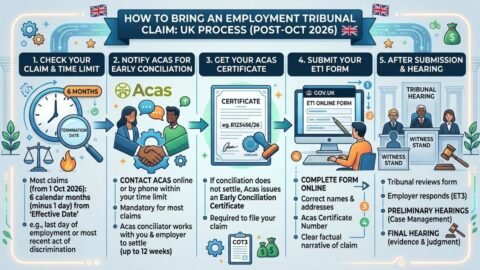
- Raise a formal grievance if informal efforts fail. Use your employer’s grievance procedure and follow the Acas Code of Practice. Our guide to disciplinary and grievance procedures in the UK explains how.
- Contact Acas for free advice and early conciliation. Early conciliation is required before you can bring a tribunal claim.
- Get specialist help. The Equality Advisory and Support Service, Citizens Advice, a trade union, Disability Rights UK, Scope or a solicitor can advise.
- Think about a tribunal claim. You can claim disability discrimination to an employment tribunal. The time limit for most claims is six months less one day for events on or after 1 October 2026, and you must go through Acas early conciliation first. Discrimination compensation can include an award for injury to feelings and is not subject to the cap on ordinary unfair dismissal awards.
- Look after yourself. Discrimination can affect your health and finances. Talk to friends, family or support groups, and consider mental health support.
Employers’ duties and your protection from retaliation
It is unlawful to treat you badly for asking for adjustments, raising a concern or supporting someone else’s complaint. Under the Employment Rights Act 2025, employers’ responsibilities for preventing harassment are also being strengthened from 30 October 2026, including harassment by third parties such as customers. See our guide to the Employment Rights Act 2025.
Looking for work: practical tips
- Search for inclusive employers. Look for Disability Confident employers, flexible working options and clear adjustment policies on their careers pages.
- Ask about adjustments early, for the application and interview. You can ask before you disclose your full circumstances.
- Think about what helps you. Make a short list of the adjustments that would help you do your job well.
- Get support. Jobcentre Plus has Disability Employment Advisers, and charities offer job coaching and employment support.
- Try different routes. Apprenticeships, volunteering, work trials, supported employment and self-employment can all lead to work.
- Be cautious of scams. Some fake job adverts target disabled people with promises of easy home-based work or ask for fees. See our guide to how to spot a fake job advert in the UK. Access to Work is free to apply for, and no one should charge you to apply.
Frequently asked questions
What counts as a disability under the Equality Act? A physical or mental impairment that has a substantial and long-term effect on your ability to do normal day-to-day activities. Long-term usually means 12 months or more. Some conditions, such as cancer, MS and HIV, are covered from diagnosis.
Do I have to tell my employer about my disability? No. But employers can only be expected to make adjustments if they know, or could reasonably be expected to know, about your disability.
Who pays for reasonable adjustments? The employer. They cannot charge you. Access to Work can fund extra support but not the adjustments an employer must make.
What is Access to Work? A government grant scheme that pays for practical support for disabled people in work or starting work, up to £69,260 a year. You apply yourself.
Can my employer apply for Access to Work for me? No. You have to apply yourself, though your employer can help with the details.
What is Disability Confident? A voluntary government scheme with three levels. Many employers in the scheme offer a guaranteed interview to disabled applicants who meet the minimum job criteria.
Can an employer ask about my health in an interview? Generally not before a job offer, except in limited circumstances, such as asking about adjustments for the interview.
Can I be dismissed because of sickness absence from my disability? It can be discrimination if you are treated badly because of something arising from your disability, unless the employer can justify it. Get advice from Acas.
How long do I have to bring a tribunal claim? Six months less one day for events on or after 1 October 2026, after contacting Acas.
Does Access to Work cover Northern Ireland? No. Northern Ireland has a separate scheme, so check nidirect.
Final thoughts
Your rights at work do not depend on how long you have been in a job, and support is available if you ask for it. Know what you need, put requests in writing, apply for Access to Work early and get advice if you meet resistance. When you are ready to look for your next role, browse the latest vacancies on our jobs board and look for employers who welcome disabled applicants.
This article is general information, not legal advice. Disability and employment law is complex, and support schemes change. Check GOV.UK, Acas and the Equality Advisory and Support Service for the latest guidance, and seek advice about your own situation.