Zero-Hours Contracts Explained: Your Rights in 2026 and 2027
Zero-hours contracts are common in retail, hospitality, care, cleaning, warehousing and gig work, and they suit some people well. But the lack of guaranteed hours causes real problems: unpredictable income, shifts cancelled at the last minute and difficulty planning childcare, rent or benefits. The Employment Rights Act 2025 is changing the rules, though most of the big changes for zero-hours workers have not started yet. This guide explains what a zero-hours contract is, the rights you have today, and what is expected in 2027.
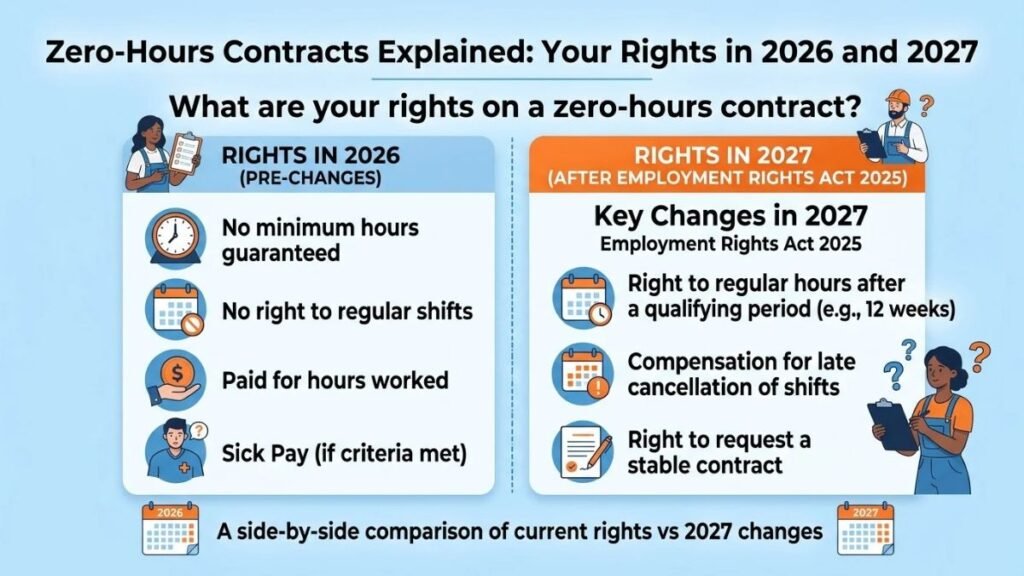
Quick answer: On a zero-hours contract the employer does not have to offer you any hours and you do not have to accept them. You already have rights to the minimum wage, paid holiday and sick pay. The new rights to guaranteed hours, reasonable notice of shifts and payment for cancelled shifts are expected in 2027, but the exact date has not been confirmed.
What is a zero-hours contract?
A zero-hours contract is an arrangement where your employer does not guarantee you any minimum number of working hours, and you are only paid for the hours you actually work. You are usually “on call”, and the employer offers shifts when they need you. Many zero-hours contracts are used for casual, seasonal or fluctuating work.
The key features are:
- No guaranteed hours. Your hours may be high one week and nil the next.
- Paid only for hours worked, not for being available.
- You may not have to accept a shift, unless your contract says otherwise, although refusing too often can mean you are offered fewer shifts.
- Your status varies. Some zero-hours staff are “workers”, some are “employees”. This affects which rights you have (see below).
Zero-hours work is widespread. One summary of Office for National Statistics data puts the figure at roughly 1.2 million people in the UK on zero-hours contracts in their main job, though estimates vary by period and source.
Pros and cons
Possible advantages
- Flexibility to fit work around study, caring or another job
- Easy to start, with little experience needed
- Useful for seasonal or short-term work, such as Christmas
Possible disadvantages
- Unpredictable pay, which makes budgeting and renting harder
- Last-minute cancellation of shifts, sometimes after you have paid for travel or childcare
- Limited access to mortgages, loans and some benefits
- Less job security and fewer employer benefits in some cases
Your rights on a zero-hours contract today
Zero-hours does not mean zero rights. These apply now.
1. Minimum wage
You must be paid at least the National Minimum Wage or National Living Wage for the hours you work. From April 2026 that is £12.71 an hour for workers aged 21 and over, £10.85 for ages 18 to 20 and £8.00 for under-18s and apprentices. Time you are required to spend at work, such as waiting or a briefing, can count as working time. See our National Minimum Wage 2026 guide.
2. Paid holiday
Workers on zero-hours contracts build up paid annual leave, including part-year and irregular hours workers. For irregular hours, holiday is usually worked out as a percentage of the hours you work, and many employers pay it with your wages (“rolled-up holiday pay”) or when you take leave. Check your payslip shows holiday pay clearly.
3. Statutory Sick Pay from day one
Since April 2026, Statutory Sick Pay is payable from the first day of sickness, and the lower earnings limit no longer applies, so more zero-hours workers qualify. Check GOV.UK for the current rate and the rules on qualifying. See our guide to the Employment Rights Act 2025.
4. No exclusivity clauses
Employers cannot stop you working for someone else by including an “exclusivity clause” in a zero-hours contract. That rule has applied since 2015, and any term that tries to prevent you working elsewhere without the employer’s permission is unenforceable.
5. A written statement of terms
From your first day, you should receive a written statement of the main terms of your job, including pay, hours (or how they work), place of work and notice. Read it before you sign, and see our guide to understanding your employment contract.
6. Payslips, rest breaks and protection from discrimination
You are entitled to payslips, rest breaks, and protection from discrimination and unlawful deductions from wages from day one.
7. Protection from unfair treatment
You are protected against being punished for exercising certain rights, such as raising a health and safety concern, asking about minimum wage or whistleblowing.
Worker or employee: why it matters
Most zero-hours staff are either workers or employees. The difference decides which rights you have.
| Right | Worker | Employee |
|---|---|---|
| Minimum wage | Yes | Yes |
| Paid holiday | Yes | Yes |
| Rest breaks | Yes | Yes |
| Statutory sick pay | Yes, if you qualify | Yes, if you qualify |
| Notice of dismissal | Limited | Statutory notice after one month |
| Unfair dismissal protection | No | Yes, after the qualifying period |
| Redundancy pay | No | Yes, after two years’ service |
Your status depends on the real working relationship, not just the label in the contract. Factors include whether you are obliged to accept shifts, whether you can send someone in your place, and how much control the employer has over you. If you are unsure of your status, contact Acas. Our guide to notice periods in the UK explains notice rules for employees.
What is changing in 2027?
The Employment Rights Act 2025 became law on 18 December 2025. It includes new rights for workers on zero-hours and low-hours contracts, including agency workers. These rights are not yet in force, and the details will be set out in regulations. Sources currently expect them to take effect in 2027, with the exact date still to be confirmed.
1. A right to guaranteed hours
Employers will have to offer a guaranteed hours contract to qualifying workers whose hours regularly exceed what they are guaranteed, reflecting the hours they have actually worked over a reference period. The government’s preferred initial reference period is 12 weeks, but the final figure will be confirmed in regulations. In practice, if you have worked regular hours for about three months, your employer will need to offer you a contract that guarantees something close to those hours. Workers will be able to choose whether to accept the offer.
2. Reasonable notice of shifts
Employers will have to give workers reasonable notice of their shifts, including the date, the start and end times and the number of hours. Workers who decline a shift because they were not given reasonable notice will be protected. The government is consulting on what “reasonable” notice means, and some guides refer to a minimum notice period, but this is not yet confirmed.
3. Payment for cancelled, moved or cut-short shifts
If your employer cancels a shift, moves it or cuts it short at short notice, you will be entitled to payment. How much you receive will depend on how late the change was made, and the final rules are still to be set.
4. Agency workers are included
The new rights are extended to qualifying agency workers, which matters in warehousing, logistics and care. Details of who is responsible, the agency or the end user, will be set out in regulations.
What the Act does not do
Despite early promises to ban “exploitative” zero-hours contracts, the Act does not ban zero-hours contracts altogether. Employers can still use them where appropriate, and workers can still choose flexible arrangements. The changes are about fairness and predictability.
What about the date? A timeline
| Date | Change |
|---|---|
| 2015 | Exclusivity clauses in zero-hours contracts banned |
| 18 December 2025 | Employment Rights Act 2025 receives Royal Assent |
| 6 April 2026 | Day-one Statutory Sick Pay, with the lower earnings limit removed, and day-one paternity and unpaid parental leave |
| 1 October 2026 | Time limit for most employment tribunal claims extended from three to six months |
| January 2027 | Unfair dismissal qualifying period due to fall from two years to six months |
| 2027 (date to be confirmed) | Guaranteed hours offers, reasonable notice of shifts and payments for cancelled shifts for zero-hours and low-hours workers |
Some older guides online say the shift notice and cancellation rules start in October 2026. More recent sources place all of the main zero-hours reforms in 2027, so treat any earlier date with caution and check GOV.UK for the latest position.
What you can do now
While you wait for the new rules, you can protect yourself:
- Keep a record of your hours. Note the dates, start and end times and any cancelled shifts. When the 12-week reference period starts, a clear record will help you show how regularly you work.
- Keep your payslips and rotas, and any messages about shift changes.
- Check your pay against the legal minimum, and check your holiday pay is included.
- Read your contract for clauses about availability, notice of shifts and what happens if you decline a shift.
- Ask for guaranteed hours now. Many employers will agree if you work regular hours, and you do not need to wait for the law.
- Know your status. Ask Acas if you are unsure whether you are a worker or an employee.
- Plan for variable income. If you claim Universal Credit or other benefits, report changes in your earnings promptly, because irregular pay affects payments.
- Get advice early if you are being treated unfairly. The tribunal time limit for most claims is now six months for events from 1 October 2026, but you must contact Acas first for early conciliation.
Zero-hours contracts in popular sectors
Zero-hours work is common in many entry-level jobs. Check the details before you accept:
- Retail and supermarkets: many roles offer contracted hours, but seasonal and flexible contracts exist. See our guides to supermarket jobs and Christmas jobs in the UK.
- Warehousing and logistics: agency and flexible shifts are common. See our guide to warehouse jobs in the UK.
- Cleaning and hospitality: hours often vary with demand. See our guide to cleaning jobs in the UK.
- Care and health: bank and agency work often involves flexible shifts.
- Gig and delivery work: often self-employed, so different rules apply.
When you apply, ask directly: “Are the hours guaranteed, and if not, how many hours do people usually get?” You can browse current vacancies on our UK jobs board, and check each advert for the hours offered.
Warning signs in zero-hours jobs
- A contract that says hours are “guaranteed” but allows the employer to cancel without pay
- Pressure to accept every shift or be penalised
- Unpaid training, trial shifts or waiting time
- Pay below the minimum wage once unpaid time is included
- Clauses preventing you from working elsewhere, which are unenforceable but still sometimes used
- No payslips, or being paid in cash with no record
- Requests for fees from an agency to register or find work, which is not allowed
Read our guide to how to spot a fake job advert in the UK if you are unsure whether a job is genuine.
Frequently asked questions
Are zero-hours contracts legal in the UK? Yes. The Employment Rights Act 2025 does not ban them, but it will add new rights for workers who work regular hours.
Do zero-hours workers get holiday pay? Yes. They build up paid holiday based on the hours they work.
Do I get sick pay on a zero-hours contract? Possibly. Statutory Sick Pay is payable from day one since April 2026 for those who qualify. Check GOV.UK for the rules and the current rate.
Can my employer cancel my shift at the last minute? Currently there is often no right to compensation unless your contract provides it. Under the 2027 changes, qualifying workers will be entitled to payment for short-notice cancellations.
Can I work for someone else on a zero-hours contract? Yes. Exclusivity clauses in zero-hours contracts are unenforceable.
When will I get a right to guaranteed hours? The right is expected in 2027, and the date has not been confirmed. The government has indicated a 12-week reference period.
Do the new rules apply to agency workers? Yes. Qualifying agency workers are included, though the detailed rules are still to be published.
Can I refuse a shift on a zero-hours contract? Often yes, unless your contract obliges you to accept. Check the wording, and be aware that regularly refusing shifts may reduce the work offered.
Final thoughts
Zero-hours contracts can offer flexibility, but you should know your rights, keep good records and ask for guaranteed hours if you work regularly. The new rules due in 2027 will give workers more predictability, but until they start, you need to protect yourself with the rights you already have. Browse the latest vacancies on our jobs board and ask about hours before you accept.
This article is general information, not legal advice. The zero-hours reforms depend on regulations that have not yet been finalised, so dates and details may change. Check GOV.UK and Acas for the latest guidance, and seek advice about your own situation.