Redundancy Rights in the UK: Pay, Notice and Consultation
Being told your job is at risk of redundancy is stressful, and it is easy to feel you have no control. In fact, UK law gives you several rights: to be consulted, to be given notice, to a fair selection process, to redundancy pay if you qualify, and to time off to look for another job. This guide explains how redundancy works, how much statutory redundancy pay you can get in 2026/27, what notice and consultation you are entitled to, and what to do next.
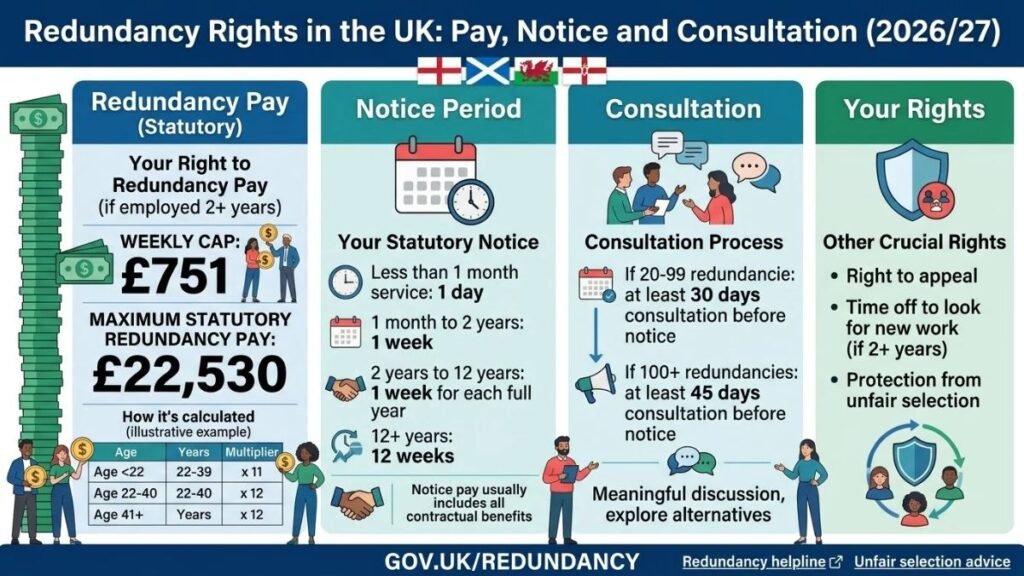
Quick answer: If you have worked for your employer for at least two years, you are normally entitled to statutory redundancy pay. From 6 April 2026 your weekly pay is capped at £751 for the calculation, so the maximum payment is £22,530. You are also entitled to notice, a fair process and reasonable time off to look for work.
What is redundancy?
Redundancy is a type of dismissal. It happens when your job disappears, usually because:
- The business closes, or your employer stops trading
- Your workplace closes, or your employer moves it, so your job no longer exists where you work
- The employer needs fewer employees to do work of a particular kind, for example because of reduced demand, a restructure or new technology
A genuine redundancy is about the job, not the person. If your employer says it is redundancy but replaces you with someone else doing the same job, or the real reason is your performance or conduct, it may not be a genuine redundancy, and it could be unfair dismissal.
Redundancy law covers employees. Casual workers, agency workers and the self-employed generally do not have the same statutory redundancy rights. If you are unsure of your status, ask Acas. Our guide to zero-hours contracts explains the difference between workers and employees.
Who gets statutory redundancy pay?
You are normally entitled to statutory redundancy pay if:
- You are an employee
- You have at least two years’ continuous service with your employer on the date your employment ends
- You are being dismissed because of redundancy
If you have less than two years’ service, you will not usually get statutory redundancy pay, though your contract or your employer’s policy might give you more. Some other rights, such as notice and a fair process, can still apply.
The two-year rule for redundancy pay is separate from the unfair dismissal qualifying period, which is due to fall to six months from January 2027. See our guide to the Employment Rights Act 2025 for the changes.
How much is statutory redundancy pay in 2026/27?
Your statutory redundancy pay depends on your age, your length of service (up to a maximum of 20 years) and your weekly pay, which is capped.
The formula
For each full year of service:
| Your age during that year of service | Pay for each year |
|---|---|
| Under 22 | Half a week’s pay |
| 22 to 40 | One week’s pay |
| 41 and over | One and a half weeks’ pay |
The 2026/27 cap
- The weekly pay used in the calculation is capped at £751 (from 6 April 2026, up from £719) for dismissals in Great Britain.
- The maximum statutory payment is therefore £22,530 (20 years x 1.5 weeks x £751).
- Northern Ireland has its own, higher weekly cap, reported as £783, giving a maximum of £23,490.
- The cap that applies depends on the date your employment ends or your notice ends, so a termination on or after 6 April 2026 uses £751.
A simple example
Someone aged 30 who has worked for six years and earns £450 a week gross would normally get six weeks’ pay: 6 x £450 = £2,700. Someone who earns £1,000 a week would still be limited to £751 a week in the calculation, so six years’ service would give 6 x £751 = £4,506.
Your “week’s pay” is usually an average over the 12 weeks before notice is given, and the rules for variable pay and overtime can be complicated. Use the official GOV.UK redundancy pay calculator to check your figure.
Tax on redundancy pay
Statutory redundancy pay is generally paid tax free, and in most cases the first £30,000 of a total termination package, including statutory and contractual redundancy pay, is tax free. Payments for notice that is not worked (pay in lieu of notice) and other contractual payments are treated differently and may be taxed. Ask your employer for a breakdown and consider getting tax advice if the amount is large.
Contractual or enhanced redundancy pay
Some employers, including many large employers and public sector organisations, pay more than the statutory minimum under your contract, a staff handbook or a collective agreement. Check your contract and any policy documents. Our guide to understanding your employment contract explains where to look.
Notice when you are made redundant
You are entitled to either your contractual notice or the statutory minimum, whichever is longer. The statutory minimum is one week for each full year of service up to 12 weeks, once you have worked for at least one month. Employers sometimes pay you instead of making you work your notice (pay in lieu of notice) if your contract allows it.
Read our full guide to notice periods in the UK to see how notice works, including garden leave and pay in lieu.
Consultation: what your employer must do
Employers should consult you before making redundancies. What this means depends on how many jobs are at risk.
Individual consultation
Even if only one person is being made redundant, a fair employer will consult you before making a decision. Consultation should include:
- Explaining why the redundancy is proposed
- Sharing how people are selected and what criteria will be used
- Listening to your views and any ideas to avoid redundancy
- Looking at alternative jobs
- Giving you time to respond
There is no fixed minimum period for individual consultation, but a rushed or one-meeting process can make a dismissal unfair.
Collective consultation
If an employer proposes to make 20 or more redundancies at one establishment within 90 days, collective consultation rules apply:
| Number of proposed redundancies | Minimum consultation before the first dismissal |
|---|---|
| 20 to 99 | 30 days |
| 100 or more | 45 days |
The employer must consult elected employee representatives or a recognised trade union and must notify the government using form HR1. If the employer fails to follow the collective consultation rules, a tribunal can award a protective award.
From 6 April 2026 the Employment Rights Act 2025 doubled the maximum protective award from 90 to 180 days’ pay for each affected employee. The government has also said it plans to change the thresholds that trigger collective consultation, but you should check GOV.UK for any change that is in force.
Fair selection
When an employer has to reduce the number of employees in a group, it must choose fairly. A fair selection process normally:
- Uses objective criteria, such as skills, qualifications, experience, performance records or attendance (with care, particularly where absence is linked to disability or pregnancy)
- Scores everyone in the pool consistently, and lets you see and challenge your score
- Defines a sensible “pool” of people at risk
- Avoids discrimination based on age, sex, race, disability, religion, pregnancy or other protected characteristics
Selecting someone because they have asserted a legal right, for example by raising a health and safety concern, joining a union, or being on or returning from family leave, can be automatically unfair.
Extra protection for pregnancy and family leave
If you are pregnant, on maternity, adoption or shared parental leave, or have recently returned from such leave, you have extra protection. Your employer must offer you any suitable alternative vacancy before other employees. The protection now covers pregnancy and a period after you return from leave, so check the current rules on GOV.UK or with Acas.
Alternative jobs and trial periods
Your employer should look for suitable alternative work within the business. If they offer you another job:
- You have a right to a four-week trial period to see if it suits you, which can be longer if you need retraining.
- If you reasonably decide the job is not suitable, you can usually still claim redundancy pay.
- If you unreasonably refuse a suitable alternative, you could lose your statutory redundancy pay.
The job is more likely to be “suitable” if the pay, status, hours, location and skills required are similar. Take advice before turning down an offer.
Time off to look for work
If you have at least two years’ service and have been given notice of redundancy, you are entitled to reasonable paid time off during working hours to look for new work or arrange training. The employer does not have to pay more than 40% of a week’s pay in total for this time off. Ask your manager in writing, and keep a record of when you use it.
Voluntary redundancy and settlement agreements
Sometimes employers ask for volunteers. Before you agree:
- Ask for the full terms in writing, including the payment, tax treatment, notice and any pension effects
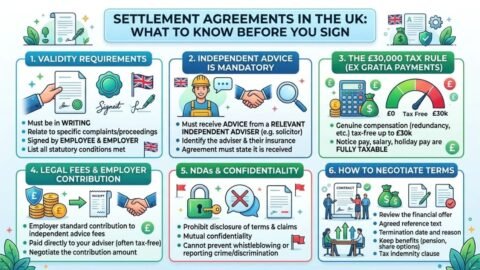
- Do not sign a settlement agreement without advice. By law, you must receive independent advice on its terms for it to be valid, and employers often pay towards the cost
- Check whether your contract has any restrictions, such as non-compete clauses
- Consider how the money would affect benefits such as Universal Credit
What if you think the redundancy is unfair?
You might have a claim if:
- The redundancy is not genuine
- You were not consulted properly or the selection was unfair
- You were selected for a discriminatory or automatically unfair reason
- You were not offered a suitable alternative job that was available
- You were not paid the correct redundancy pay
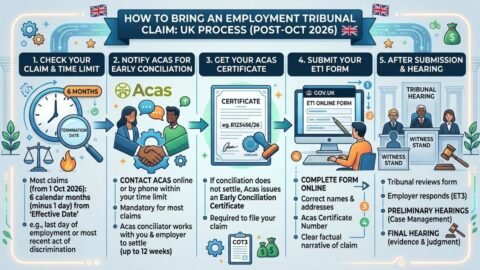
To bring an unfair dismissal claim you generally need two years’ service now, which is due to fall to six months from January 2027, though some claims, such as discrimination, need no qualifying period. For events on or after 1 October 2026, the time limit for most employment tribunal claims is six months, and you must go through Acas early conciliation first. Act quickly, keep all letters, emails and notes of meetings, and get advice from Acas, Citizens Advice, a trade union or an employment solicitor.
If your employer becomes insolvent
If your employer goes bust and cannot pay you, you may be able to claim redundancy pay, unpaid wages, notice pay and holiday pay from the government’s Redundancy Payments Service, up to statutory limits. Contact the insolvency practitioner and check GOV.UK for how to claim.
Practical steps if you are at risk of redundancy
- Stay calm and ask for the facts in writing. Find out why your role is at risk, how selection works and the timetable.
- Check your contract and policies for notice, enhanced pay and procedures.
- Work out your service and your pay. Use the GOV.UK calculator for your statutory figure.
- Ask about alternative jobs and apply for any that suit you.
- Keep records of meetings, letters and your scores.
- Use your paid time off to job hunt, update your CV and register with recruiters. Our guide to writing a UK CV with no experience has a useful template, and you can browse vacancies on our UK jobs board.
- Check your finances. Make a budget, tell your mortgage or landlord if necessary and check what benefits you may qualify for.
- Get support. Acas offers free advice on 0300 123 1100, and Citizens Advice can help with money and benefit questions.
- Prepare for interviews. Practise explaining your redundancy positively. Our guide to customer assistant interview questions and answers explains the STAR method for examples.
Frequently asked questions
How much redundancy pay will I get? The statutory amount depends on your age, service and weekly pay. The weekly pay is capped at £751 from 6 April 2026, so the maximum statutory payment is £22,530.
Do I need two years to get redundancy pay? Yes, in most cases. You normally need two years’ continuous service as an employee to get statutory redundancy pay.
Is redundancy pay taxed? Statutory redundancy pay is generally tax free, and the first £30,000 of most termination payments is tax free. Pay in lieu of notice and some other payments can be taxable.
How much notice must I get? Your contractual notice, or the statutory minimum of one week per full year of service up to 12 weeks, whichever is longer.
Can my employer make me redundant while I am on maternity leave? Only with a genuine redundancy and a fair process. You have extra protections, including priority for suitable alternative vacancies.
What is collective consultation? It applies when an employer proposes 20 or more redundancies at one establishment within 90 days. They must consult for at least 30 days (20 to 99 redundancies) or 45 days (100 or more).
Can I be made redundant and then replaced? If the same job is filled by someone else soon after, the redundancy may not be genuine. Ask for advice if this happens.
Can I claim Universal Credit after redundancy? Possibly. Check your eligibility, as redundancy pay and savings may affect your claim.
Final thoughts
Redundancy is hard, but knowing your rights lets you ask the right questions and check you are being treated fairly. Keep a record of everything, take advice early and use your time off to start the next chapter. When you are ready, browse the latest vacancies on our jobs board and update your CV.
This article is general information, not legal advice. Rules, limits and time limits change each year. For advice on your situation, contact Acas, Citizens Advice, a trade union or a qualified employment solicitor, and check GOV.UK for the latest figures.