Maternity, Paternity and Shared Parental Leave and Pay in the UK (2026/27)
Family leave and pay rules in the UK changed in April 2026, and they remain confusing, especially for people who are new to a job, self-employed or on irregular hours. How long can you take off? How much will you be paid? Do you need to have worked for your employer for a certain time? This guide explains maternity, paternity, shared parental and related leave and pay for 2026/27, who qualifies, what to tell your employer and what to do if your situation does not fit the standard rules.
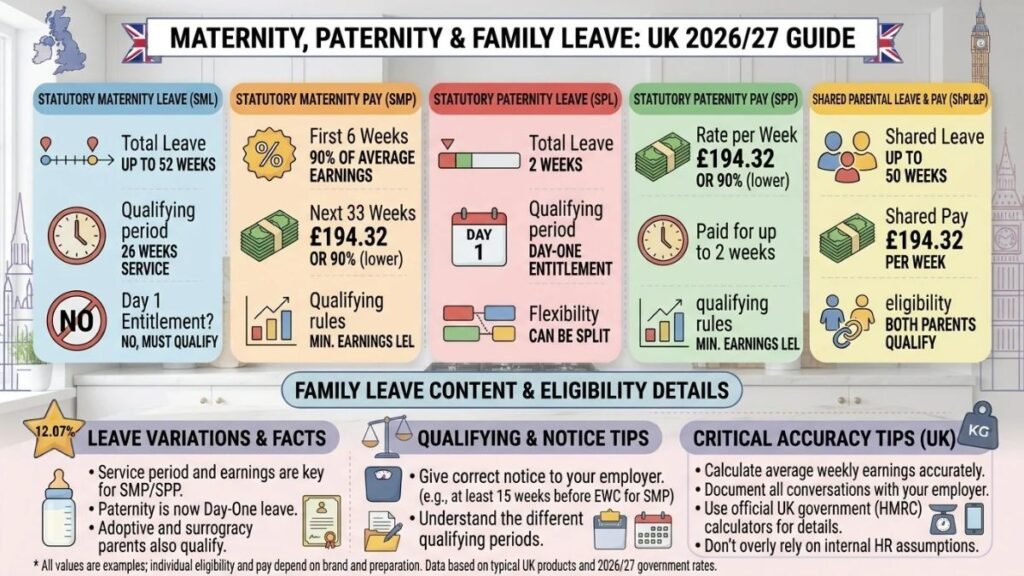
Quick answer: From 6 April 2026 the standard weekly rate for statutory maternity, paternity, adoption and shared parental pay is £194.32 (or 90% of your average weekly earnings, if lower). Maternity leave is up to 52 weeks, with up to 39 weeks of pay. Paternity leave and unpaid parental leave became day-one rights in April 2026, though paternity pay still needs 26 weeks of service.
Maternity leave
How long is maternity leave?
All employees who are pregnant are entitled to up to 52 weeks of maternity leave, made up of 26 weeks of ordinary leave and 26 weeks of additional leave. It is a day-one right, so you do not need a minimum period of service to take it.
- You must take at least two weeks off after the baby is born (four weeks if you work in a factory).
- You can start your leave as early as 11 weeks before the week your baby is due, or later if you prefer, and it starts automatically if you are off work for a pregnancy-related reason in the last four weeks.
- Your employment rights continue during leave, including holiday build-up, pension rights and the right to return.
How to tell your employer
You normally need to tell your employer by the end of the 15th week before the week your baby is due, which is about 25 weeks into your pregnancy. You should say that you are pregnant, the expected week of birth and when you want your leave to start. Your employer may ask for a MATB1 certificate from your midwife or doctor, and you should give it to them. Put your notification in writing and keep a copy.
If you are unsure, tell your employer as soon as you feel able, and ask Acas for free advice.
Your right to return
You have the right to return to the same job if you take 26 weeks or less, and to the same job or a suitable alternative on no less favourable terms if you take more. If your job has disappeared because of redundancy, extra protections apply, including priority for suitable alternative vacancies. See our guide to redundancy rights in the UK.
Statutory Maternity Pay (SMP)
Statutory Maternity Pay is paid for up to 39 weeks. For 2026/27 it works like this:
| Weeks | Pay |
|---|---|
| First 6 weeks | 90% of your average weekly earnings, with no upper limit |
| Next 33 weeks | £194.32 a week, or 90% of your average weekly earnings if that is lower |
| Final 13 weeks of leave | Unpaid, unless your employer offers more |
SMP is subject to Income Tax and National Insurance, like normal pay, and your employer deducts them before paying you.
Who qualifies for SMP?
To get SMP, you normally need to:
- Be an employee (not self-employed) and have been continuously employed by your employer for at least 26 weeks by the 15th week before your baby is due (the “qualifying week”)
- Have average weekly earnings of at least the Lower Earnings Limit, which is £129 a week in 2026/27
- Give the right notice and provide proof of pregnancy
- Still be pregnant at the 11th week before the due week, or have already had the baby
Even if you do not qualify for SMP, you still have the right to maternity leave as an employee. And you may qualify for a different benefit (see Maternity Allowance below).
An example
Suppose your average weekly earnings are £500.
- Weeks 1 to 6: 90% of £500 = £450 a week, so £2,700 in total
- Weeks 7 to 39: £194.32 a week for 33 weeks, so £6,412.56 in total
- Total SMP for the 39 weeks: about £9,113 before tax and National Insurance
If your average weekly earnings are £200, 90% is £180, which is below £194.32, so you would receive £180 a week for the whole 39 weeks, about £7,020.
These are examples only. Your employer will work out your average earnings from a set period before your qualifying week, so ask them for a breakdown.
Contractual maternity pay
Some employers pay more than the statutory minimum, for example full pay for several weeks. Check your contract, staff handbook or ask HR. Our guide to understanding your employment contract explains where to look. Some contractual schemes require you to return to work for a period or repay some of the extra pay, so read the terms.
Maternity Allowance
If you do not qualify for SMP, for example because you are self-employed, have changed jobs recently or are unemployed, you may be able to claim Maternity Allowance from the government instead. In 2026/27 it is paid for up to 39 weeks at the same standard rate of £194.32 a week, or 90% of your average weekly earnings if that is lower.
To qualify you generally need to have worked for at least 26 weeks (not necessarily for the same employer) out of the 66 weeks before your baby is due, and to have earned above a minimum amount for a set number of weeks. Check GOV.UK for the current rules and how to apply. You claim it from Jobcentre Plus, usually from about the 26th week of pregnancy.
Paternity leave and pay
Paternity leave: now a day-one right
From 6 April 2026, paternity leave became a day-one right under the Employment Rights Act 2025. You no longer need to have worked for your employer for 26 weeks to take it. Eligible employees who are the biological father, the mother’s spouse or partner (including same-sex partners), or the child’s adopter or intended parent in a surrogacy arrangement, and who will be responsible for the child’s upbringing, can take:
- One or two weeks of leave
- The leave can be taken as two separate weeks, not necessarily back to back, according to guidance published for employers
- It can be taken within the first 52 weeks after the birth or adoption, but check GOV.UK for the latest timing rules
Give your employer notice, normally by the 15th week before the due week, or within seven days of being matched with a child for adoption. Check your contract and GOV.UK for the detail.
Statutory Paternity Pay (SPP)
The leave is a day-one right, but the pay still has conditions. For Statutory Paternity Pay in 2026/27 you normally need:
- 26 weeks of continuous employment by the 15th week before the due week
- Average weekly earnings of at least the Lower Earnings Limit (£129 a week)
- The correct notice
SPP is paid at £194.32 a week or 90% of your average weekly earnings, whichever is lower, for one or two weeks.
So a new starter can now take paternity leave, but may only receive statutory pay if they meet the 26-week test. Check whether your employer offers contractual paternity pay.
Bereaved partner’s paternity leave
There is also a new right for bereaved partners to take leave when the mother or primary adopter dies. Check GOV.UK for the detail.
Shared Parental Leave and Pay
Shared Parental Leave (SPL) lets eligible parents share up to 50 weeks of leave and up to 37 weeks of pay after the birth or adoption of a child. It can be taken in blocks, together or separately, and can be a flexible way to split childcare.
How it works
- The mother or primary adopter must end or reduce their maternity or adoption leave and pay, and agree to share the remainder.
- Each parent can take leave in up to three blocks (or more with employer agreement), or in a continuous period.
- Shared Parental Pay (ShPP) is the same standard rate: £194.32 a week or 90% of average weekly earnings if lower.
- You must give your employer at least eight weeks’ notice of your leave plans.
Who qualifies?
Both parents must meet the work and earnings tests. In general, each parent needs to be an employee (or worker, for pay) with 26 weeks’ continuous service by the 15th week before the due week, and the other parent needs to have worked for at least 26 weeks in the 66 weeks before the due week and earned above a minimum amount. The rules are complicated and employers need to be told in specific ways, so check GOV.UK’s Shared Parental Leave planner and speak to your employer or Acas.
Keeping In Touch and Shared Parental Leave In Touch days
While on leave you can do some work without ending your leave or losing pay:
- Keeping in touch (KIT) days: up to 10 days during maternity or adoption leave
- Shared Parental Leave in touch (SPLIT) days: up to 20 days during shared parental leave
These are optional, and both you and your employer must agree. You should be paid for the work you do on these days.
Unpaid parental leave: day one from April 2026
Parents can take unpaid parental leave to look after a child. From 6 April 2026 it became a day-one right, so you do not need a minimum period of service.
- Up to 18 weeks of unpaid leave per child, until the child’s 18th birthday
- Normally taken in blocks of one week, up to four weeks a year per child, unless your employer agrees otherwise
- You must give 21 days’ notice to your employer
This is separate from, and in addition to, maternity, paternity and shared parental leave. Check your contract for any employer rules about how and when to book it.
Other family leave and pay
- Adoption leave and pay: the same pattern as maternity, with up to 52 weeks of leave and up to 39 weeks of Statutory Adoption Pay, at the same rates.
- Neonatal care leave and pay: parents of babies who need neonatal care can take extra leave, and may be entitled to pay at the standard rate if they meet the service and earnings tests. Check GOV.UK for the eligibility details.
- Parental bereavement leave and pay: two weeks of leave for parents who lose a child under 18 or have a stillbirth, with pay at the standard rate for those who qualify.
- Time off for antenatal appointments: pregnant employees have the right to paid time off for antenatal care, and partners may have a right to unpaid time off to attend some appointments.
- Time off for dependants: reasonable unpaid time off to deal with an emergency involving a dependant.
Your rights during family leave
- Protection from unfair treatment and dismissal. It is unlawful to treat you unfairly or dismiss you because you are pregnant or have taken or asked for family leave. Redundancy has extra safeguards, including priority for alternative vacancies.
- Holiday builds up while you are on leave. See our guide to holiday entitlement and holiday pay.
- Pension rights. Your employer should keep paying their pension contributions during paid leave, based on your normal pay.
- Pay rises. You should receive any general pay rise you would have had if you had been at work.
- Return to work. You have the right to return to your job, as described above.
- Health and safety. Your employer must assess risks to you and your baby, and offer alternative work or paid suspension if risks cannot be removed.
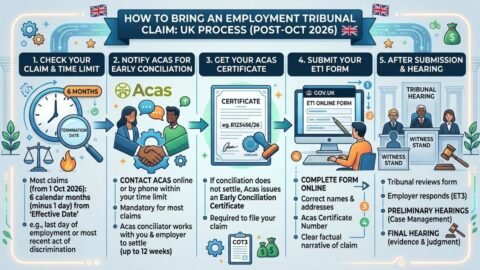
If you think you have been treated unfairly, keep records and contact Acas. The time limit for most employment tribunal claims is six months for events on or after 1 October 2026, and you must go through Acas early conciliation first. Read our guide to the Employment Rights Act 2025 for the wider changes.
What if you are a new starter, agency worker or on irregular hours?
- New starters: you have the right to maternity leave from day one, and now paternity and unpaid parental leave too, but you may not qualify for statutory pay if you have under 26 weeks’ service. Check Maternity Allowance if you do not qualify for SMP.
- Agency and casual workers: some qualify as employees or workers and some do not. Your status affects your rights, so check with Acas. Our guide to zero-hours contracts explains the difference.
- Irregular hours: your average earnings are calculated over a set reference period, so check with your employer how your pay will be worked out.
- Self-employed: you are not entitled to SMP or SPP, but you may qualify for Maternity Allowance. You can also take time off, though not as an employment right.
How to plan: a checklist
- Check your eligibility for leave and pay, and use the GOV.UK maternity and paternity pay calculators.
- Read your contract and staff handbook for any enhanced family leave and pay.
- Tell your employer in good time, in writing, and keep copies of notices and certificates.
- Ask HR for an estimate of your pay, in writing.
- Check your payslips while on leave. See our guide to payslips, tax codes and National Insurance.
- Consider Shared Parental Leave early, because of the notice rules and the need for both parents’ employers to be involved.
- Plan childcare and finances, including your final pay, holiday and any benefits such as Universal Credit or Tax-Free Childcare.
- Keep records, and contact Acas if you have a problem.
Job hunting while pregnant or planning a family
You are not required to tell an employer you are pregnant at the interview, and it is unlawful for an employer to refuse to hire you because you are pregnant. Asking about your plans for children is generally inappropriate. You will need to tell your new employer by the 15th week before the due date, and you may not qualify for statutory pay if you have not worked for them for 26 weeks, though you will still have the right to leave. Read our guide to common interview questions and answers in the UK for what employers can and cannot ask, and browse the latest vacancies on our UK jobs board.
Frequently asked questions
How much is statutory maternity pay in 2026/27? 90% of average weekly earnings for six weeks, then £194.32 a week (or 90% of your earnings if lower) for 33 weeks.
How long is maternity leave in the UK? Up to 52 weeks, with up to 39 weeks of pay.
Do I need to have worked for my employer for 26 weeks to take maternity leave? No. Maternity leave is a day-one right. You need 26 weeks of service to qualify for Statutory Maternity Pay.
Is paternity leave a day-one right? Yes, from 6 April 2026. But Statutory Paternity Pay still needs 26 weeks of continuous service and earnings above the Lower Earnings Limit.
How much is statutory paternity pay? £194.32 a week or 90% of average weekly earnings, whichever is lower, for one or two weeks.
What is Shared Parental Leave? A scheme that lets eligible parents share up to 50 weeks of leave and up to 37 weeks of pay.
Can I get maternity pay if I am self-employed? Not Statutory Maternity Pay, but you may qualify for Maternity Allowance, which pays up to 39 weeks at £194.32 a week or 90% of earnings if lower.
What is unpaid parental leave? Up to 18 weeks of unpaid leave per child until their 18th birthday, available from day one since April 2026.
Can I be dismissed for being pregnant? No. It is unlawful to dismiss or treat you unfairly because of pregnancy or family leave. Contact Acas straight away if you think this has happened.
Final thoughts
Family leave rules depend on your job, your service and your earnings, so check your own situation early, put notices in writing and ask your employer for a pay estimate. When in doubt, contact Acas or Citizens Advice. When you are ready for your next role, browse the latest vacancies on our jobs board and read your contract carefully before you sign.
This article is general information, not legal advice. Family leave rules are detailed and change often, and each person’s circumstances differ. Check GOV.UK and Acas for the latest guidance, and seek advice about your own situation.