Jobs for Over 50s and Returners: How to Get Back Into Work in the UK
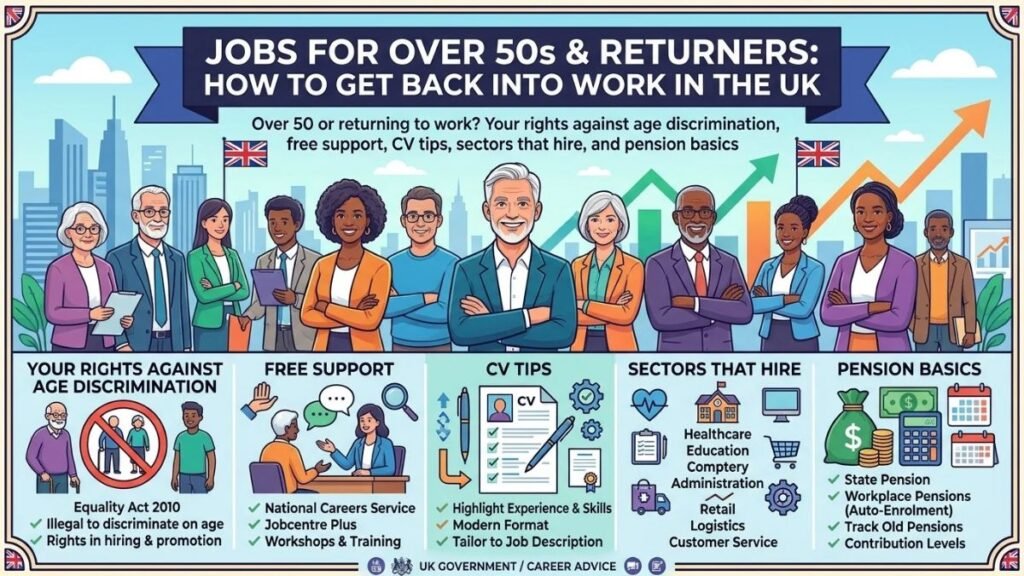
If you are over 50 and looking for work, or returning after a break for caring, illness, redundancy or early retirement, you are far from alone. Around one in three people in work in the UK is now aged 50 or over, and employers need experienced staff. But it can feel harder than it should: worries about age bias, out-of-date CVs, changing technology and pension decisions all add to the pressure. This guide explains your legal protection against age discrimination, how to update your CV and approach employers, what support is available, which jobs often suit experienced workers and what to consider with your pension and benefits.
Quick answer: Age is a protected characteristic under the Equality Act 2010, so employers cannot lawfully refuse to hire you because of your age. There is no upper age limit on apprenticeships or most training, and free government support such as the Midlife MOT and Jobcentre Plus 50PLUS help is available. Focus your CV on recent skills and achievements, address career gaps briefly and positively, and consider sectors where experience is valued.
The picture for older workers in 2026
- Roughly one in three people in employment in the UK is aged 50 or over.
- Around three million people aged 50 to State Pension age are not in work, according to commentary from think tanks and campaigners, and many of them want to work.
- The State Pension age is rising from 66 to 67, starting in April 2026 and completing in March 2028. If you turn 50 in 2026, your State Pension age is 67 under current law, which can mean around 17 more working years.
- Surveys suggest more than one in three over-50s feel they have experienced age discrimination when applying for jobs, and some report concern about automated and AI-based recruitment screening. That would be unlawful if it leads to unfair treatment based on age.
- The government says it is reforming employment support to be more tailored for people aged 50 and over, through measures such as 50PLUS Champions in Jobcentres, additional Work Coach time for new Universal Credit customers over 50 and Midlife MOTs.
These figures come from published statistics, government statements and commentary, and change over time, so check the latest on GOV.UK.
Your rights: age discrimination
The Equality Act 2010 makes it unlawful to discriminate because of age in recruitment, pay, training, promotion, redundancy and dismissal.
| Type | What it means | Example |
|---|---|---|
| Direct discrimination | Treating you worse because of your age | Rejecting you because you are “too old” for the team |
| Indirect discrimination | A rule that applies to everyone but disadvantages an age group, without good reason | Requiring “no more than five years’ experience” for a senior role |
| Harassment | Unwanted conduct related to age that creates an intimidating or hostile environment | Repeated jokes about retiring |
| Victimisation | Treating you badly because you complained about age discrimination | Being sidelined after raising a concern |
Points to know:
- Adverts. Phrases such as “digital native”, “recent graduate” or “young and dynamic team” can suggest age bias. An employer needs a strong reason for any age-related requirement.
- Compulsory retirement. There is no default retirement age in the UK. Employers can only force retirement at a set age if they can justify it, which is rare.
- Questions about age. Employers should not ask your age or date of birth in the early stages, and you do not need to give it on a CV.
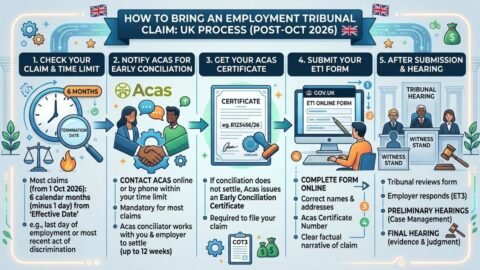
- Time limits. The time limit for most tribunal claims is six months less one day for events on or after 1 October 2026, and you must go through Acas early conciliation first. Discrimination claims need no minimum service. See our guide to unfair dismissal in the UK.
It can be hard to prove age discrimination, so keep records of adverts, emails and interview feedback. If you suspect it, contact Acas or the Equality Advisory and Support Service.
Step 1: Take stock with a Midlife MOT
The Midlife MOT is a free online tool from the Department for Work and Pensions that helps you review your work and skills, health and money. It signposts you to support, and Jobcentre Plus also offers Midlife MOTs to some Universal Credit claimants aged 50 and over. The government’s JobHelp pages have a dedicated “Finding work at 50 plus” section, with advice on options including volunteering, retraining and flexible working. Use them to decide what you want from the next stage of work: full-time or part-time, same field or something new, employed or self-employed.
Step 2: Update your CV and online profile
A modern, focused CV helps employers see your value.
- Lead with a short profile that states what you offer now, not just what you did in the past.
- Focus on the last 10 to 15 years. Summarise earlier roles in a line or two, without dates if you wish.
- Do not include your date of birth, photo or full address. You do not need to show every qualification date.
- Show recent skills and training. Include software, systems, courses and certificates, such as Microsoft Office, online tools or industry qualifications.
- Use achievements with numbers, such as “trained 20 new staff” or “cut complaints by 15%”.
- Keep it to two pages and use a clean, modern layout. Use a professional email address, not an old or unusual one.
- Match keywords from the advert, since many employers use software to scan CVs.
- Update LinkedIn, with a clear headline, a recent photo and a summary written for the job you want.
See our guides to writing a UK CV with no experience (the layout and wording tips apply to any CV) and writing a cover letter in the UK.
Explaining a career gap
If you took time out to care for someone, because of illness, redundancy or early retirement, keep your explanation short and positive:
“I took a career break from 2021 to 2025 to care for a family member. During that time I kept my skills up through [course or volunteering], and I’m now ready to return to full-time work.”
Do not apologise. Emphasise what you have done to stay up to date and what you bring now.
Step 3: Build or refresh your skills
There is plenty of support for adult learners, and no upper age limit on most of it.
- Digital skills. Learn or refresh the tools your target employers use, such as Microsoft 365, Google Workspace, video meetings, social media and basic data skills. Free online courses and library classes can help.
- Free and funded courses. Free Courses for Jobs and Advanced Learner Loans are open to adults aged 19 or over in England, subject to eligibility, so check GOV.UK.
- Skills bootcamps and sector-based work academies. Jobcentre Plus can offer training and a guaranteed job interview through some programmes. Ask your Work Coach.
- Apprenticeships. There is no upper age limit. Many people retrain through apprenticeships at any age. See our guide to apprenticeships in the UK.
- Returner programmes. Some employers run structured returnships for people who have taken a long career break, often in finance, engineering, technology and professional services. Search for “returner programme” and check employer careers pages.
- Volunteering. Volunteering can build recent experience, new skills and references, and sometimes leads to paid work.
- Professional bodies and trade qualifications, such as bookkeeping, teaching assistant courses or trade cards.
Step 4: Know where the opportunities are
Many employers value experience, reliability and maturity. Sectors that often welcome older workers include:
| Sector | Why it can suit you | Guides |
|---|---|---|
| Care and health | Life experience and empathy are valued, with training provided | Care worker jobs and NHS jobs |
| Education | School hours and holidays suit many people, and TAs are in demand | Teaching assistant jobs |
| Retail and customer service | Customer-facing skills and flexibility, with part-time options | Supermarket jobs and call centre jobs |
| Admin and office work | Organisation and communication skills | Admin and office jobs |
| Driving and transport | Strong demand and a good safety record count for a lot | HGV driver jobs, delivery driver jobs and taxi and private hire driver jobs |
| Hospitality and cleaning | Many part-time and flexible roles | Hospitality jobs and cleaning jobs |
| Trades and construction | Experience and reliability matter, though some jobs are physical | CSCS card and construction jobs |
| Self-employment and consulting | Use your experience as a freelancer, adviser or tradesperson | How to become self-employed |
| Counselling, training and mentoring | Life and work experience are an advantage, with qualifications | Check professional bodies |
The DWP’s JobHelp pages point to specialist job sites for older workers, such as Rest Less, which lists employers that describe themselves as age-diverse. You can also browse vacancies on our UK jobs board, and look for employers who say they welcome applicants of all ages.
If you are working in a physically demanding job and your health is changing, consider moving to less physical roles within the same sector, such as supervisor, trainer, assessor or customer-facing positions.
Step 5: Support from Jobcentre Plus and others
- Jobcentre Plus work coaches can discuss options and, in some areas, offer extra time for people over 50 who are new to Universal Credit. Ask whether there is a local 50PLUS Champion.
- The Midlife MOT and the JobHelp pages are free.
- Careers advice. The National Careers Service offers free advice for adults in England. The service is being reshaped into a new national jobs and careers service, with changes from October 2026, so check GOV.UK for the current contact details.
- Work and Health support is available for people with health conditions or disabilities. See our guide to disability and work in the UK.
- Age UK and other charities offer advice on discrimination and job hunting, and some run local employment clubs.
- Local colleges and libraries can help with digital skills and CVs.
- Trade unions can advise if you are in work and facing redundancy.
Pensions and money: what to think about
Working in your fifties and sixties affects your finances. Keep these points in mind and get free guidance before making big decisions.
- State Pension age. It is rising from 66 to 67 between April 2026 and March 2028. Check your own age on GOV.UK. Government reviews of the pension age continue, so check for changes.
- State Pension and your National Insurance record. You generally need 35 qualifying years for the full new State Pension. You can check your record on GOV.UK and sometimes fill gaps with voluntary contributions.
- Workplace and private pensions. You can usually access them from age 55, rising to 57 in 2028, subject to scheme rules. Taking money early can affect your tax and future income, and the amount you can later pay in tax-free. Use free Pension Wise guidance from MoneyHelper before you decide.
- Tax and National Insurance. Employees stop paying National Insurance at State Pension age, but still pay Income Tax. See our guide to payslips, tax codes and National Insurance.
- Benefits. Working may affect Universal Credit or other benefits, so check before you start or change your hours.
- Part-time and phased retirement. You can ask your employer to reduce your hours as you approach retirement. See our guide to flexible working in the UK.
- Redundancy pay. Statutory redundancy pay includes 1.5 weeks’ pay for each year of service from age 41. See our guide to redundancy rights in the UK.
- Minimum wage. If you are 21 or over, the legal minimum from April 2026 is £12.71 an hour. See our National Minimum Wage 2026 guide.
Health, caring and menopause at work
- Health conditions and disabilities. You have the right to reasonable adjustments, and Access to Work can help. Our guide to disability and work in the UK explains how.
- Menopause. Women over 50 are the fastest growing segment of the workforce, and many go through the menopause transition while working. The symptoms can amount to a disability in some cases, and employers should be supportive. Ask about workplace policies, flexible hours and adjustments, and see GOV.UK and Acas guidance.
- Caring responsibilities. Employees can request flexible working from day one and can take up to one week of unpaid carer’s leave a year. See our guide to flexible working in the UK.
- Sick pay. Statutory Sick Pay is payable from the first day for eligible employees. See our guide to Statutory Sick Pay 2026.
Applying and interviewing as an experienced candidate
Application tips
- Apply to jobs where you meet most of the requirements, and tailor each CV and letter.
- Network. Many jobs are filled through contacts. Let former colleagues, friends and professional groups know you are looking.
- Follow up politely after applying.
- Consider agencies, which can place people in temporary and permanent roles and sometimes lead to permanent jobs.
Interview tips
- Show enthusiasm and adaptability. Give examples of when you learned something new or changed how you worked.
- Address technology confidently. Mention the tools you use and how you learn new ones.
- Be ready for “overqualified” concerns. Explain why the role suits you, such as better work-life balance, a change of direction or using your skills in a new setting.
- Talk about teamwork with all ages. Give examples of working with, mentoring or learning from younger colleagues.
- Answer salary questions with a researched range. Our guide to how to ask for a pay rise or negotiate salary in the UK explains how.
- Use the STAR method (Situation, Task, Action, Result) for examples. See our guides to common interview questions and answers in the UK and customer assistant interview questions and answers.
- If you face inappropriate questions about your age, retirement plans or health, you can steer back to your skills. If you think you were discriminated against, keep notes and contact Acas.
Common worries and how to handle them
| Worry | What you can do |
|---|---|
| “They will think I’m too old.” | Focus on recent achievements and skills, and choose employers who value experience |
| “My skills are out of date.” | Take short courses, learn current tools and mention them on your CV |
| “I’ve been out of work for years.” | Use volunteering, courses or a returner programme to rebuild recent experience |
| “I can’t compete with younger candidates.” | Highlight reliability, judgement, customer skills and mentoring ability |
| “I’m not sure I can do a physical job.” | Look at supervisory, training, customer or less physical roles |
| “I’m worried about my pension.” | Get free guidance from Pension Wise and the Money and Pensions Service before you decide |
Scams that target older job seekers and returners
Scammers know that people looking for work after a break can be vulnerable. Watch for:
- Work from home offers with high pay for easy tasks, or that ask for fees for training or equipment. See our guides to work from home jobs in the UK and how to spot a fake job advert in the UK.
- Fake recruiters who ask for your bank details, passport or National Insurance number before you have a job.
- Requests to move money or receive parcels, which can involve crime.
- Pension scams, such as cold calls, texts or emails offering to “unlock” your pension early or invest it in a “guaranteed” scheme. Never agree to anything under pressure, and check with the Financial Conduct Authority and Pension Wise first.
- Romance and investment scams that begin on social media and lead to requests for money.
If you think you have been scammed, contact your bank immediately and report it to Report Fraud.
What if you are made redundant in your fifties?
Redundancy at 50 can feel like a crisis, but you have rights and options.
- Check your pay and notice. See our guide to redundancy rights in the UK.
- Check for age discrimination in the selection process. Selecting people on the basis of age or length of service in a way that disadvantages older workers can be unlawful.
- Use time off to look for work, if you have two years’ service.
- Take advice about your pension and tax before you decide what to do with a lump sum.
- Make a plan. Consider whether to look for a similar role, retrain, move into a new sector or start your own business.
- Contact Acas, your union or Citizens Advice if you think the process was unfair.
If you are dismissed and think it was unfair or discriminatory, see our guides to unfair dismissal in the UK and disciplinary and grievance procedures in the UK.
Frequently asked questions
Is it illegal to refuse to hire me because of my age? Yes, in most cases. Age is a protected characteristic under the Equality Act 2010, and direct and indirect age discrimination are unlawful. It can be hard to prove, so keep records.
Is there an age limit for apprenticeships? No. There is no upper age limit on apprenticeships, though entry requirements and funding rules vary.
What is the State Pension age in 2026? It is rising from 66 to 67 between April 2026 and March 2028. Check your own State Pension age on GOV.UK.
What is a Midlife MOT? A free service that helps you review your work, health and money. There is a digital version online, and some Jobcentres offer it to Universal Credit claimants aged 50 and over.
What jobs suit people over 50? Care, education support, customer service, admin, driving, retail, hospitality, trades, self-employment and consultancy are common routes, depending on your experience, health and goals.
Should I put my age or date of birth on my CV? No. You do not need to, and employers should not ask for it at the application stage.
How do I explain a long career gap? Be brief and positive, say what you did during the gap (caring, courses, volunteering) and focus on what you offer now.
Can I work and claim my pension? Yes. You can work while receiving a workplace or State Pension, but it can affect your tax and in some cases your benefits. Get free guidance first.
Do I still pay National Insurance after State Pension age? Employees stop paying National Insurance at State Pension age, but still pay Income Tax.
Where can I get free help? Jobcentre Plus, the Midlife MOT, JobHelp, the National Careers Service, Age UK, Citizens Advice, Pension Wise and Acas all offer free advice.
Final thoughts
Experience is an asset, and many employers know it. Update your CV, refresh your skills, target employers and sectors that value maturity, use the free support available and protect yourself from scams. When you are ready, browse the latest vacancies on our jobs board and apply directly with employers.
This article is general information, not legal, financial or pension advice. Rules on pensions, benefits and employment support change often. Check GOV.UK, MoneyHelper and Acas for the latest guidance, and seek advice about your own situation.