How to Get an SIA Licence and Become a Security Guard in the UK (2026)
Security is one of the most accessible careers in the UK. There are jobs in shops, offices, hospitals, building sites, events, airports and more, and you do not need a degree or previous experience. What you do need, in most cases, is a licence from the Security Industry Authority (SIA). This guide explains what an SIA licence is, who can get one, how much it costs, how to apply step by step, and what security guards earn.
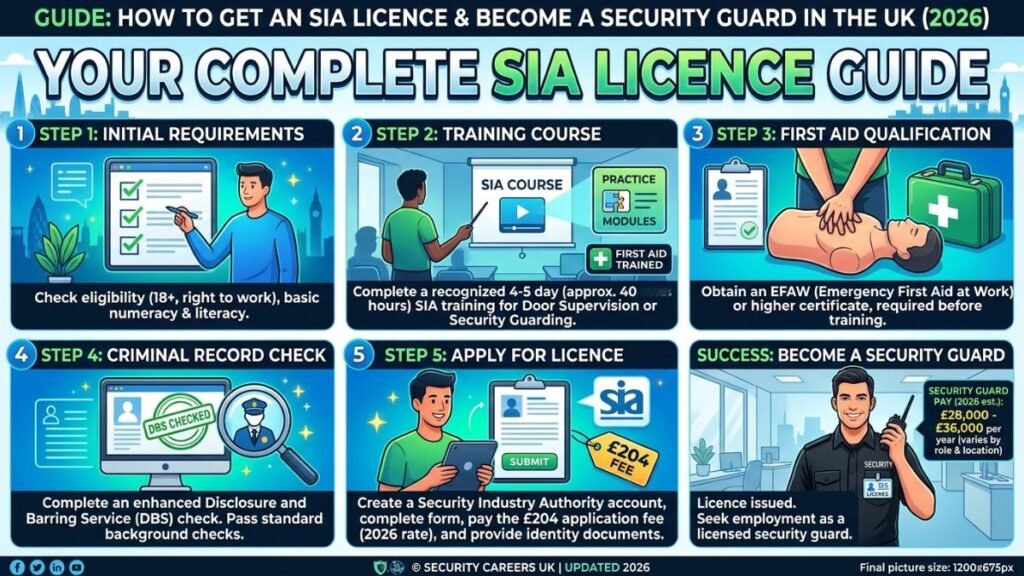
Quick answer: To work as a security guard in England, Wales or Scotland you generally need an SIA Security Guard licence. You must be at least 18, pass a Level 2 security officer qualification (and hold a valid first aid certificate), pass the SIA’s identity and criminal record checks, and pay the licence fee, which is £204 for three years as of April 2026.
What is an SIA licence?
The Security Industry Authority is the UK regulator for the private security industry. It issues licences to people who do certain types of security work. The aim is to make sure that people working in security are properly trained, checked and who they say they are.
Working as a front-line security guard without a valid licence is a criminal offence. Some employers will tell you that you can start work before your licence arrives. Be careful: the licensing rules are strict, and both you and the employer can be prosecuted. Always check the current SIA guidance before you start.
SIA licensing applies in England, Wales and Scotland. Northern Ireland has different arrangements, so check the SIA website if you live or work there.
Which SIA licence do you need?
The licence you need depends on the job. The main front-line licences are:
| Licence | What the work involves | Qualification needed |
|---|---|---|
| Security Guard | Guarding premises, property or people, such as shops, offices, car parks, construction sites and events | Level 2 Award for Working as a Security Officer in the Private Security Industry |
| Door Supervisor | Working on the door of pubs, bars, clubs and venues | Level 2 Award for Working as a Door Supervisor in the Private Security Industry |
| CCTV Operator (Public Space Surveillance) | Monitoring public space CCTV | Level 2 Award for Working as a CCTV Operator (Public Space Surveillance) |
| Close Protection | Protecting individuals | Level 3 Certificate for Close Protection Operatives |
Other licences exist, including cash and valuables in transit, key holding and vehicle immobilising, as well as licences for supervisors and managers. In Scotland, the equivalent qualifications are set at SCQF level.
For most people starting out, the Security Guard licence is the one to choose. The Door Supervisor licence is also popular, since it is often accepted for a wider range of roles and venues, but a door supervisor licence does not automatically cover everything a security guard licence does. Check the current SIA rules for what each licence allows.
Who can apply? Eligibility
To get a Security Guard licence you must:
- Be at least 18 years old on the day you apply. Some training providers accept learners younger than 18, but you cannot hold a licence until you are 18.
- Have the right to work in the UK. The SIA checks this as part of your application.
- Pass identity checks. You will provide valid photo ID, proof of address and a passport-style photo.
- Pass a criminal record check. The SIA checks every applicant’s record.
- Hold the right training qualification from an approved, regulated training provider.
- Hold a valid first aid certificate. Since April 2021, a first aid certificate has been a prerequisite for security guard training. Training providers usually ask for a certificate such as Emergency First Aid at Work that remains valid for at least 12 months from the first day of your course.
- Be able to read, write and communicate in English at a basic level, which training providers check at enrolment.
What about a criminal record?
Having a conviction does not automatically stop you getting a licence, but some offences will. The SIA publishes criteria that explain which convictions are likely to lead to refusal and how long it takes before they are no longer taken into account. Before you pay for training, check the SIA’s published criminal record guidance. If you are unsure what appears on your record, you can request your own basic criminal record certificate first. The SIA application fee is not refunded if your application is refused.
How much does it cost?
Budget for the following:
| Cost | Typical amount |
|---|---|
| SIA licence application fee | £204 for a three-year licence (from 1 April 2026) |
| Level 2 security guard training course | Varies by provider. One provider advertises a four-day course at £179.99, or £249.99 with first aid included |
| First aid certificate (if not included) | Varies, roughly the difference in the example above |
| Photo and ID verification | Small extra costs for photos or ID checks |
| Uniform and kit | Often provided by the employer, but sometimes you buy your own |
With the example course above, the total for training and licence is around £384 if you already hold first aid, or around £454 with first aid included. Prices vary a lot, so compare several approved providers.
The SIA fee was held at £184 until 31 March 2026 because of a temporary rebate. It returned to £204 from 1 April 2026. Some older websites still show £184, £190 or £220, so always confirm the current fee on GOV.UK before you pay.
Some employers and agencies pay for training and the licence, sometimes in return for a commitment to work for them or repay the cost if you leave early. Read any agreement carefully before you sign.
How to get an SIA licence: step by step
Step 1: Check you are eligible
Confirm your age, right to work and criminal record position. Check the SIA’s published criteria before you spend money.
Step 2: Get a first aid certificate
Book an Emergency First Aid at Work course (or an equivalent approved certificate) if you do not already hold one. It must be valid for the period your training provider requires.
Step 3: Choose an approved training provider
Your training must come from a training provider that is approved to deliver the SIA-recognised qualification and that is regulated. Do not pay a provider until you have checked it is approved. Courses normally last three to five days, including exams and practical scenarios such as conflict management.
Step 4: Complete the Level 2 course and pass the assessments
You will take multiple-choice exams and scenario-based practical assessments. When you pass, the training provider gives you a certificate, and records your result with the awarding body.
Step 5: Apply online for your licence
Apply through the SIA’s online service on GOV.UK. You will need:
- Your training certificate details
- Proof of identity and right to work
- Your address history, including the last five years
- A passport-style photo that meets the SIA’s rules
- Your National Insurance number, if you have one
- A debit or credit card to pay the fee
Step 6: Wait for the SIA decision
The SIA runs identity and criminal record checks, then decides whether to grant your licence. Respond quickly to any request for more information. Processing times change, so check the SIA website for current timescales.
Step 7: Receive and carry your licence
If you are approved, you receive a licence card. You must wear it visibly while working as a front-line security guard, and you can be checked by the SIA. The licence normally lasts three years.
Step 8: Renew on time
Renew your licence before it expires. You will pay the fee again and pass another criminal record check. Depending on when you first qualified, you may need to retake some training, so check the SIA’s renewal guidance.
What does a security guard do?
The work varies by site, but typical duties include:
- Patrolling premises and checking doors, gates and alarms
- Monitoring entrances, checking passes and recording visitors
- Watching CCTV and responding to incidents
- Preventing theft and anti-social behaviour
- Dealing with emergencies, such as fire alarms and first aid incidents
- Writing reports and logging events
- Calming conflict and, only where necessary, using the limited powers that the law allows
Places that employ security guards include shops and shopping centres, offices, hospitals, universities, construction sites, warehouses, festivals and stadiums, car parks, and transport hubs such as airports and stations. Shifts are often long and may include nights, weekends and bank holidays.
How much do security guards earn?
Pay depends on the site, employer, shift and location. Examples from 2026 adverts for aviation security roles show contractor rates of about £12.71 to £12.85 an hour, and a rate of around £13 an hour for a ground handling security role, while a directly employed airport security officer role at Stansted was advertised at £18.42 an hour including a shift allowance. Pay in London and for specialist sites is often higher. The legal minimum for workers aged 21 and over is £12.71 an hour from April 2026, so entry-level contract guarding often starts at or just above it.
Compare the full package: night shift premiums, overtime, holiday, sick pay, uniform costs and how many hours are guaranteed. Read our National Minimum Wage 2026 guide for the legal rates, and our guide to understanding your employment contract to check your hours and notice.
Where to find security guard jobs
- Security contractors and guarding companies, which hire for many client sites
- Direct employers, such as hospitals, councils, universities, retailers and venues
- Airports, where security officers need additional vetting. See our guide to how to get an airport job in the UK
- Event security companies for festivals, concerts and sports
- Job boards, including our UK jobs board
- Your training provider, which may have links to local employers
Only apply through official employer websites or reputable agencies, and never pay a fee to get a security job.
Career progression
Security can lead to better-paid and more specialist work. Typical routes are:
- Senior or lead guard, then site supervisor
- Control room operator or CCTV operator
- Door supervisor, event security and crowd management
- Close protection, with a higher-level qualification
- Security manager, with further training and a non-front-line licence
- Specialist areas such as aviation security, cash in transit and retail loss prevention
Interview tips for security guard jobs
Employers look for people who are reliable, observant, calm under pressure and good with people. Prepare for questions such as:
- Why do you want to work in security?
- How would you deal with an aggressive or upset person?
- What would you do if you saw someone acting suspiciously?
- How do you cope with working alone or on long shifts?
- Are you happy to work nights, weekends and bank holidays?
- Tell me about a time you followed a rule even though it was difficult.
Use the STAR method (Situation, Task, Action, Result) for examples, and be ready to show your licence or evidence that your application is in progress. Our guide to customer assistant interview questions and answers explains the method in more detail.
Scams and mistakes to avoid
- Unapproved training providers. Check a provider is approved before you pay, and be wary of courses that seem very cheap or very short.
- “No licence needed” offers. If someone says you can work as a front-line guard without a licence, be cautious. It could put you at risk of prosecution.
- Fees for jobs or “guaranteed” licences. Never pay anyone to get a job or to “fast-track” your licence.
- Fake licences. Never buy or use a licence that is not yours. You can check whether a person holds a valid licence on the SIA’s public register.
- Training agreements you do not understand. Read the terms if an employer pays for your course, especially repayment clauses.
- Applying before checking your record. The fee is not refunded if you are refused.
Read our guide to how to spot a fake job advert in the UK for more warning signs.
Frequently asked questions
Do I need an SIA licence to be a security guard? In most cases, yes. Working as a front-line security guard without a licence in England, Wales or Scotland is a criminal offence.
How much is an SIA licence? The application fee is £204 for a three-year licence as of April 2026. Check GOV.UK for the current fee.
How old do you have to be? You must be at least 18 to hold an SIA licence.
How long does it take to get an SIA licence? Training normally takes three to five days. The SIA’s processing time varies, so check its website for current timescales.
Do I need first aid to get a licence? Yes. A valid first aid certificate is required before you can take the security guard training.
Can I get an SIA licence with a criminal record? It depends on the offence and how long ago it was. Check the SIA’s published criteria before applying.
Can I work as a security guard with no experience? Yes. The qualification is open to beginners, and many employers hire first-time guards.
How long does a licence last? A licence normally lasts three years and then needs renewing.
Final thoughts
Becoming a security guard takes a few days of training, a small investment and a clean enough record to pass the SIA’s checks, but it can lead to steady work in almost every town. Check the current rules on GOV.UK, choose an approved training provider, and keep a copy of your documents for your application. Then browse the latest security and aviation vacancies on our jobs board.
This article is general information, not legal advice. SIA rules, fees and training requirements change, so check the SIA website and GOV.UK for the latest details before you apply or pay for training.