How to Become Self-Employed in the UK: Registering, Tax and National Insurance
More people in the UK work for themselves than ever before: drivers, tradespeople, cleaners, tutors, freelancers, hairdressers and thousands of small online sellers. Being your own boss offers flexibility and the chance to earn more, but it also means you handle your own tax, National Insurance, insurance and paperwork, and you lose the rights that come with being an employee. This guide explains how to become self-employed, how to register with HMRC, what tax and National Insurance you will pay in 2026/27, which deadlines matter and what to watch out for.
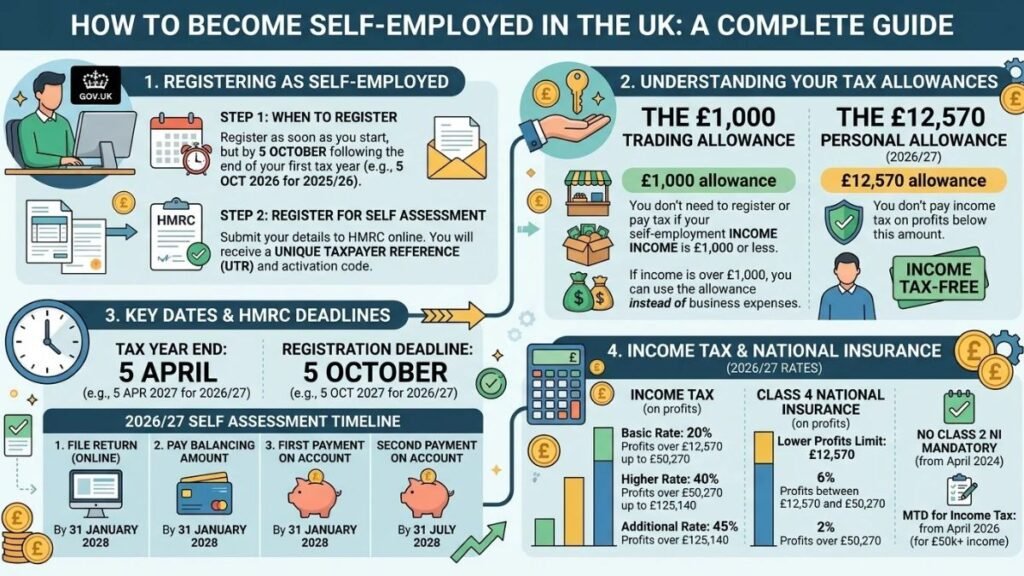
Quick answer: To become a sole trader you register for Self Assessment with HMRC by 5 October after the end of the tax year in which you started (for example, by 5 October 2027 if you start in the 2026/27 tax year). You pay Income Tax on profits above the £12,570 personal allowance, plus Class 4 National Insurance of 6% on profits between £12,570 and £50,270. You must register if your self-employed income is over £1,000 a year.
Are you really self-employed?
Before you register, check that you are genuinely self-employed. Your status depends on how you actually work, not on what a contract says. You are more likely to be self-employed if you:
- Decide how, when and where you work
- Can send someone else to do the work in your place
- Provide your own equipment and take the financial risk, for example buying materials or covering losses
- Work for several clients, and have no obligation to accept every job
- Are not treated like an employee, with a manager controlling your hours, uniform and tasks
If a company controls your work like an employer but calls you self-employed, you may be a worker or employee with rights to the minimum wage and holiday pay. Check with Acas or use HMRC’s employment status check tool. Our guides to delivery driver jobs and taxi and private hire driver jobs explain how status works in those sectors.
Self-employed, employed or a limited company?
| Option | What it is | Key points |
|---|---|---|
| Sole trader | You run the business as an individual | The simplest set-up. You and the business are legally the same person, so you are personally responsible for debts. You keep the profits after tax |
| Partnership | You run a business with one or more other people | Each partner is taxed on their share of profits. The partnership files its own return too |
| Limited company | A separate legal business you own | More paperwork and costs, such as Companies House filings and company accounts. Limited liability, and different tax rules for salary and dividends |
| Employee | You work for an employer | Tax is taken through payroll, with employment rights |
Most people starting out choose to be a sole trader. You can switch to a limited company later if your business grows. This guide focuses on sole traders.
Do you need to register? The £1,000 trading allowance
HMRC gives you a trading allowance of £1,000 a tax year for your gross self-employed income. If your income from self-employment is £1,000 or less, you usually do not need to register or tell HMRC. If it is more than £1,000, you generally must register for Self Assessment.
Important points:
- The allowance applies to gross income (before expenses), not profit.
- If you use the allowance, you cannot also deduct your actual business expenses from that income. You choose whichever is better for you, if you are under the limit or are choosing which method to use.
- You may still choose to register if you want to pay voluntary National Insurance, or if you need proof of self-employment, for example for a mortgage or a tenancy.
- If you are paid through the Construction Industry Scheme (CIS), different rules apply. See our guide to CSCS cards and construction jobs.
How to register as self-employed: step by step
- Check you need to register. You do if your self-employed gross income is over £1,000 in a tax year, or you need proof of self-employment.
- Gather your details. You will need your National Insurance number, personal details, the date you started trading and a description of the work you do.
- Register with HMRC. Register for Self Assessment online through GOV.UK and choose the sole trader option, or call HMRC’s self-employment line. You can also register by post, though online is faster. You will receive a Unique Taxpayer Reference (UTR) by post, and a code to activate your online account, which can take a couple of weeks.
- Meet the deadline. You must tell HMRC by 5 October following the end of the tax year in which you started trading. The tax year runs from 6 April to 5 April. If you started in the 2025/26 tax year, the deadline was 5 October 2026. If you start in the 2026/27 tax year, it is 5 October 2027. Register as soon as you start, because you may be fined for registering late, and you will need your UTR before you can file a return.
- Choose a business name (optional). As a sole trader you can trade under your own name or a business name. Business names cannot include certain sensitive words, cannot be misleading, and should not infringe someone else’s trade mark. You do not register a sole trader’s business name with Companies House.
- Open a separate business bank account (recommended). It is not a legal requirement for a sole trader, but it makes your records much easier.
- Start keeping records from day one. See below.
- Check whether you need licences, insurance or registrations for your type of work, such as taxi licences, food hygiene registration, gas safety registration or professional accreditation.
Tax and National Insurance in 2026/27
Income Tax
You pay Income Tax on your profits (your income minus allowable expenses, or the trading allowance), not on your total takings. In England, Wales and Northern Ireland for 2026/27:
| Band | Taxable income | Rate |
|---|---|---|
| Personal allowance | Up to £12,570 | 0% |
| Basic rate | £12,571 to £50,270 | 20% |
| Higher rate | £50,271 to £125,140 | 40% |
| Additional rate | Over £125,140 | 45% |
Scotland has different Income Tax bands, so check the Scottish Government and GOV.UK if you live there. If you have other income, such as a job, you add it all together to work out your tax. Our guide to payslips, tax codes and National Insurance explains how employed pay is taxed.
National Insurance for the self-employed
Self-employed people pay Class 4 National Insurance on their profits, collected through Self Assessment. For 2026/27:
| Annual profits | Class 4 rate |
|---|---|
| Up to £12,570 | 0% |
| £12,570 to £50,270 | 6% |
| Over £50,270 | 2% |
Class 2 National Insurance used to be a flat weekly payment. Since April 2024 it is no longer compulsory for most self-employed people. If your profits are at or above the Small Profits Threshold of £7,105 (2026/27), you are treated as having paid Class 2, which gives you a qualifying year for the State Pension, without paying anything. If your profits are below £7,105, you can choose to pay voluntary Class 2 contributions (currently £3.65 a week) to protect your record. Check GOV.UK for the current rates.
Worked examples
These examples show approximate tax for 2026/27 for someone with no other income, in England:
| Annual profit | Income Tax | Class 4 NI | Total (approx.) |
|---|---|---|---|
| £5,000 | £0 | £0 | £0 (consider voluntary Class 2) |
| £10,000 | £0 | £0 | £0 (Class 2 treated as paid) |
| £20,000 | About £1,486 | About £446 | About £1,932 |
| £30,000 | About £3,486 | About £1,046 | About £4,532 |
| £50,000 | About £7,486 | About £2,246 | About £9,732 |
These are my own approximate calculations using the 2026/27 figures, for illustration only. Use HMRC’s calculators or an accountant for your own case.
Self Assessment: how it works and when to pay
As a sole trader you pay your tax through a yearly Self Assessment tax return. Nothing is taken automatically from your income, so you must set money aside.
Key dates
| Date | What happens |
|---|---|
| 6 April to 5 April | The tax year |
| 5 October | Deadline to register for Self Assessment if you started trading in the previous tax year |
| 31 October | Deadline for paper tax returns |
| 31 January | Deadline for online tax returns, and to pay any tax and Class 4 NI due for the previous tax year. For example, the 2025/26 tax return is due by 31 January 2027 |
| 31 January and 31 July | Payments on account, if you owe more than a certain amount. These are advance payments towards next year’s bill, each usually half of the previous year’s liability |
Late returns and late payments lead to automatic penalties and interest, so file early. Many people find that their first tax bill is larger than expected because it may include the payment on account towards the next year, so plan ahead.
What to put aside
A common approach is to put aside a percentage of every payment you receive, such as 20% to 30% depending on your profits, in a separate savings account. An accountant or the HMRC calculators can give you a better estimate.
Making Tax Digital for Income Tax
HMRC is introducing Making Tax Digital for Income Tax, which replaces the annual return with digital records and quarterly updates. The timetable is:
| From | Applies to self-employed people (and landlords) with qualifying income over |
|---|---|
| April 2026 | £50,000 |
| April 2027 | £30,000 |
| April 2028 | £20,000 |
If your income is below these levels, you can carry on as before for now, but check HMRC’s guidance because the rules may change. Use software that is compatible with HMRC’s system if the rules apply to you.
Keeping records and claiming expenses
What records to keep
- Income: invoices, receipts, bank records and payment records
- Expenses: receipts and invoices for business costs
- Mileage and vehicle use, if you claim for them
- Contracts and correspondence with clients
You must keep records for at least five years after the 31 January submission deadline for the relevant tax year. Use a spreadsheet, an accounting app or bookkeeping software.
Allowable expenses
You can deduct costs that are wholly and exclusively for your business, which reduces your taxable profit. Common examples include:
- Tools, equipment and materials
- Fuel, vehicle running costs and parking (for business use), or simplified mileage allowances
- Business insurance and professional fees
- Phone, broadband and software (the business-use share)
- Advertising, website and marketing costs
- Training that updates skills you already use in the business
- Accountancy fees and bank charges
- Work clothing, such as uniforms or protective gear (not everyday clothes)
- A reasonable share of home costs if you work from home, using simplified flat rates or actual costs
You cannot claim for personal costs, normal commuting or entertaining clients. If you use the trading allowance, you cannot also claim these expenses on the same income. Check HMRC’s guidance for current simplified expense and mileage rates.
VAT, insurance and other practical points
- VAT. You must register for VAT if your taxable turnover goes over the VAT threshold, which is £90,000 (check HMRC for the current figure). You can register voluntarily below that. Some types of work, such as private hire driving in some cases, have their own VAT rules.
- Business insurance. Depending on your work you may need public liability insurance, professional indemnity, tools or equipment cover, or business vehicle insurance. Many clients ask for evidence.
- Pensions. There is no employer to enrol you in a workplace pension, so consider paying into a personal pension.
- Sick pay and holiday. You do not get Statutory Sick Pay or paid holiday as a self-employed person, so build a cushion and consider income protection. See our guides to Statutory Sick Pay 2026 and holiday entitlement and holiday pay to see what employees receive.
- Maternity and paternity. Employees get statutory pay, but self-employed parents may qualify for Maternity Allowance. See our guide to maternity, paternity and shared parental leave and pay.
- Universal Credit. If you claim Universal Credit as a self-employed person, there are special rules, such as a minimum income floor in some cases. Check GOV.UK.
- Contracts and getting paid. Use written agreements, send clear invoices, state payment terms and chase late payments politely but firmly.
- Licences and registrations. Some jobs need licences, such as taxi and private hire, or registrations, such as gas safety. Check what applies to yours.
- Right to work. You must have the right to work in the UK, and some visas, including Student visas, do not allow self-employment. See our guides to right to work checks in the UK and part-time jobs for students in the UK.
Popular self-employed jobs and where to read more
| Work | Related guides |
|---|---|
| Delivery and courier driving | Delivery driver jobs |
| Taxi and private hire | Taxi and private hire driver jobs |
| Construction and trades | CSCS card and construction jobs |
| Cleaning | Cleaning jobs in the UK |
| Freelance writing, admin and online work | Work from home jobs and admin and office jobs |
| Tutoring, coaching and personal services | Check any licensing, safeguarding and insurance needs |
You can also compare self-employment with employed work on our UK jobs board.
Pros and cons of being self-employed
Advantages
- Flexibility over hours and the work you take on
- Potential to earn more as your business grows
- Control over how you work
- Tax advantages, such as claiming business expenses
Disadvantages
- Irregular income, and no pay when you are ill or on holiday
- You handle tax, bookkeeping, insurance and chasing payments
- No employer pension, sick pay, holiday pay or redundancy pay
- Limited employment protection
- Mortgage lenders and landlords may want longer evidence of income
Common mistakes to avoid
- Registering late. Miss the 5 October deadline and you risk penalties.
- Not setting money aside for tax. Open a savings pot and pay into it regularly.
- Mixing personal and business money, which makes records messy.
- Not keeping receipts and records. You need them to claim expenses and support your return.
- Missing the 31 January deadline, even if you owe nothing. Penalties can apply for late returns.
- Forgetting payments on account. The first payment on account can surprise new self-employed people.
- Being falsely self-employed. If you are really an employee, you could be missing out on rights, and the business could face penalties.
- Ignoring insurance. One accident or claim can cost far more than the premium.
- Not checking licences. Working without a required licence can be a criminal offence.
Scams and risks
Tax and self-employment attract scams. Watch for:
- Fake HMRC calls, texts and emails claiming you owe tax or are due a refund. HMRC does not demand payment by gift card or threaten arrest. Forward suspicious emails to report@phishing.gov.uk and texts to 7726.
- “Self-employment” job adverts that ask you to pay for a start-up kit, training, a licence or a “guaranteed” income. See our guide to how to spot a fake job advert in the UK.
- Companies that call you self-employed but control your work, or deduct unexplained fees, which may be false self-employment.
- Tax refund or “tax advice” firms that charge large fees for something you can do free with HMRC.
- Account-rental and “borrowing” schemes, where someone asks to use your self-employed status or account. This can be illegal.
Report fraud to Report Fraud, and contact your bank immediately if you have lost money.
Do you need an accountant?
You do not have to use one, and many simple sole trader businesses file their own return using HMRC’s online service or accounting software. An accountant can be worth the cost if your finances are complicated, you have several income sources, you are growing, you need to register for VAT or you are unsure about expenses. Look for a qualified accountant, check their credentials and agree the fee in advance.
Frequently asked questions
How do I become self-employed in the UK? Register for Self Assessment with HMRC as a sole trader by 5 October after the end of the tax year in which you started, and keep records of your income and expenses.
Do I need to register if I earn less than £1,000? Usually not, because of the £1,000 trading allowance on gross self-employed income. You may still choose to register for other reasons.
How much tax do self-employed people pay in 2026/27? Income Tax at 20% on profits above the £12,570 personal allowance up to £50,270, plus Class 4 National Insurance at 6% on profits between £12,570 and £50,270 and 2% above.
Do the self-employed still pay Class 2 National Insurance? It is no longer compulsory. If your profits are £7,105 or more, you are treated as having paid it. Below that, you can choose to pay voluntary contributions.
When is the Self Assessment deadline? 31 January for online returns and for payment of the tax due. The 2025/26 return is due by 31 January 2027.
What is Making Tax Digital? A system of digital record keeping and quarterly updates replacing the annual return for self-employed people over certain income levels, from April 2026 (over £50,000), April 2027 (over £30,000) and April 2028 (over £20,000).
Can I be self-employed and employed at the same time? Yes. You pay tax on both incomes. Register for Self Assessment if your self-employed income is over £1,000.
Can I claim Universal Credit if I am self-employed? Possibly, but there are special rules for self-employed claimants. Check GOV.UK.
Do I need to register for VAT? Only if your taxable turnover goes over the VAT threshold (£90,000), though you can register voluntarily.
Can I be self-employed on a Student visa? Generally no. Check your visa conditions before you start.
Final thoughts
Becoming self-employed is straightforward to start, but the responsibilities are real. Register on time, keep good records, set money aside for tax and check your status and insurance before you start. When you are ready to compare options, browse the latest vacancies on our jobs board alongside self-employed work.
This article is general information, not tax, legal or financial advice. Tax rates, thresholds and deadlines change, and the Scottish tax system is different. Check GOV.UK and HMRC for the latest guidance, and seek advice from a qualified accountant about your own situation.