Notice Periods in the UK Explained
A new job offer arrives with a start date attached, and suddenly your notice period at your current employer becomes a genuinely practical constraint you need to navigate carefully — negotiate too aggressively and you risk souring a professional relationship you might need later; accept an unreasonably long delay and you might lose the new opportunity altogether. This is a practical guide to how UK notice periods actually work, what’s legally required, and how to handle the conversation on both ends.
Statutory minimum notice periods
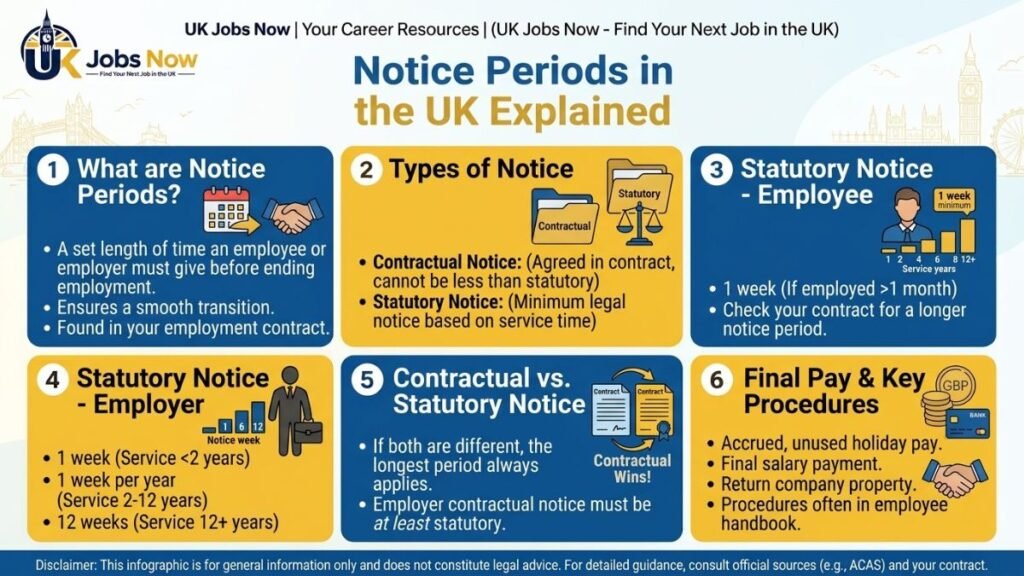
UK law sets out statutory minimum notice periods that apply regardless of what an individual employment contract says, as a baseline protection for both parties. For an employee resigning, the statutory minimum is one week’s notice once you’ve been continuously employed for one month or more, regardless of how long you’ve worked there beyond that point. For an employer terminating employment, the statutory minimum scales with length of service — generally one week’s notice per complete year of continuous service, up to a maximum of twelve weeks for employees with twelve or more years of service. These are minimums, not maximums, and many contracts specify longer notice periods than the statutory baseline, particularly for more senior roles.
Contractual notice periods versus statutory minimums
Your actual notice period is whichever is longer between your contractual notice period (specified in your employment contract or offer letter) and the statutory minimum described above. It’s genuinely common, particularly for more senior or specialist roles, for a contract to specify a considerably longer notice period than the statutory minimum — a month, three months, or occasionally longer for very senior positions — and it’s worth checking your specific contract directly rather than assuming the statutory minimum automatically applies, since your actual contractual obligation may well be longer.
What happens if your contract doesn’t specify a notice period
If your employment contract genuinely doesn’t specify a notice period at all, the statutory minimums described above apply by default. This is relatively uncommon for anything beyond informal or very short-term employment arrangements, since most formal contracts do specify a notice period explicitly, but it’s worth checking your specific documentation directly if you’re unsure, rather than assuming a specific figure without confirming it.
Negotiating your notice period with a new employer
If a new employer’s desired start date conflicts with your current notice period, it’s worth raising this directly and early, rather than waiting until closer to your intended start date to address a conflict you already know exists. Most reasonable employers understand that a genuinely professional candidate honours their existing contractual notice obligations, and a request to push back a start date by a few weeks to accommodate your notice period is a normal, common part of the hiring process rather than something to apologise excessively for.
Can you negotiate a shorter notice period with your current employer?
It’s sometimes possible to agree a shorter notice period with your current employer than your contract technically requires, but this requires their genuine, mutual agreement — you can’t simply decide unilaterally to serve a shorter notice period than your contract specifies without risking a breach of contract, even if you feel your reasons for wanting to leave sooner are genuinely compelling. If you need to leave earlier than your contractual notice period allows, it’s worth having a direct, honest conversation with your current employer explaining the situation, since many are willing to be flexible, particularly if you’re leaving on genuinely good terms and offer to support a smooth handover within the reduced time.
Garden leave: what it means
Some contracts, particularly at a more senior level, include a garden leave provision, where your employer can require you to stay away from work during some or all of your notice period, while still being paid, typically to protect sensitive information or client relationships during a transition to a competitor. If your contract includes this provision, it’s worth understanding it clearly before resigning, since it affects your practical timeline for starting a new role even though you’re technically still employed and being paid during the garden leave period.
Payment in lieu of notice (PILON)
Some employers offer, or specify in the contract, the option of payment in lieu of notice — where instead of working your full notice period, your employer pays you the equivalent salary for that period and you leave immediately. Whether this is available depends on your specific contract terms and your employer’s willingness to offer it, and it’s worth asking directly if a faster departure would genuinely help your situation, rather than assuming it’s automatically available or automatically unavailable.
A practical summary
| Situation | What applies |
|---|---|
| Contract specifies a notice period | The contractual period applies, provided it meets or exceeds the statutory minimum |
| No notice period specified in contract | Statutory minimum applies by default (one week from employee after one month’s service) |
| Wanting to leave before notice period ends | Requires mutual agreement with your current employer — not something you can decide unilaterally |
| Contract includes garden leave | Employer can require you to stay away from work during notice, while still paid |
Resigning professionally
However eager you are to leave, resigning professionally — a clear, polite written resignation, appropriate notice, and genuine effort to support a smooth handover — protects your professional reputation and future references. Industries and professional networks are often smaller and more interconnected than they initially appear, and a poorly handled departure can have longer-lasting consequences than the short-term relief of leaving abruptly might genuinely seem worth in the moment.
Notice periods during probation
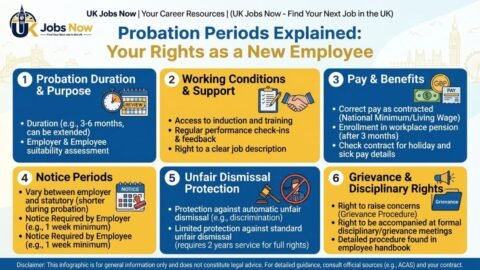
It’s worth knowing that notice periods during a probationary period are often shorter than the standard notice period that applies once probation is successfully completed — many contracts specify a reduced notice period, sometimes as short as one week on either side, specifically during probation, reflecting the more provisional nature of employment at this early stage. This is covered in more depth in our dedicated guide to probation periods, and it’s worth checking your specific contract’s probation-specific notice terms directly, since they can differ meaningfully from the standard post-probation notice period that applies later in your employment.
What happens to unused holiday when you resign
When you leave a role, you’re generally entitled to be paid for any statutory holiday entitlement you’ve accrued but not yet taken, calculated proportionally based on how far through the holiday year you are at your departure date. Conversely, if you’ve taken more holiday than you’d proportionally accrued by your departure date, your final pay may be adjusted to reflect this — it’s worth checking your specific contract terms and having a clear conversation with HR about your final pay calculation before your last day, rather than being caught off guard by an unexpected deduction.
Getting started
If you’re currently navigating a notice period alongside a new job offer, checking your specific contract directly and having an honest, timely conversation with both your current and prospective employer tends to produce the smoothest outcome. You can also browse current active UK job listings if you’re planning ahead for a future move and want to understand realistic timelines before actively starting a search.
Frequently Asked Questions
What is the statutory minimum notice period for resigning from a UK job?
One week, once you’ve been continuously employed for one month or more, though many contracts specify a longer contractual notice period that takes precedence over this statutory minimum.
Can I leave my job before my notice period ends?
Only with your employer’s genuine agreement — you can’t unilaterally decide to serve a shorter notice period than your contract requires without risking a breach of contract, even with good intentions.
What is garden leave?
A contractual provision, common in more senior roles, allowing an employer to require you to stay away from work during some or all of your notice period while still being paid, typically to protect sensitive information during a transition.
Can my notice period be paid out instead of worked?
Sometimes, through payment in lieu of notice (PILON), if your contract allows for it or your employer is willing to offer it — it’s worth asking directly if a faster departure would genuinely help your situation.
What should I do if my new job’s start date conflicts with my notice period?
Raise it directly and early with your prospective employer — most reasonable employers understand that honouring an existing notice obligation is a normal, professional part of changing jobs, and are usually willing to adjust a start date accordingly.