Zero-Hours Contracts Explained: What They Mean for You
Zero-hours contracts are one of the more genuinely divisive arrangements in the UK labour market, defended by some as valuable flexibility and criticised by others as one-sided insecurity dressed up as choice — and the honest truth is that both descriptions can be accurate depending on the specific employer and how the arrangement is actually used in practice. This is a practical, balanced guide to what a zero-hours contract genuinely means, the specific rights you retain despite the lack of guaranteed hours, and how to judge whether one is genuinely worth accepting in your own situation.
What a zero-hours contract actually is
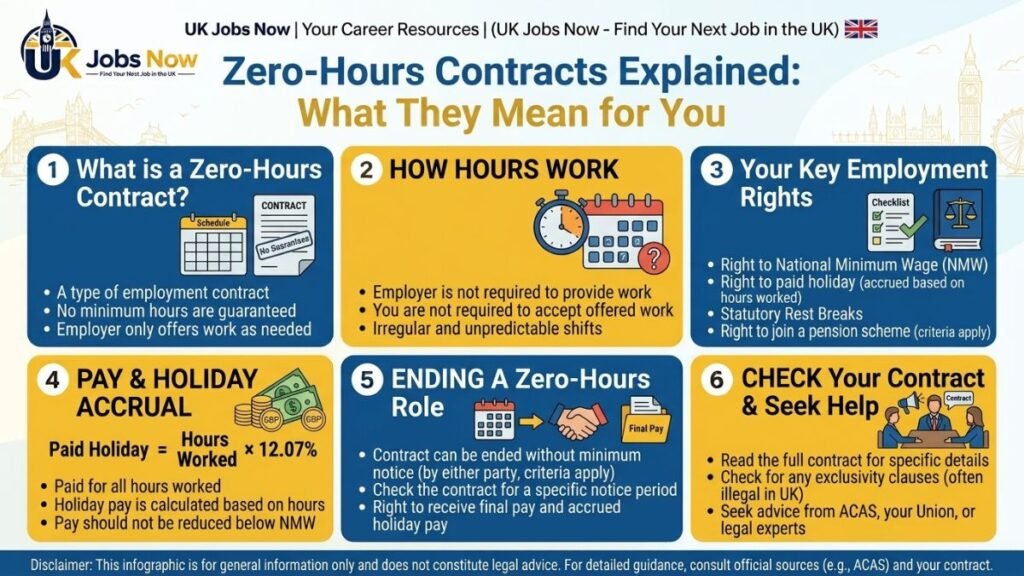
A zero-hours contract is an employment arrangement where your employer isn’t obliged to offer you a minimum number of working hours, and you’re generally not obliged to accept any specific hours offered, though the precise terms of individual contracts vary and it’s worth reading any specific contract carefully rather than assuming a single standard format applies universally. This structure means your income can genuinely fluctuate significantly week to week, depending entirely on how much work your employer offers and how much of it you choose to accept.
Rights you retain on a zero-hours contract
Despite the lack of guaranteed hours, zero-hours workers retain several genuine, specific statutory rights. You’re entitled to the National Minimum Wage or National Living Wage for whatever hours you actually work, statutory paid holiday entitlement calculated proportionally based on hours worked, and protection from unlawful discrimination, exactly the same as any other worker. You also have the right to work for other employers simultaneously, and any contractual clause attempting to prevent this — known as an exclusivity clause — is generally unenforceable under UK law for genuine zero-hours arrangements, meaning you’re legally entitled to seek additional or alternative work elsewhere even while under a zero-hours contract with one employer.
Employment status: worker versus employee
It’s worth understanding that zero-hours contract holders are typically classed as “workers” rather than full “employees” under UK employment law, which is a genuine, specific legal distinction with real practical consequences — workers have a narrower set of statutory rights than employees, notably lacking full unfair dismissal protection and statutory redundancy pay in most cases, rights that only apply once you’ve met specific length-of-service and employment-status thresholds. This distinction is worth understanding clearly rather than assuming “worker” and “employee” are interchangeable terms, since the specific rights that apply to your situation depend on which category genuinely describes your arrangement.
When zero-hours arrangements genuinely work well
It’s worth being fair about the situations where a zero-hours contract can genuinely suit someone’s circumstances — students needing flexibility around variable study commitments, people who deliberately want to work irregularly around other priorities, or those testing out a new type of role or employer before committing to more fixed hours. In these situations, the flexibility genuinely cuts both ways, and the arrangement can be a reasonable, even preferable choice compared to a fixed-hours commitment that wouldn’t accommodate the same flexibility.
When zero-hours arrangements are more genuinely problematic
The arrangement becomes more genuinely difficult when someone needs predictable, reliable income — supporting dependents, managing fixed regular costs like rent, or simply wanting basic financial stability — and finds themselves effectively dependent on a single employer’s inconsistent, unpredictable offers of work without the flexibility to easily supplement income elsewhere in practice, even where the legal right to do so exists. This gap between the legal flexibility on paper and the practical reality of managing genuinely unpredictable income is where most of the legitimate criticism of zero-hours contracts concentrates.
Questions worth asking before accepting a zero-hours role
| Question | Why it matters |
|---|---|
| How much work has been genuinely typical for existing staff recently? | Gives a realistic sense of actual likely hours, beyond the contract’s formal zero guarantee |
| How much advance notice is typically given for shifts? | Affects how practically compatible the role is with other commitments or a second job |
| Is there a genuine, realistic path to more guaranteed hours over time? | Relevant if you’re using the role as a stepping stone toward more stability |
| Will declining offered shifts genuinely be held against me? | Tests whether the stated flexibility to decline work is genuinely respected in practice |
Requesting a more predictable contract
UK workers with sufficiently irregular hours, including many zero-hours workers, have gained specific new rights in recent years to request a more predictable working pattern after a qualifying period of service — it’s worth checking the current specific eligibility criteria and process directly on GOV.UK, since this is an area of law that has evolved and continues to be refined, and staying current on your specific entitlements matters more here than relying on general awareness that such a right exists in some form.
Is a zero-hours contract worth accepting?
This depends genuinely on your specific circumstances and what alternatives are realistically available to you. If a zero-hours role is your only realistic option and it offers a reasonable, demonstrated pattern of consistent work in practice, it may be a genuinely reasonable choice, particularly as a stepping stone. If you have the option of a fixed-hours role at comparable pay, and financial predictability matters to you, that alternative is generally the more secure choice for most people’s practical needs, all else being equal.
Zero-hours contracts and part-time work: a genuine distinction
It’s worth clearly distinguishing a zero-hours contract from fixed part-time work, covered in more depth in our guide to part-time jobs — a fixed part-time contract guarantees a specific, agreed number of hours each week, while a zero-hours contract guarantees none at all. Both can loosely be described as offering “flexibility,” but the practical predictability of income is meaningfully different between the two, and it’s worth understanding exactly which arrangement a specific role actually offers, since job listings don’t always make this distinction as clear as they genuinely should for a prospective applicant.
How zero-hours contracts are typically used across different sectors
Zero-hours arrangements are particularly common in sectors with genuinely variable, hard-to-predict demand — hospitality, retail around seasonal peaks, and care work are among the most common. In some of these contexts, the arrangement reflects genuine, legitimate operational variability that a fixed-hours contract genuinely couldn’t accommodate well. In others, it’s used more as a way to shift the risk of variable demand entirely onto the worker rather than the business, which is where much of the more legitimate, widely voiced criticism of the arrangement is specifically directed by workers’ advocates and policymakers alike.
Combining a zero-hours role with other income sources
Given the legal right to work elsewhere while under a zero-hours contract, some people deliberately combine a zero-hours role with a second job or freelance work to build more predictable overall income, rather than relying on a single unpredictable source. This approach can genuinely work well, though it requires careful practical management of potentially overlapping or conflicting shift patterns between different commitments, and it’s worth being upfront with each employer about your other work where relevant, to avoid genuine scheduling conflicts arising unexpectedly.
Getting started
You can browse current active UK job listings filtered by job type to compare zero-hours, fixed part-time, and full-time opportunities directly, rather than accepting the first offer without weighing the genuine alternatives available.
Frequently Asked Questions
Am I entitled to holiday pay on a zero-hours contract?
Yes — zero-hours workers are entitled to statutory paid holiday, calculated proportionally based on the hours you actually work, exactly the same underlying entitlement as any other worker.
Can my employer stop me from working for someone else while on a zero-hours contract?
Generally no — exclusivity clauses preventing a genuine zero-hours worker from working elsewhere are largely unenforceable under UK law, meaning you’re legally entitled to seek additional or alternative work.
What’s the difference between a “worker” and an “employee” on a zero-hours contract?
Workers have a narrower set of statutory rights than full employees, notably around unfair dismissal protection and statutory redundancy pay, which typically require meeting specific length-of-service and employment-status thresholds that many zero-hours arrangements don’t reach.
Can I refuse shifts offered under a zero-hours contract?
Generally yes, since neither party is obliged to offer or accept hours under a genuine zero-hours arrangement, though it’s worth checking whether declining shifts is genuinely respected in practice at a specific employer before assuming this flexibility works both ways equally.
Do I have any right to more predictable hours if I’m on a zero-hours contract?
UK workers with sufficiently irregular hours have gained specific rights in recent years to request a more predictable working pattern after a qualifying period — it’s worth checking the current specific criteria directly on GOV.UK given this area of law continues to evolve.