Part-Time Jobs in the UK: Rights, Pay and How to Find One
Part-time work carries an unfair reputation in some corners of career advice as a lesser, stopgap option rather than a genuine, deliberate choice — but for parents balancing childcare, students funding their studies, people managing health conditions, or simply anyone who’s decided that fewer hours genuinely suits their life better right now, part-time work is a completely legitimate, mainstream way to earn an income in the UK, with real legal protections behind it. This is a practical guide to how part-time work actually functions, what rights you’re entitled to, and how to search for it effectively.
What counts as part-time work
There’s no single, fixed legal definition of “part-time” in UK employment law — it’s generally understood as working fewer hours than a comparable full-time role at the same employer, which is typically somewhere around 35 to 40 hours a week, though this varies by sector and individual employer. What matters more than the specific hour count is that part-time workers have the same fundamental employment status and protections as full-time workers, just calculated proportionally for the hours actually worked.
Your rights as a part-time worker
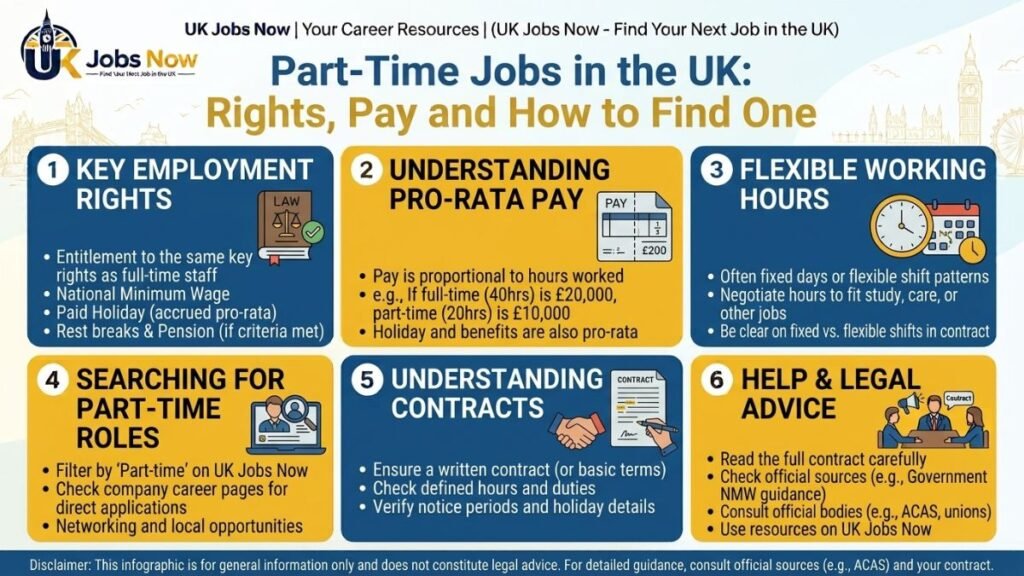
UK law specifically protects part-time workers from being treated less favourably than comparable full-time employees purely because of their part-time status, under the Part-time Workers Regulations. This means part-time workers are entitled to the same hourly rate of pay as a full-time equivalent doing the same job, pro-rata holiday entitlement calculated proportionally to hours worked, the same access to training and promotion opportunities, and the same statutory rights around notice periods, redundancy, and other core employment protections, all calculated proportionally where relevant to reflect the reduced hours. If you genuinely believe you’re being treated less favourably purely because you work part-time, this is a specific, actionable legal protection worth understanding and, where necessary, raising directly with your employer or seeking further advice on through ACAS.
Calculating pro-rata pay and holiday
Pro-rata calculations are simply proportional — if a full-time role at 40 hours a week pays a given annual salary, a role at 20 hours a week (half the full-time hours) would pay half that annual salary at the same hourly rate, and holiday entitlement is calculated the same way. It’s worth understanding this calculation yourself so you can sanity-check any pay or holiday figures quoted to you during a hiring process, since errors in pro-rata calculations do happen, whether through genuine mistake or otherwise.
Common part-time role types and where to find them
| Sector | Part-time availability |
|---|---|
| Retail | Very commonly available, particularly for customer-facing roles with flexible scheduling |
| Hospitality | Extremely common given the sector’s shift-based structure |
| Customer service | Commonly available, particularly for phone and remote-based roles |
| Administrative roles | Available, though often somewhat less common than in retail or hospitality |
| Professional and office-based roles generally | Increasingly available, particularly as flexible and hybrid working has become more normalised |
Searching effectively for part-time work
Beyond simply filtering job listings by part-time status, it’s worth being specific in your search about your exact availability and preferred hours, since “part-time” itself covers a genuinely wide range — anywhere from a few hours a week to close to full-time — and clarity about your specific needs upfront saves time for both you and a prospective employer. If you’re seeking part-time work in a field or at a seniority level where it’s less commonly advertised by default, it’s also worth directly asking a prospective employer whether a role advertised as full-time might have flexibility, since some employers are open to this even without explicitly advertising it.
Part-time work and career progression
It’s worth being honest that career progression while working part-time can, in some organisations and roles, move more slowly than a full-time equivalent, simply due to reduced hours and, in some cases, less organisational visibility — though this varies considerably by employer and specific role, and shouldn’t be assumed universally. If progression matters to you, it’s a reasonable and useful question to ask directly during a hiring process: how does this employer specifically support career development and promotion for part-time staff, rather than assuming either a positive or negative answer by default.
Combining part-time work with other commitments
Part-time work is often chosen specifically to balance alongside other genuine commitments — study, caring responsibilities, health considerations, or simply a deliberate choice to prioritise time outside work. It’s worth being upfront and clear about your availability during any application process, since misalignment discovered after starting a role tends to cause more disruption for both sides than addressing it directly and honestly from the outset, when adjustments are usually far easier to make.
Part-time work and Universal Credit or other benefits
If you’re claiming Universal Credit or another means-tested benefit, taking on part-time work will generally affect your entitlement, though the specific interaction depends on your individual circumstances, earnings, and which benefits you’re claiming. It’s genuinely worth understanding how a specific role’s pay would affect your situation before accepting it, and Citizens Advice or the GOV.UK benefits calculator are useful, independent starting points for this kind of specific calculation, since getting this wrong can create genuine, avoidable financial disruption that a small amount of upfront research would have prevented entirely.
Zero-hours contracts versus fixed part-time hours
It’s worth distinguishing part-time work with fixed, guaranteed hours from zero-hours contracts, which don’t guarantee any minimum number of hours at all and are covered in more depth in our dedicated guide to zero-hours contracts. Both fall broadly under the “part-time” umbrella in casual conversation, but they carry meaningfully different levels of income predictability, and it’s worth understanding which specific arrangement a role actually offers before accepting it, since a genuinely fixed part-time contract offers considerably more stability than a zero-hours arrangement even when the average number of hours worked ends up genuinely comparable between the two.
Negotiating part-time arrangements within an existing full-time role
Beyond searching for roles explicitly advertised as part-time, it’s worth knowing that negotiating a move from full-time to part-time hours within a role you already hold is a genuinely common and often successful approach, particularly if you have an established track record with your current employer. This typically involves a formal flexible working request, and it’s worth preparing a clear, specific proposal — the exact hours you’re requesting, how you’d manage your existing responsibilities within reduced hours, and any relevant personal context you’re comfortable sharing — rather than a vague, open-ended request, since a well-prepared, specific proposal is generally easier for an employer to properly consider, discuss, and ultimately approve.
Building a CV that reflects part-time experience well
There’s no need to apologise for or downplay part-time roles on a CV — describe the achievements and responsibilities within a part-time position with exactly the same specific, results-focused language covered in our guide to writing a UK CV, since the value of your work isn’t diminished by the number of hours it took to deliver it. If a role’s part-time status genuinely isn’t relevant to how you’re presenting your experience, there’s no requirement to explicitly flag it on the CV itself at all, beyond noting accurate dates of employment.
Getting started
You can browse current active UK job listings filtered by the part-time job type across every category and region to see current openings genuinely suited to reduced-hours working.
Frequently Asked Questions
Do part-time workers get the same hourly pay as full-time employees?
Yes — UK law requires that part-time workers receive the same hourly rate as a comparable full-time employee doing the same job, under the Part-time Workers Regulations, with holiday and other entitlements calculated proportionally.
How many hours count as part-time in the UK?
There’s no single fixed legal definition, but it’s generally understood as fewer hours than a comparable full-time role at the same employer, which is typically around 35 to 40 hours a week depending on the sector and employer.
Can I ask my employer to reduce my hours to part-time?
Many employees have a statutory right to request flexible working, including reduced hours, though the specific eligibility criteria and process are worth checking directly on GOV.UK, since requirements and employer obligations can change.
Does working part-time affect my chances of promotion?
It can, in some organisations, move more slowly than for full-time staff, though this varies considerably by employer — it’s a reasonable question to ask directly during a hiring process rather than assuming either outcome.
Is it harder to find part-time work in professional or office-based roles?
Traditionally somewhat, compared to sectors like retail and hospitality, though this has genuinely improved as flexible and hybrid working has become more normalised — it’s worth asking directly whether a role advertised as full-time might have flexibility even if not explicitly stated.