Graduate Schemes Explained: Are They Worth It?
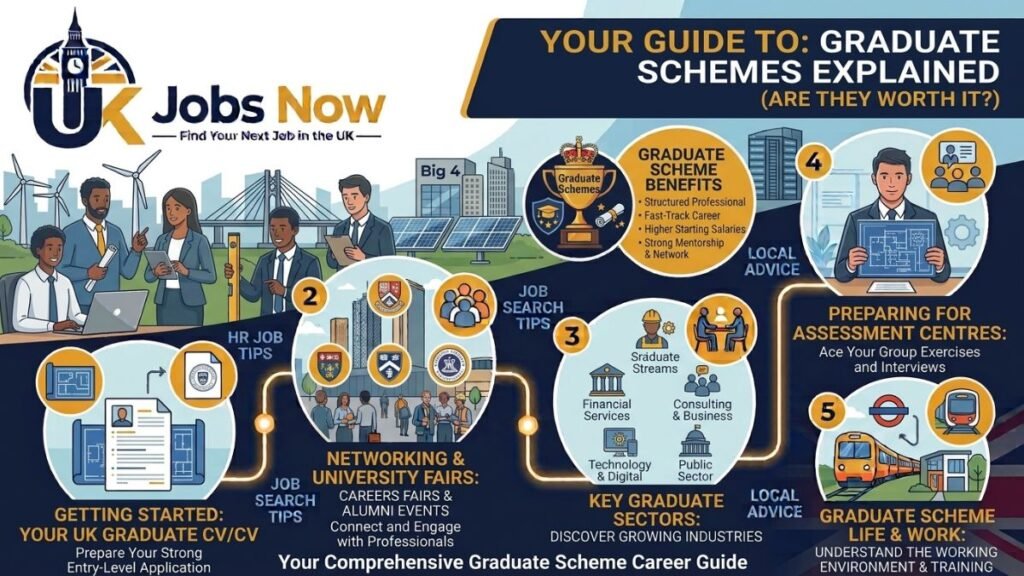
Graduate schemes get pitched as the default, prestigious route out of university, and for some genuinely strong candidates in specific fields, they are. But they’re also a narrower, more specific product than the recruitment marketing around them often suggests — structured, time-limited, often highly competitive, and genuinely better suited to some people and career goals than others. This is a practical, honest look at how UK graduate schemes actually work, what they genuinely offer, and how to judge whether one is worth the considerable effort a competitive application typically requires.
What a graduate scheme actually is
A graduate scheme is a structured, typically one-to-three-year programme run by an employer specifically for recent graduates, usually combining rotational placements across different parts of the business, formal training and development support, and often a defined path toward a specific qualification or professional accreditation relevant to the field. This deliberate structure is what distinguishes a graduate scheme from simply being hired into a standard entry-level role — the defining feature is the deliberate, structured development pathway built around your first few years, rather than a role with a fixed, single set of responsibilities from day one.
The genuine benefits of a structured scheme
Beyond the training itself, a well-run graduate scheme offers a few things genuinely harder to replicate through a standard entry-level hire: broad early exposure to different parts of a business through rotational placements, which helps you discover which specific area you’re most drawn to before committing to a narrower specialism; a cohort of fellow graduates going through the same structured experience together, which can provide genuine peer support, friendship, and networking value that persists well beyond the scheme itself; and, for schemes connected to a professional qualification, formal, employer-funded support toward that qualification, which can be a genuinely significant financial and structural advantage compared to pursuing the same qualification independently.
Why graduate schemes are often genuinely competitive
Well-known graduate schemes at large, prestigious UK employers often receive a very high volume of applications relative to the number of places genuinely available, which means the application process is typically more extensive and demanding than a standard entry-level application — commonly involving an online application form with specific competency-based questions, one or more psychometric tests (covered in more depth in our guide to psychometric tests), a video interview, and often a final-stage assessment centre, covered in our guide to UK assessment centres. Treating a competitive graduate scheme application with this level of seriousness from the start — rather than underestimating the process — genuinely matters given how many stages a typical application involves.
Application timing: earlier than many candidates expect
A genuinely important, often underappreciated fact about UK graduate schemes: many open their applications considerably earlier than students expect, sometimes over a year before the actual start date, and popular schemes can close applications well before their official deadline once they’ve received sufficient volume. Starting your research and preparation genuinely early in your final year of study, rather than waiting until closer to graduation, is one of the most practically important pieces of advice for anyone specifically targeting competitive graduate schemes, since missing an early application window can mean missing the opportunity entirely for that year’s intake and having to wait a full year for the next cycle.
Graduate schemes versus direct entry-level applications
| Factor | Graduate scheme | Direct entry-level role |
|---|---|---|
| Structure | Formal, structured rotations and development plan | Typically a single, defined role from the start |
| Application process | Often extensive — multiple stages, tests, assessment centres | Usually more straightforward — CV, interview |
| Competition level | Often very high for well-known schemes | Varies, generally less concentrated than top graduate schemes |
| Flexibility to explore different areas early | Often built in through rotations | Limited — you’re typically hired into one specific area |
Are graduate schemes worth it?
This genuinely depends on your specific field and career goals, and it’s worth being honest that a graduate scheme isn’t automatically the superior choice for everyone. If you’re genuinely unsure which specific area of a broad field appeals to you, and want structured, employer-funded exposure to help you decide, a graduate scheme’s rotational structure offers real value that a direct entry-level hire into one fixed role doesn’t. If you already know precisely what specific role and specialism you want, and a direct entry-level position offers that more quickly and with a less demanding application process, it’s entirely reasonable to bypass the graduate scheme route entirely and apply directly — plenty of genuinely successful careers never involved a formal graduate scheme at all, having been built instead through direct hires and steady internal progression.
Preparing a strong graduate scheme application
Given the volume of applications competitive schemes receive, genuine tailoring matters even more than for a typical job application — research the specific scheme’s stated values and competencies closely, and prepare specific, real examples that map directly onto what they say they’re assessing, rather than generic examples reused across every application. Our guide to common UK interview questions and the STAR method is directly relevant preparation for the interview stages, and it’s worth budgeting genuinely significant time for a competitive scheme’s full multi-stage process rather than assuming it will move as quickly as a standard job application, since the gap between initial application and a final offer can easily stretch across several months.
What happens if you don’t get onto a graduate scheme
A rejected graduate scheme application is genuinely common, given how competitive well-known schemes are, and it’s worth not treating it as a verdict on your overall employability — many candidates who don’t secure a place on a formal scheme go on to build genuinely strong careers through direct entry-level roles at the same or comparable employers, sometimes even moving into more senior positions faster than they might have through a structured scheme’s fixed rotational timeline, since a direct hire can occasionally progress on a less rigid schedule. Our guide to handling job rejection is worth reading if a competitive scheme application doesn’t work out, since the same principles about not over-generalising from one outcome apply directly here.
Sector-specific graduate scheme patterns worth knowing
Graduate scheme prevalence and structure varies considerably by sector — they’re particularly well-established and competitive in areas like finance, consulting, law, and large corporate retail and consumer goods companies, while some sectors, including much of the creative industries, technology startups, and smaller businesses generally, more commonly hire graduates directly into standard entry-level roles rather than running formal, structured schemes. It’s worth understanding your specific target sector’s typical hiring pattern before assuming a graduate scheme is the default or only route available, since in some fields it genuinely isn’t the primary way most people enter, and a direct application may be both faster and equally credible.
Getting started
If you’re weighing graduate schemes against direct entry-level roles, it’s worth researching both routes actively rather than assuming one is automatically better — you can browse current active UK job listings filtered by the graduate job type to see current direct entry-level and graduate-specific openings across sectors.
Frequently Asked Questions
When should I start applying for graduate schemes?
Often considerably earlier than expected — many schemes open applications over a year before the actual start date, and popular ones can close early once they’ve received sufficient volume, so starting research and preparation early in your final year of study is genuinely important.
Are graduate schemes better than a direct entry-level job?
Not automatically — it depends on your specific goals. Graduate schemes offer structured, broad early exposure through rotations, which suits candidates genuinely unsure which specific area appeals to them; a direct entry-level role can be faster and more straightforward if you already know exactly what you want and don’t need that broader exploratory period built into your first year or two of work.
How competitive are UK graduate schemes typically?
Well-known schemes at large, prestigious employers often receive a very high volume of applications relative to available places, resulting in a genuinely demanding, multi-stage selection process.
Do all graduate schemes involve rotations across different parts of the business?
Many do, though the specific structure varies by employer and scheme — it’s worth checking a specific programme’s actual structure directly rather than assuming all schemes follow an identical format.
Can I still have a successful career without doing a graduate scheme?
Yes, absolutely — plenty of genuinely successful careers are built through direct entry-level roles, lateral moves, and other non-scheme routes, and a graduate scheme is one legitimate path among several, not a requirement for career success.