Unfair Dismissal Rights From January 2027: What Changes for Employees
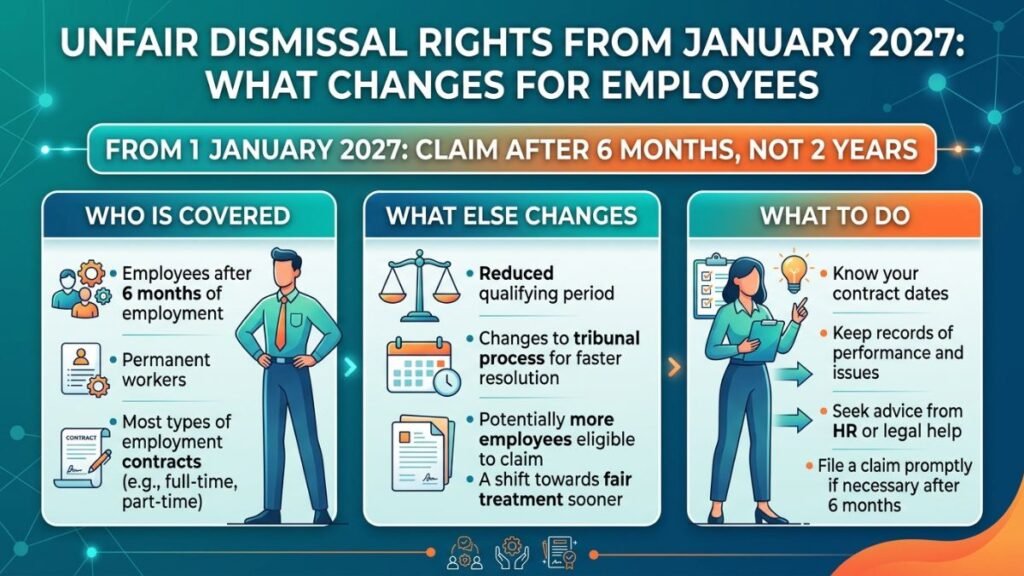
If you have started a new job in the last couple of years, one change to UK employment law matters more than almost any other. From 1 January 2027, most employees will be able to claim unfair dismissal after six months in the job instead of two years. This guide explains what is changing, who gains protection and when, what is not changing, and what you can do to prepare.
This article is general information for employees in Great Britain, not legal advice. For a specific situation, speak to Acas, Citizens Advice, a union or a solicitor.
The short version
- Qualifying period: drops from two years of continuous service to six months for dismissals on or after 1 January 2027.
- Compensation cap: the limit on the compensatory award for ordinary unfair dismissal claims is being removed.
- Not a day-one right: the government originally planned protection from the first day of a job, but the final law settled on six months.
- Automatic protections stay: claims such as dismissal for whistleblowing or discrimination never needed a qualifying period and still do not.
What is changing and why
The change comes from the Employment Rights Act 2025, which received Royal Assent on 18 December 2025. Until now, an employee normally needed two years of continuous service before they could bring an ordinary unfair dismissal claim. That gave employers wide freedom to let newer staff go without following a formal fair process.
The original plan was to make unfair dismissal a right from day one, alongside a lighter statutory probation process. Both ideas were dropped before the Act was finalised. The compromise is a six-month qualifying period, with the commencement date set for 1 January 2027.
Who gains protection, and when
The new rule applies where the effective date of termination (the day your employment actually ends) falls on or after 1 January 2027. The practical effect is that anyone who already has six months of continuous service on that date is protected straight away.
| When you started the job | When you can claim for ordinary unfair dismissal |
|---|---|
| Before 1 July 2026 | From 1 January 2027 |
| 1 July 2026 | From 1 January 2027 |
| 1 October 2026 | From 1 April 2027 |
| 15 January 2027 | From 15 July 2027 |
Some people will gain more than others. Someone who started in March 2025 would previously have waited until March 2027. Under the new rule they are covered from 1 January 2027.
A note on notice. Statutory rules can add the minimum statutory notice period to an employee’s length of service when an employer dismisses someone just short of qualifying. In practice, an employee dismissed in the last days of December 2026 may find their termination date falls in January 2027 and brings them under the new threshold. If this applies to you, get advice quickly, because time limits are short.
What counts as a fair dismissal
Once you have qualifying service, your employer needs a fair reason and a fair process. The potentially fair reasons are:
- Conduct, such as misconduct or breaking workplace rules
- Capability, meaning performance or ill health
- Redundancy, where the role genuinely is no longer needed
- Statutory restriction, where continuing the job would break the law
- Some other substantial reason, a catch-all category
A fair reason is not enough alone. The employer must also act reasonably in the way they handle it, which usually means telling you the concern, giving you a chance to respond and, where relevant, a chance to improve. Acas publishes a code of practice on disciplinary and grievance procedures that tribunals take into account.
The compensation cap is going
Currently, the compensatory award for ordinary unfair dismissal is capped at the lower of a set number of weeks’ pay or a fixed statutory amount. From January 2027 that limit is removed. This matters most for higher earners, who were previously the most constrained by the cap. Compensation is still based on your actual losses and is not an automatic windfall, but the ceiling disappears.
What this means for probation periods
Many employers use a three or six month probation. Under the old law, that sat comfortably inside the two-year window, so a probation dismissal rarely led to an unfair dismissal claim. From 2027, a probation that runs to six months, or is extended, can bring you into protected territory.
For you as an employee, that means:
- Dismissal at the end of a six-month probation can now be challenged if the reason or process was unfair.
- Employers are likely to review performance earlier, often around months three and five, so ask for clear feedback and written objectives.
- An extended probation is worth taking seriously. Ask what specific concerns need to be addressed.
Our guide to probation periods and your rights covers the practical side of these conversations, and our guide to notice periods in the UK explains how notice works during and after probation.
What is not changing
- Automatically unfair dismissals such as dismissal for whistleblowing, raising a health and safety concern, asserting a statutory right, or reasons linked to pregnancy and maternity still need no qualifying service.
- Discrimination claims under the Equality Act 2010 never required a minimum period and still do not.
- Other dismissal rights, including wrongful dismissal for breach of contract, work separately from unfair dismissal.
- Redundancy pay has its own eligibility rules and is not affected by this change.
The Act also lowers the service needed to request written reasons for dismissal to six months, in line with the new threshold.
If you are dismissed: what to do
- Ask for the reason in writing and keep every email, letter and message about the decision.
- Check your dates. Confirm your start date, your continuous service and your effective date of termination.
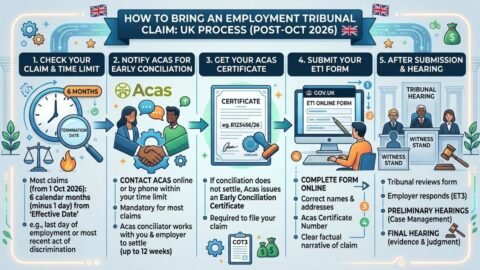
- Act quickly. The usual time limit to start a tribunal claim is three months less one day from the termination date, and you must go through Acas early conciliation first.
- Contact Acas, Citizens Advice or your union for free guidance before you decide anything.
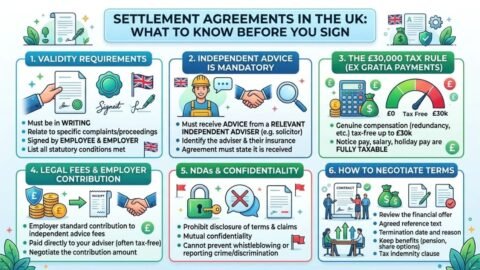
- Be careful with settlement agreements. Do not sign without understanding what rights you are giving up. Independent legal advice is normally required for the agreement to be valid.
What if you are job hunting right now?
The new rules make it worth reading the contract before you accept an offer. Check the probation length, the notice terms and any clause that lets the employer extend probation. Our guide to understanding your employment contract explains the key terms. When you are ready to look, you can browse current UK job listings.
Frequently asked questions
When do the new unfair dismissal rules start?
They apply to dismissals where the effective date of termination is on or after 1 January 2027.
Is unfair dismissal a day-one right?
No. The government first proposed that, but the final Act set a six-month qualifying period.
I started my job in August 2026. When can I claim?
You will reach six months of continuous service in February 2027, so you would be able to claim for an ordinary unfair dismissal from then.
Does this apply in Northern Ireland?
Employment law is devolved in Northern Ireland, and the Employment Rights Act 2025 mainly covers Great Britain. If you work in Northern Ireland, check the position with the Labour Relations Agency.
Can I be dismissed during probation after January 2027?
Yes, but if you have six months of service, the dismissal must be for a fair reason and follow a fair process. Before six months, you still have no ordinary unfair dismissal claim, although automatic protections and discrimination law apply from day one.
Does the compensation cap really disappear?
Yes. The cap on the compensatory award for ordinary unfair dismissal is removed from the same date, although you must still show financial loss.
Where can I get free advice?
Acas, Citizens Advice and trade unions all offer free guidance, and Acas runs the early conciliation service you must use before making a tribunal claim.
Sources to check before you rely on this
Employment law is changing quickly, so confirm the current position on GOV.UK and the Acas website before acting. We update this guide as commencement details are confirmed.