Right to Work in the UK: Documents, Share Codes and Employer Checks
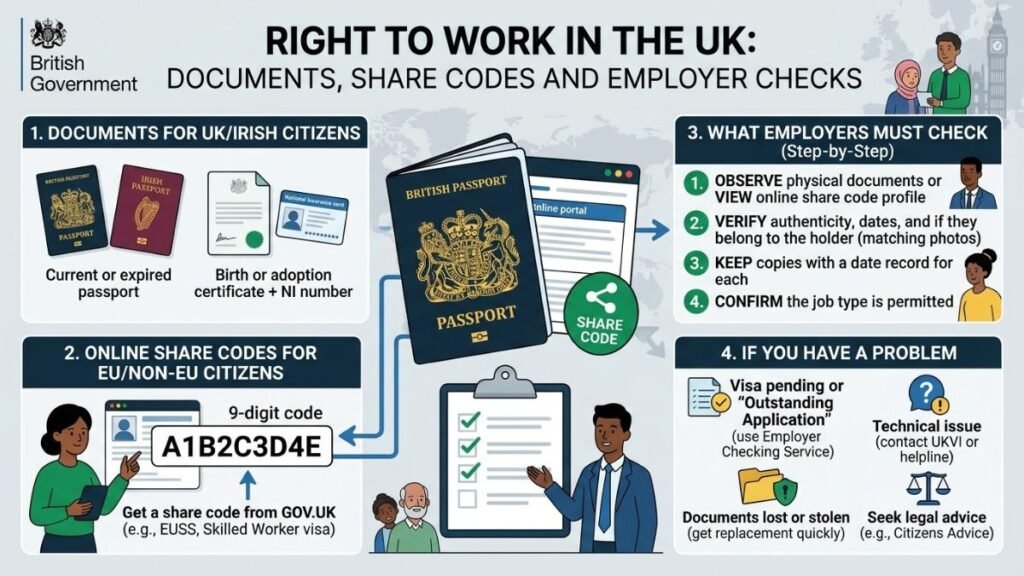
Before you start almost any job in the UK, your employer must check that you are legally allowed to work. These right to work checks catch many job seekers by surprise, especially people who hold an eVisa, have lost an old document, or are waiting for a decision from the Home Office. This guide explains what the check involves, which documents are accepted, how share codes work, and what to do if you have a problem.
Quick answer: Employers must check your right to work before you start. British and Irish citizens usually show a passport. Most other people prove their status online with a share code from their UKVI account. Employers who get this wrong can face fines of up to £60,000 per worker, so they take it seriously.
What is a right to work check?
A right to work check is a legal check an employer carries out to confirm that you are allowed to do the job in the UK. If the employer does the check correctly, it gives them a statutory excuse against a civil penalty if it later turns out that you were working illegally.
Key points:
- The check must be done before you start work, not after.
- It applies to every new employee, including British citizens, part-time, temporary and seasonal staff.
- If your permission to work has an end date, your employer must do a follow-up check before it expires.
- The check is about your right to work, not your nationality, so employers must not treat people differently because of how they look or sound. Discrimination is against the law.
If you are applying for jobs, expect to be asked about your right to work at the application, interview or job offer stage. Many employers make the offer conditional on passing the check.
The three ways employers can check
The Home Office allows three methods. Your employer will choose one based on your situation.
| Method | Who it suits | How it works |
|---|---|---|
| Online check with a share code | People with an eVisa or other digital immigration status, including EU Settlement Scheme holders | You generate a share code from your UKVI account and give it to your employer with your date of birth. They check it on GOV.UK |
| Manual document check | British and Irish citizens, and anyone with acceptable original documents | You show your original documents. The employer checks them, in your presence or by live video where allowed, and keeps a dated copy |
| Digital check through a certified provider | British and Irish citizens with a valid passport or Irish passport card | A registered digital identity service checks your passport and face remotely |
If you hold an eVisa, you must be checked online with a share code. A digital provider cannot replace the online check for someone with an eVisa.
Share codes explained
If your immigration status is held digitally (an eVisa), you prove your right to work with a share code.
- It is a 9-character code that begins with the letter W.
- It is valid for 90 days, so you can use it for several employers during that time.
- You give it to the employer along with your date of birth.
- The employer enters both on the GOV.UK service and sees a page confirming whether you can work, any conditions, and your photo. They check that the photo matches you.
How to get a share code
- Go to the official GOV.UK service for viewing and proving your immigration status.
- Sign in to your UKVI account.
- Choose to prove your right to work and generate a share code.
- Give the code to your employer, or ask the recruiter to check it.
Do not pay anyone to generate a share code for you. The service is free and you do it yourself.
Who needs a share code?
This applies to most people who are not British or Irish citizens, including:
- Holders of Skilled Worker, Health and Care Worker, Graduate, Student and other visas that are held as an eVisa
- EU Settlement Scheme holders (settled and pre-settled status)
- Frontier worker permit holders
British and Irish citizens cannot get a share code, because their passport proves their right to work.
Old cards and BRPs
Biometric residence permits (BRPs) and cards issued under older schemes have been phased out in favour of eVisas. If you still carry an old card, do not rely on it. Create or update your UKVI account and use a share code instead. If your account details are out of date, update them before you start applying for jobs, because fixing problems can take time.
Documents accepted for a manual check
If you are checked manually, the employer must see original documents from one of two lists.
List A: ongoing right to work
These show you have a permanent right to work, so no follow-up check is needed:
- A British or Irish passport (current, or expired in some cases)
- An Irish passport card
- A UK birth or adoption certificate, together with an official document showing your National Insurance number
- A certificate of registration or naturalisation as a British citizen, with proof of your National Insurance number
- Certain documents that show you are exempt from immigration control
List B: time-limited right to work
These show you can work for now, but your employer must check again before the expiry date. Which documents qualify has changed as the Home Office has moved to digital status, so check the latest list on GOV.UK. If your right to work depends on an eVisa, you will be asked for a share code instead.
The employer must copy and date each document and keep the copy for the whole time you work for them and for two years afterwards.
A National Insurance number is not enough on its own. It is not proof of the right to work, although an official document showing it can be one part of a List A combination.
What you need to do before your first day
- Tell the employer early if you need a share code or if your documents are not straightforward.
- Sort your UKVI account if you have an eVisa, and check that your details and photo are up to date.
- Take your original documents to the interview or first day, if you are being checked manually. Photocopies and scans are not enough for a manual check.
- Allow time. Do not hand in notice at your current job until you have a confirmed start date and your new employer has done the check. See our guide to notice periods in the UK.
- Have your National Insurance number ready, or apply for one. It is needed for payroll, but you can usually start work while you are waiting.
- Keep your visa conditions in mind. For example, some visas limit your working hours or the type of work. Working outside your conditions can put your immigration status at risk.
What if you can’t produce the usual documents?
Some people cannot get documents or a share code through no fault of their own. Common situations include:
- A pending application or appeal. The employer may be able to use the Home Office’s Employer Checking Service to confirm your right to work.
- A lost passport or documents. Contact the relevant authorities and ask the employer what else you can show. A British citizen without a passport may be able to use a birth certificate plus National Insurance evidence.
- A problem with your UKVI account or eVisa. Contact UKVI, and keep a record of your attempts.
If an employer will not accept valid proof, or treats you differently because of your background, you can get free advice from Acas or the Equality Advisory and Support Service.
Special situations
Students
International students may have limits on the hours they can work during term time and in some cases on the type of work. The rules depend on your course and visa, so check your visa conditions and your university’s guidance before accepting a job.
Graduates and other visa holders
Many visa types let you work, but conditions vary. Check your eVisa status online. If your visa is due to end, your employer will need to check again before the date shown.
Agency and temporary work
Agencies must check your right to work before they send you to a client. See our guides to warehouse jobs in the UK and Christmas jobs in the UK 2026 if you are looking for temporary roles.
Self-employed, gig and other working arrangements
The Home Office has extended the right to work check scheme to more working arrangements from 1 October 2026. That could affect some gig, agency and contractor engagements. The details are in a new code of practice and employer guidance, so check GOV.UK for the latest position. Self-employed people should still make sure they are allowed to work in the way they plan to.
Jobs with extra checks
Some jobs need more than a right to work check, such as a criminal record check or security vetting. See our guides to how to get an airport job in the UK and how to get an SIA licence and work as a security guard.
Why employers are so careful
Employers face civil penalties for employing someone who is not allowed to work. The maximum penalty is up to £60,000 per illegal worker for a repeat breach, with a starting point of £45,000 for a first breach. Serious cases can lead to criminal prosecution, closure of a business and loss of a sponsor licence. This is why many employers insist on proper checks, and why you should not take offence if you are asked.
For you, working illegally can also have serious consequences, including problems with future visa applications. Never work without the right to do so, and be careful of anyone who offers you a job without checking.
Right to work scams and risks
Immigration is a favourite subject for scammers. Be wary of:
- Anyone who charges you a fee to “generate” or “verify” a share code
- Job offers that say no right to work check is needed, which usually means the job is illegal or fake
- Anyone who asks you to hand over your passport to hold it for them
- Fake agents who promise visas, sponsorship or NHS jobs in return for payment
- Requests for your documents by WhatsApp or email before you have a real job offer
Only share documents with an employer or agency you have checked. Read our guides to how to spot a fake job advert in the UK and jobs with visa sponsorship in the UK.
Frequently asked questions
Do British citizens need a right to work check? Yes. Employers must check everyone. British citizens usually show a passport or other List A document.
Can I start work before the check is done? No. The employer must do the check before you start. If they cannot complete it, they should not let you begin.
What is a share code? A 9-character code starting with W that you generate in your UKVI account. Employers use it to check your right to work online.
How long is a share code valid? For 90 days, and you can use it with more than one employer in that period.
Do I need to pay for a share code? No. It is a free government service.
Can an employer ask for a specific document? No. You can choose which acceptable document to show. If you hold an eVisa, you will need to provide a share code.
Is a National Insurance number proof of the right to work? No. It is needed for tax and payroll but does not prove your right to work on its own.
Will my employer check again later? If your permission to work has an expiry date, yes. Your employer must do a follow-up check before it ends.
What happens if my visa expires? You must stop working if you no longer have the right to work. Apply to extend or change your visa before it expires, and tell your employer.
Final thoughts
A right to work check is a normal part of getting a job in the UK. The easiest way through it is to prepare: keep your documents safe, make sure your UKVI account is up to date, and tell your employer early if you need extra time. Browse the latest vacancies on our UK jobs board, and apply directly to employers.
This article is general information, not immigration or legal advice. Home Office rules and guidance change often, including the changes that started on 1 October 2026. Check GOV.UK for the latest requirements, and speak to a regulated immigration adviser about your own situation.