Job Search Burnout: How to Keep Going Without Losing Motivation
Somewhere around week six or eight of an intensive job search, a specific kind of exhaustion tends to set in — not just disappointment about any single rejection, but a broader depletion where opening the job board itself starts to feel heavy. This is genuinely common, it has a name (job search burnout), and it’s worth taking seriously rather than just pushing through on willpower, because burnout tends to make the underlying search less effective, not just less pleasant.
Why job searching burns people out in a specific way
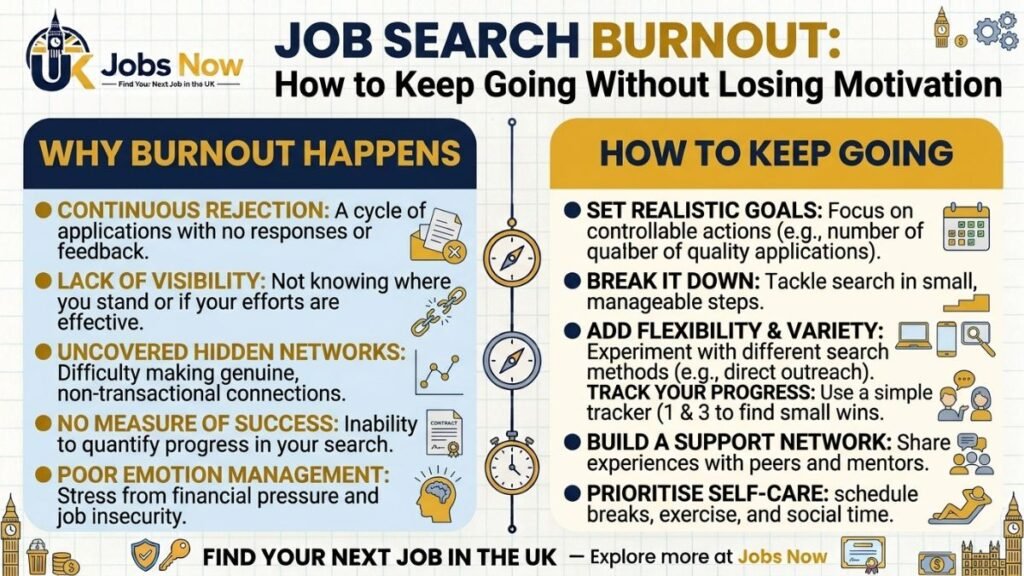
Job searching has a few features that make it particularly prone to burnout compared to other demanding tasks. It combines genuine effort (writing tailored applications, preparing for interviews) with a high rate of rejection or silence, no guaranteed timeline for when it ends, and — for anyone searching while unemployed — often real financial pressure layered on top. Unlike a job itself, where effort generally has some predictable relationship to outcome, job searching can involve a strong application and genuine effort producing no response at all, for reasons entirely outside your control. That combination of effort, uncertainty, and limited control is a well-documented recipe for burnout in almost any context, and a job search has all three in abundance.
Recognising the signs before they compound
Burnout tends to build gradually rather than arriving all at once, which is part of why it’s easy to miss until it’s fairly advanced. Worth paying attention to: a growing reluctance to even open job listings, applications becoming noticeably less tailored and more rushed than they used to be, difficulty concentrating during interview preparation, increased irritability or low mood that seems connected to the search specifically, and a creeping sense that nothing you do will make a difference regardless of effort. None of these individually is alarming, but a cluster of several, sustained over a couple of weeks, is worth acting on deliberately rather than waiting for it to resolve on its own.
Why burnout makes your search less effective, not just less pleasant
It’s worth being clear about the practical, not just emotional, cost of burnout here. A rushed, generic application written while burnt out is measurably weaker than a tailored one — and given how much a tailored CV and cover letter genuinely affect response rates, burnout can create a discouraging cycle where declining energy produces weaker applications, which produce fewer responses, which deepens the burnout further. Addressing burnout directly isn’t a distraction from your search; it’s a genuinely practical step toward making the rest of your search more effective.
Practical steps that actually help
Build in genuine structure, including deliberate breaks
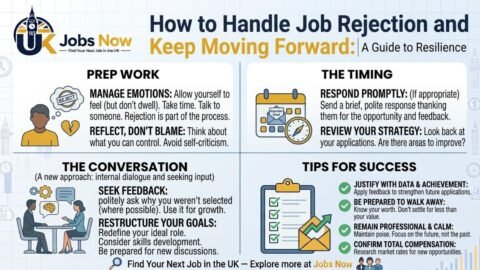
Unstructured job searching — checking listings sporadically throughout the entire day, with no clear start or stop — tends to feel both more exhausting and less productive than a more contained approach. Setting specific times for job search activity, and genuinely stepping away from it outside those windows, protects both your energy and, somewhat counterintuitively, your actual output during the time you are searching.
Separate the parts of your identity from the outcome of any single application
This is easier said than done, but it’s a genuinely important reframe: a rejection reflects fit for one specific role against one specific candidate pool at one specific moment, not a comprehensive verdict on your worth or ability. Our guide to handling job rejection covers this distinction in more depth, and it’s particularly relevant to burnout specifically, since repeatedly internalising rejection as personal failure is one of the more direct paths toward exhaustion.
Track genuine progress, not just final outcomes
Our guide to organising your job search with a tracker is relevant here too — a tracker that shows interview invitations, positive feedback, and other genuine signals of progress, not just a tally of rejections, tends to give a more accurate and less discouraging picture of how a search is actually going than memory alone, which tends to weight recent negative experiences disproportionately.
Protect activities and relationships outside the search entirely
It’s genuinely common, particularly during an unemployed job search, for the search itself to expand to fill all available time and headspace, crowding out exercise, social contact, and downtime that would normally provide balance. Deliberately protecting some of this — even a modest amount — tends to improve both wellbeing and, indirectly, the quality of your search, since arriving at an application or interview with some genuine reserve of energy produces better results than arriving depleted.
Adjust your target volume if it’s become unsustainable
There’s a common but often counterproductive instinct to respond to a slow search by applying to even more roles, faster, with less care per application. If this is happening, it’s worth deliberately reversing it — a smaller number of genuinely well-tailored applications, sustainably paced, tends to outperform a higher volume of rushed ones, both in results and in how sustainable the search feels day to day.
A simple self-check
| Sign | What it might indicate |
|---|---|
| Dreading opening job listings each day | Early burnout — worth building in more structure and breaks before it deepens |
| Applications getting noticeably shorter and less tailored | Energy depletion affecting quality — worth reducing volume and refocusing on fewer, stronger applications |
| Persistent low mood connected specifically to the search | Worth addressing directly, potentially including a conversation with a GP or counsellor if it’s sustained or severe |
| Feeling nothing you do makes a difference | A sign to revisit your tracker for genuine positive signals you may be underweighting |
When it’s worth seeking additional support
If burnout is severe, sustained over an extended period, or connected to broader low mood or anxiety that feels beyond what’s proportionate to the job search itself, it’s worth treating this as a genuine wellbeing concern, not just a job search inconvenience — a conversation with a GP, or accessing NHS talking therapies (available through self-referral in England via NHS Talking Therapies), is a reasonable and appropriately serious step, not an overreaction. Financial pressure connected to unemployment can also be a significant contributing factor, and organisations like Citizens Advice can provide practical support alongside any emotional aspect of what you’re managing.
Keeping the search moving without pushing through burnout blindly
The goal isn’t to stop searching entirely, but to search in a way that’s sustainable enough to actually reach a good outcome, rather than one that burns out before it does. Once you’ve built in some structure and protected your energy a little better, you can return to browsing current active UK job listings with renewed, more sustainable focus, rather than the depleted, joyless scrolling that tends to characterise burnout at its worst.
How burnout can quietly affect interview performance too
It’s worth being aware that burnout doesn’t only affect application quality — it can genuinely show up in interviews as well, in the form of flattened energy, less enthusiasm coming across than you actually feel, or slower, less sharp thinking during competency-based questions that reward quick, clear examples. If you notice this happening, it’s worth treating a scheduled interview as a genuine reason to prioritise rest and recovery in the day or two beforehand, even if that means temporarily pausing other search activity, rather than arriving at a genuinely important conversation running on empty.
Financial pressure as a specific driver of burnout
For anyone searching while unemployed, financial pressure often sits underneath and intensifies burnout in a way that’s worth naming directly rather than treating purely as a motivation or mindset issue. If money worries are a significant part of what’s driving exhaustion, it’s worth seeking practical support alongside anything else — Citizens Advice offers free, practical guidance on benefits, budgeting, and financial support during unemployment, and addressing this concrete pressure directly can meaningfully ease the broader sense of burnout, even before the job search itself resolves.
Frequently Asked Questions
Is job search burnout a real, recognised issue, or just normal frustration?
It’s a genuine and well-documented experience, distinct from ordinary day-to-day frustration — a sustained pattern of exhaustion, reduced motivation, and declining application quality connected specifically to job searching, rather than a single bad day.
How do I know if I’m burnt out versus just having a difficult week?
Burnout tends to be a sustained pattern over a couple of weeks or more — persistent dread, declining application quality, low mood — rather than a single difficult day or a normal reaction to one disappointing rejection.
Does taking a short break from job searching hurt my chances?
A short, deliberate break to recover is generally far less damaging than continuing to apply while burnt out, since burnout measurably reduces application quality — a brief pause to recover, followed by a return to more focused, better-quality searching, is usually the more effective overall approach.
What’s the difference between job search burnout and general low mood?
Burnout is typically specific to the search itself and tends to ease somewhat when you step away from it, even briefly. If low mood persists broadly, beyond the search specifically, or feels disproportionate to the situation, that’s worth discussing with a GP rather than attributing entirely to job hunting.
Should I reduce how many jobs I’m applying to if I’m feeling burnt out?
Often yes — a smaller number of genuinely well-tailored applications, sustainably paced, tends to produce better results than a high volume of rushed ones sent while running on empty, and it’s also simply more sustainable to maintain over the course of a longer search.