How to Write a UK CV With No Experience
Writing your first CV can feel impossible when you have never had a job. The good news is that most UK employers hiring for entry-level roles, such as retail, hospitality, cleaning, warehouse and customer service jobs, do not expect work history. They want to see that you are reliable, willing to learn and able to do the basics. This guide shows you exactly what to include, how to lay it out the UK way, and gives you a template and a full example you can copy.
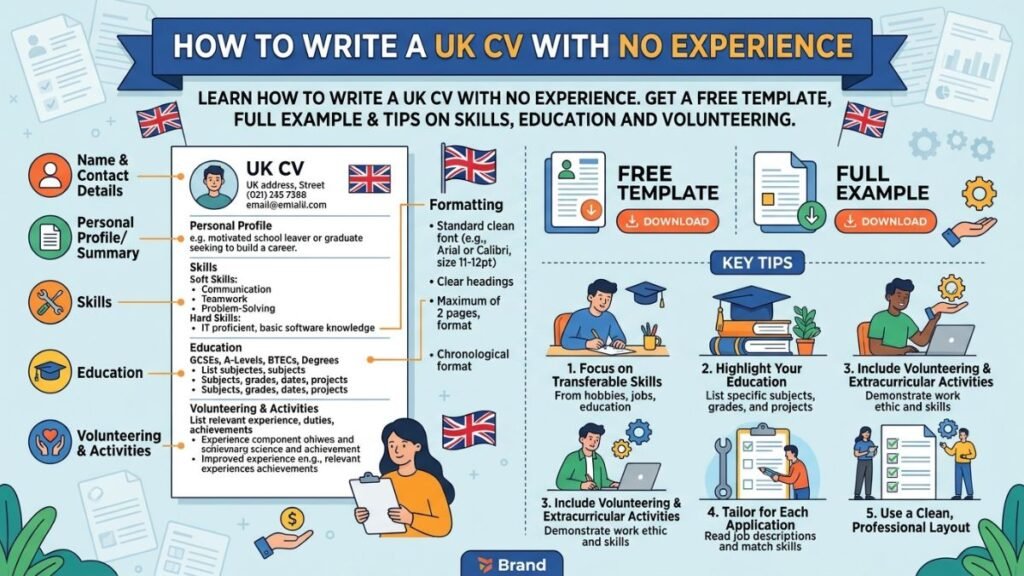
Quick answer: A UK CV is usually one to two pages, with no photo, a short personal statement at the top, your skills, education, any work, volunteering or activities, and references “available on request”. With no experience, lead with your skills and education and use examples from school, volunteering, sport and home life.
What is a UK CV, and how is it different?
A CV (curriculum vitae) is a short document that sells you to an employer. In the UK:
- It is normally one to two pages. Employers read dozens of applications, and careers advice services generally recommend keeping it short. One page is ideal if you have little to include.
- It does not include a photo, date of birth, marital status, religion or national ID number. Employers do not need this information, and leaving it out helps keep recruitment fair.
- It is written in UK English (for example “organised”, not “organized”).
- It is called a CV, not a resume. Some employers also ask for a covering letter.
If you have worked or studied in another country, keep the same structure, but explain overseas qualifications in simple terms so a UK employer understands them.
Do you need experience to get a job?
Not for many jobs. Employers hiring for entry-level roles often say “no experience necessary” and give training. What they are really checking is whether you:
- Turn up on time and take the job seriously
- Are friendly and can work with other people
- Can follow instructions
- Are willing to learn
- Have the right to work in the UK
Your CV just needs to show those qualities with real examples.
What to include on a CV with no experience
1. Name and contact details
Put these at the top:
- Your full name, in a clear, larger font
- A mobile number you answer
- A professional email address, such as firstname.lastname@email.com (avoid nicknames)
- Your town or city and postcode area (the first half of your postcode is enough), not your full address
- Optional: a LinkedIn profile, if it is up to date and professional
For safety, do not post your full address, date of birth or ID numbers on public job sites. See our guide to how to spot a fake job advert in the UK for why this matters.
2. Personal statement (profile)
This is a short paragraph of two to four sentences at the top. It tells the employer who you are, what you can offer and what job you want. With no experience, focus on your strengths and your attitude.
Formula: who you are + your key strengths + what you are looking for + what you will bring.
Example: “Reliable and friendly school leaver with strong communication skills, gained through volunteering at a local charity shop and captaining my college football team. Quick to learn and comfortable working in a team. Looking for a customer assistant role where I can develop my customer service skills and contribute to a busy store.”
Change the statement for each job so it matches the advert.
3. Key skills
List four to six skills that match the job. Add a brief proof for each. Good skills for entry-level jobs include:
- Customer service: helping and listening to people
- Teamwork: working with others to get tasks done
- Communication: speaking and writing clearly
- Reliability and punctuality: a good attendance record at school or college
- IT skills: Microsoft Word, Excel, email, social media, or a till system you have used
- Time management: balancing studies, family and other commitments
- Languages: any languages you speak, with your level (for example, fluent, conversational)
- Problem solving: an example of fixing something or helping someone
Do not just write “hard-working”. Show it: “Organised a fundraising bake sale that raised £250 for charity.”
4. Education and qualifications
With no work history, education goes near the top. List in reverse order (most recent first):
- School, college or university name, and dates
- Qualifications and grades, such as GCSEs, BTECs, A levels, T Levels, or an overseas equivalent
- Relevant courses, such as First Aid, food hygiene, health and safety or a language course
If your grades are strong, list them. If they are not, you can list subjects and say “Full details available on request”.
5. Work experience, volunteering and activities
This is where you show you have done something. These all count:
- Volunteering: charity shops, food banks, community centres, religious or youth organisations
- Work experience placements from school or college
- Informal work: helping in a relative’s shop, babysitting, dog walking, paper rounds, lawn mowing, selling items online
- School or college roles: prefect, student council, peer mentor, society leader
- Sports, clubs and teams: captain, coach, member, organiser
- Caring responsibilities: looking after siblings or relatives shows maturity and reliability
- Projects and events: organising a fundraiser, running a stall, a Duke of Edinburgh award or a school enterprise project
For each, give the role, the organisation, the dates, and two or three bullet points saying what you did and achieved. Start each bullet with an action word (organised, helped, served, led, trained, maintained).
6. Interests (optional)
One short line is enough, and only if relevant, such as “Playing for a local football team, volunteering and cooking.” Skip generic lines like “socialising”.
7. References
You can write “References available on request.” at the bottom. Before applying, ask a teacher, tutor, volunteer leader or coach if they would be willing to act as a referee. For some jobs, such as airports, schools and care roles, you will need to give references and account for your recent history. Read our guide to how to get an airport job in the UK for an example.
The best CV format for beginners
There are two main CV formats:
- Reverse chronological: lists your most recent experience first. Best if you have some work or volunteering history.
- Skills-based (functional): focuses on skills and achievements more than job titles. Best if you have little or no formal work.
A good option for beginners is a hybrid: personal statement, skills, education, then experience and activities. The layout below works for most entry-level jobs.
Order of sections
- Name and contact details
- Personal statement
- Key skills
- Education and qualifications
- Work experience, volunteering and activities
- Interests (optional)
- References
Free CV template you can copy
Copy this into Word or Google Docs and replace the text in brackets.
[YOUR FULL NAME] [Town, Postcode area] | [Mobile number] | [Email address]
Personal statement [Two to four sentences: who you are, your key strengths, the type of job you want and what you will bring.]
Key skills
- [Skill 1: short proof]
- [Skill 2: short proof]
- [Skill 3: short proof]
- [Skill 4: short proof]
Education [School/College name], [Town] – [Month Year] to [Month Year]
- [Qualification and grade]
- [Qualification and grade]
Volunteering and experience [Role], [Organisation], [Month Year] to [Month Year]
- [What you did and what you achieved]
- [What you did and what you achieved]
Interests (optional) [One short line]
References Available on request.
Full example: CV for a first retail job
Sam Taylor Leeds, LS6 | 07xxx xxxxxx | sam.taylor@email.com
Personal statement Friendly and reliable college student with excellent attendance and strong communication skills, gained through volunteering at a charity shop and playing in a local football team. Quick to learn, calm under pressure and happy to work weekends and evenings. Looking for a part-time customer assistant role to build my retail experience.
Key skills
- Customer service: served and helped up to 50 customers per shift in a charity shop
- Teamwork: vice-captain of a football team of 14 players
- Cash handling: used a till and card reader at a school fundraising event
- IT skills: confident with Microsoft Word, Excel and email
- Reliability: 98% attendance at college
Education Leeds City College – September 2025 to present
- BTEC Level 3 in Business (predicted Distinction)
Oak Lane High School, Leeds – September 2020 to June 2025
- 6 GCSEs at grades 4 to 7, including English and Maths
Volunteering and experience Volunteer Sales Assistant, Hope Charity Shop, Leeds – March 2025 to present
- Greet customers, answer questions and operate the till
- Sort and display donated stock, keeping the shop floor tidy
- Opened and closed the shop with a supervisor on Saturday mornings
Vice-Captain, Meanwood Juniors FC – 2023 to present
- Encourage team members and help organise training sessions
- Represent the team at club meetings
Interests Football, cooking and volunteering in my community.
References Available on request.
Tips to make your CV stand out
- Tailor it to every job. Read the advert and use the same keywords. If it says “customer service” and “teamwork”, make sure those words appear in your CV, as many employers use software to scan applications.
- Keep it to one page if you can. Short, clear and specific beats long and vague.
- Use a simple layout. A clean font such as Arial or Calibri in size 10 to 12, with clear headings and plenty of white space. Avoid fancy graphics, tables and columns, which may not scan properly.
- Use bullet points, starting with action verbs.
- Be specific. Numbers and results help, such as “raised £250” or “served 50 customers”.
- Be honest. Never invent jobs, grades or skills. Employers check, and lying can lose you the job.
- Proofread. Check spelling and grammar, and ask someone else to read it. Mistakes suggest a lack of attention to detail.
- Save it as a PDF unless the employer asks for Word. Name the file clearly, such as “Sam-Taylor-CV.pdf”.
Gaps and difficult situations
Gaps in your history. If you have been out of work, in education, caring for someone, ill or travelling, say so briefly rather than leaving a blank. Some jobs, such as airport roles, need a full five-year history.
Health conditions and disabilities. You do not have to mention them on your CV. If you need adjustments at interview, you can tell the employer separately.
Criminal record. You do not usually put this on a CV. Some jobs ask about it at a later stage. Take advice from an organisation such as Unlock or Acas if you are unsure.
Right to work. You can add a line such as “Eligible to work in the UK” if it is true and relevant. If you need visa sponsorship, read our guide to jobs with visa sponsorship in the UK.
Do you need a cover letter?
Not always, but it helps. A short cover letter (three or four short paragraphs) lets you explain why you want the job and why you would be good at it. Mention the job title, the company and one thing you like about them. Keep it to one page.
After you have written your CV
- Check it against the job advert and make sure the key skills match.
- Prepare for interview. Read our guide to customer assistant interview questions and answers.
- Apply directly. Use the employer’s own website, and see the latest roles on our UK jobs board.
- Never pay anyone to write, send or “verify” your CV or to get you a job.
Frequently asked questions
Can I get a job with no experience in the UK? Yes. Many entry-level jobs in retail, hospitality, cleaning, warehouses and customer service are open to people with no experience.
How long should a CV be in the UK? One to two pages. With no experience, aim for one page.
Should I put a photo on my CV? No. UK CVs do not normally include photos, and it is best to leave them out.
What do I put on my CV if I have never worked? Your education, skills, volunteering, school or college roles, sports and clubs, and any informal work or caring responsibilities.
Do I need to include my age or date of birth? No. It is not needed and it is better not to share it.
Should I write my CV in Word or PDF? Send a PDF unless the employer asks for Word. Both are fine for most jobs.
Can I use a CV template? Yes, but choose a simple one. Avoid overly designed templates that may not scan well, and change it to fit each job.
Final thoughts
A CV with no experience is not an empty CV. It is a chance to show your attitude, your skills and what you have already done in school, your community and your daily life. Keep it short, specific and honest, tailor it to each job and then start applying. Browse the latest vacancies on our jobs board and use this template to send your first application today.
This article is general guidance. Employers have different preferences, so always follow the instructions in the job advert.