How to Spot a Fake Job Advert in the UK
Fake job adverts and recruitment scams are one of the most common ways criminals target people who are looking for work. They copy real company names, post attractive roles and then ask for your money, your documents or your bank details. This guide shows you the warning signs, the most common types of job scam, how to check an advert is genuine, and what to do if you think you have been caught out.
Quick answer: A genuine employer or recruiter will never ask you to pay to get a job, and will never hire you only through WhatsApp, Telegram or text messages. If an offer is unexpected, vague, or too good to be true, stop and check it independently before sharing anything.
Why job scams work
Scammers know that job hunters are hopeful, busy and often short of money. They use that to rush you. Typical lures include high pay for little work, remote or flexible hours, no experience needed and an instant offer. Many pose as well-known employers or recruitment agencies, and some contact people who have simply uploaded a CV to a job site.
The goal is usually one of three things: take money from you, steal your identity, or use your bank account to move stolen money.
12 warning signs of a fake job advert
1. You are asked to pay
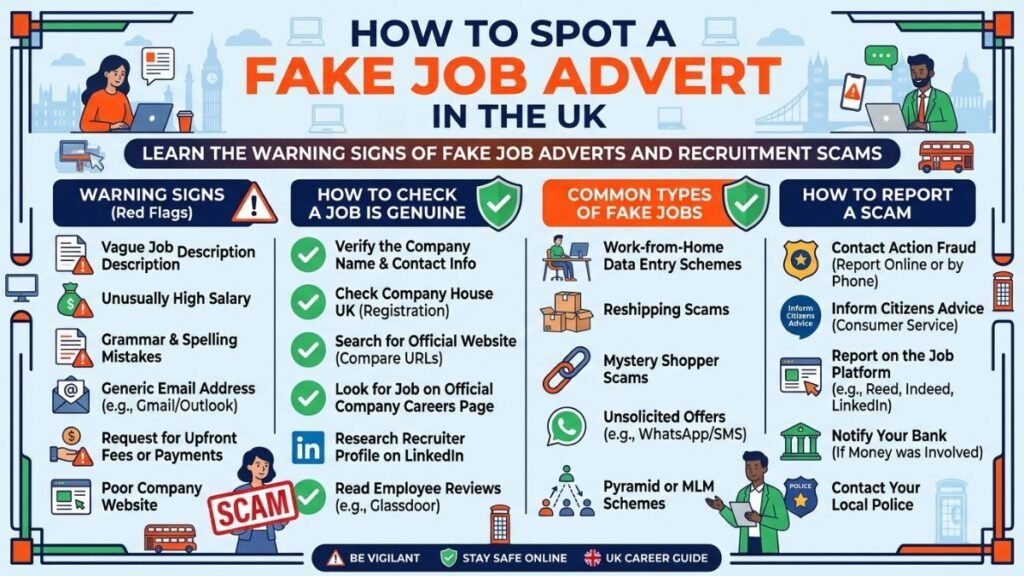
This is the clearest red flag. Genuine employers do not charge you to apply, interview, be hired or start work. Scammers invent fees for things like a background check, uniform, training, equipment, insurance, a visa or an airside pass. In the UK, recruitment agencies are not allowed to charge workers a fee for finding them work (with narrow exceptions in areas like modelling and entertainment). If anyone asks you to pay in advance, walk away.
2. The offer comes out of the blue
You get a message or call about a job you never applied for, often by text, WhatsApp or social media. Real recruiters do sometimes contact people, but they can tell you where they found your details and will have a verifiable company behind them.
3. The conversation moves to WhatsApp or Telegram
Many scams start on a job site or by text and then push you onto an instant messaging app. Some well-known recruiters publicly state that they never make job offers or take applications through messaging apps. Be cautious about any process run entirely over chat.
4. The pay is too good
Very high pay for simple tasks, no skills or no experience is a classic lure. Compare the salary with similar jobs. If a role pays far above the market rate, ask why.
5. The advert is vague
Genuine adverts describe the duties, location, hours, pay, employer and how to apply. Scam adverts are often short, generic, copy-pasted, or full of spelling and grammar errors, and may not name the employer.
6. There is no interview, or a very weak one
If you are offered a job without a proper interview, or the “interview” is a text chat, be suspicious. Real employers want to meet you by phone, video or in person and check your right to work.
7. You are asked for sensitive details too early
At the application stage you should not be asked for your passport, National Insurance number, bank details or a copy of your driving licence. A real employer asks for these after a job offer, for right-to-work, payroll and vetting checks, and through a secure, official process.
8. The contact details do not match
Watch for free email addresses (such as Gmail or Outlook) used by a supposed large company, email domains that are slightly misspelt versions of the real company, and phone numbers that do not match the official website.
9. The company or recruiter cannot be verified
Search for the company name, its registered address and its number on Companies House. Look for a real website, real reviews and real staff on LinkedIn. A company that has only just appeared, or has no history, deserves caution.
10. You are asked to receive and move money
If the “job” involves receiving payments into your account and passing them on, buying gift cards or cryptocurrency, or cashing cheques, it is likely a money mule scam. You could be drawn into criminal activity, even if you did not know.
11. You are sent equipment or a cheque
Some scams send you a cheque to buy equipment from a particular supplier, then the cheque bounces after you have paid. Others send a laptop or phone you are told to keep or send on. Do not buy anything on a new employer’s behalf before you have a contract and have been through proper checks.
12. There is pressure and urgency
Phrases like “offer expires today”, “only three places left” or “reply now” are designed to stop you thinking. A real employer will give you time to read a contract and ask questions.
The most common types of UK job scam
Advance-fee scams. You are offered a job and then asked to pay for checks, training, uniform, equipment, a visa or a pass. After you pay, the job vanishes or more fees appear.
Task and “review” scams. You are told you can earn money by completing simple online tasks, liking videos or boosting products. You may be paid small amounts at first and then asked to deposit your own money to “unlock” larger earnings. You then cannot withdraw anything.
Data harvesting. A fake job advert collects your CV, ID and bank details, which are used for identity fraud or sold on.
Impersonation scams. Criminals use the name and logo of a real employer or agency, sometimes with a convincing website or email. Many large employers publish fraud warnings about this.
Fake visa sponsorship jobs. Scammers promise a UK job with sponsorship and ask for payment for a Certificate of Sponsorship or visa. Genuine sponsors do not sell sponsorship to workers. Check any employer on the official government register of licensed sponsors before you engage.
Money mule jobs. You are asked to use your own bank account to receive and transfer money for a “payments processor” or “finance assistant” role.
Fake overseas jobs. Offers of work abroad that need quick payments for flights, accommodation or paperwork.
How to check a job advert is genuine
Use this quick checklist before you apply or share any information:
- Find the job on the employer’s own website. If a company advertises on a job board, the same vacancy should appear on its official careers page. Type the web address yourself rather than clicking a link in a message.
- Check the company. Look it up on Companies House, check the registered address and whether it is active, and see how long it has existed.
- Check the recruiter. Look for the agency’s own website, address and landline, and ask for the name of the client company.
- Verify contact details independently. Call the number on the official website, not the number in the advert or message, and confirm the vacancy and the person who contacted you.
- Look at the email address. The domain should match the company’s real website exactly.
- Search for scam reports. Search the company name together with words like “scam”, “fake” or “fraud”.
- Be sure about the process. Ask what the interview and hiring stages are, and who you will meet.
- Ask yourself: have I been asked for money, or for ID too early? If yes, stop.
On UK Jobs Now, we link to the employer’s own application page, label expired jobs and have a job verification policy. Even so, you should always carry out your own checks. If you see a listing on our site that looks suspicious, tell us through our contact page and we will review it.
Some employers are well known for using only their own application system. For example, in our guide to M&S jobs we explain that you apply through the official careers site. Likewise, our guide to airport jobs explains that you should never pay anyone to get a job or an airside pass.
What to do if you think you have been scammed
Act quickly. The sooner you act, the better your chances of limiting the damage.
- Stop all contact with the scammer. Take screenshots and save messages, emails, phone numbers, names, websites and payment details.
- Contact your bank immediately if you have paid money or shared bank details. You can ring 159 to be connected to your bank’s fraud team, or use the number on the back of your card. Ask whether you may be entitled to reimbursement.
- Report it to Report Fraud. Report Fraud replaced Action Fraud as the national reporting service for fraud and cyber crime in England, Wales and Northern Ireland in December 2025. Report online at reportfraud.police.uk or call 0300 123 2040. In Scotland, check current guidance or call Police Scotland on 101.
- Report it to JobsAware. JobsAware is a UK service that gives free advice to people affected by job scams and lets you report suspicious activity.
- Report the advert to the job site, social media platform or messaging service where you found it.
- Forward suspicious emails to the National Cyber Security Centre at report@phishing.gov.uk, and forward suspicious texts to 7726.
- Protect your identity. If you shared ID documents, change passwords, watch your bank statements and credit file, and consider ID fraud protection. Citizens Advice can help with next steps.
- Do not feel embarrassed. These scams are professional and sophisticated, and many careful people are caught.
How to protect yourself when job hunting
- Use trusted job boards and official employer websites.
- Keep personal details off public profiles and CVs. You can leave out your full address, date of birth and ID numbers.
- Use a separate email address for job applications.
- Do not click links or open attachments from unknown senders.
- Use strong, unique passwords and two-step verification on your job and email accounts.
- Tell friends and family about scams you have seen.
Frequently asked questions
Is it normal to pay for a DBS check or uniform before starting a job? No. A genuine employer arranges and pays for background checks and uniform, or at least gives you a proper written explanation. Be very careful about paying a third party before you have a contract.
Can recruiters contact me on WhatsApp? Some genuine recruiters do use messaging apps to arrange interviews, but a job offer made only through chat, or any request for payment or ID, is a warning sign.
How can I tell if a recruitment agency is real? Check it has a UK registered company number on Companies House, a landline and a website that matches its emails, and ask which client the vacancy is for. Then verify by calling a number you found yourself.
What should I do if I gave my passport details to a scammer? Contact your bank, report it to Report Fraud, and consider asking for ID fraud protection. Keep an eye on your credit file.
Can I get my money back? Sometimes. Contact your bank immediately and ask about reimbursement. The outcome depends on how you paid and the circumstances, so act as quickly as you can.
Final thoughts
Most job scams fall apart when you slow down and verify. Check the company, check the contact details, and never pay to get work. If something feels wrong, trust your instincts and ask someone you trust before you reply. Then, when you are ready, browse verified vacancies on our UK jobs board, and apply directly through each employer’s own website.
This article is general information, not legal or financial advice. Reporting services and procedures can change, so check the official websites for current details.