How to Become a Nurse in the UK: Routes, Pay and Degree Apprenticeships
Nursing is one of the most in-demand and rewarding careers in the UK, with jobs in hospitals, GP surgeries, care homes, schools, prisons and people’s homes. There are several ways in, from a university degree to an earn-while-you-learn apprenticeship, and you can start straight from school, after another career or from a healthcare support job. This guide explains the routes to becoming a registered nurse, entry requirements, funding, NMC registration, what nurses earn in 2026/27 and how to apply.
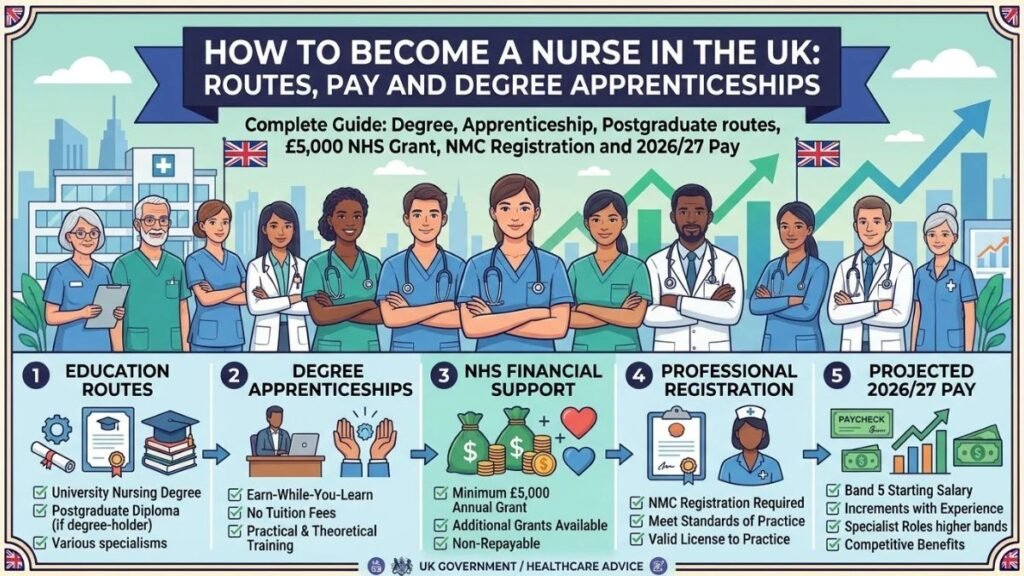
Quick answer: To become a registered nurse in the UK you must complete a Nursing and Midwifery Council (NMC) approved programme, usually a three-year degree or a roughly four-year degree apprenticeship, and then register with the NMC. Newly qualified nurses in England start on NHS Band 5, which pays £32,073 to £39,043 in 2026/27. Eligible degree students in England also receive a non-repayable £5,000 a year NHS training grant.
What does a nurse do?
Registered nurses assess patients’ needs, plan and deliver care, give medicines, monitor conditions, educate patients and families and work with doctors and other professionals. Nurses work in:
- Hospitals, on wards, in emergency departments, theatres and intensive care
- Community and primary care, including district nursing, GP practices and health centres
- Mental health services
- Care homes and nursing homes
- Schools, prisons, the armed forces and occupational health
- Specialist units, such as cancer care, paediatrics, midwifery-linked services and palliative care
The four fields of nursing
Pre-registration nursing programmes in the UK train you in one of four fields.
| Field | Who you care for |
|---|---|
| Adult nursing | Adults with acute, long-term or end-of-life care needs, in hospitals and the community |
| Children’s nursing | Babies, children and young people, and their families |
| Mental health nursing | People with mental health conditions, in hospitals and community teams |
| Learning disability nursing | People with learning disabilities and their families, in many settings |
You choose your field when you apply, and it determines the type of registration you get. Some programmes allow limited work in other fields during placements.
Routes to becoming a registered nurse
| Route | Typical length | How it works |
|---|---|---|
| Nursing degree (BSc) | 3 years full time | Study at university with practice placements, then register with the NMC |
| Registered nurse degree apprenticeship (Level 6) | About 4 years | Work as a paid apprentice for an employer while studying part time for a degree |
| Postgraduate nursing (MSc or graduate diploma) | About 2 years | For people who already have a degree in another subject |
| Nursing associate, then top-up to registered nurse | About 2 years, then further study | Train as a nursing associate, then progress through a degree or apprenticeship |
| Open University and part-time routes | Longer | For people who work in healthcare while studying |
| Armed forces | Varies | Train as a nurse in the forces |
| Return to practice | Varies | For nurses whose registration has lapsed |
A short online course, work experience alone or an overseas qualification that is not recognised cannot give you UK registered nurse status. You need an NMC-approved programme, or recognition through the NMC’s overseas route (see below).
The nursing degree
This is the most common route. Key points:
- Length: typically three years full time, with theory at university and clinical placements in hospitals and the community. UK nursing programmes include at least 2,300 hours of practice learning, roughly half the course.
- Entry requirements: vary by university. Typically you need GCSEs (including English and maths, often at grade 4 or above) and Level 3 qualifications such as A levels, a BTEC or an Access to Higher Education Diploma (Nursing). Many universities also ask for evidence of values and experience, and use an interview.
- Applications: through UCAS. The main UCAS deadline for courses starting in September is in late January, though some universities accept later applications and clearing places. Check UCAS for current dates.
- Placements: unpaid on most degrees, but supported by NHS funding (see below).
- Careers: after graduating you register with the NMC and apply for Band 5 jobs.
Registered nurse degree apprenticeship (Level 6)
This route lets you earn while you learn.
- You are employed by an NHS trust or another health employer, and study part time for a nursing degree with a university.
- It usually takes around four years where no prior learning is recognised, and may be shorter if you have relevant qualifications.
- You are paid a wage throughout (at least the apprentice minimum wage, and employers often pay more), and training is funded through the apprenticeship system, so there are no tuition fees.
- Entry typically requires A levels or equivalents, plus GCSE English and maths, and a job offer from an employer. Competition for places can be strong.
- On completion, you earn your degree and apply to register with the NMC.
See our guide to apprenticeships in the UK for how apprenticeship pay and rights work, and our guide to NHS jobs for how to find vacancies.
Postgraduate (graduate-entry) nursing
If you already hold a degree in a related subject (often a health, science or social care degree), you may be able to complete a two-year postgraduate nursing programme that leads to NMC registration. Check each university’s entry rules.
The nursing associate route
A nursing associate is a regulated role that sits between a healthcare assistant and a registered nurse. Nursing associates are registered with the NMC in their own right, usually train through a two-year apprenticeship (a foundation degree at Level 5), and work in Band 4 roles. Many then progress to registered nurse through a shortened degree or degree apprenticeship, which can be a good way in if you work in healthcare and want to build up.
In 2026/27, Band 4 on the NHS pay scale in England runs from about £28,392 to £31,157.
Working your way up from healthcare support
Many nurses start as healthcare assistants or support workers. These jobs give you experience, references and sometimes employer support for training. See our guides to NHS jobs and care worker jobs.
Studying as an adult or career changer
Mature students are welcome on nursing courses, and many have caring or healthcare experience. If you do not have the required qualifications, an Access to HE Diploma is a common route, and some employers run pre-nursing programmes. If you are returning to work after a break, see our guide to jobs for over 50s and returners in the UK.
Entry requirements and the application process
Each university and employer sets its own requirements, so always check before you apply. Common elements include:
- GCSEs or equivalents in English and maths, usually grade 4 or above
- Level 3 qualifications, such as A levels, BTEC or an Access to HE Diploma, often with a minimum number of UCAS points
- A personal statement showing your motivation and understanding of nursing
- Values-based interview or assessment, often looking at compassion, communication, teamwork and resilience
- Health and character checks, including an enhanced DBS check, occupational health screening and vaccinations
- References and sometimes evidence of relevant experience or volunteering
How to apply: step by step
- Choose your field of nursing and research courses and employers.
- Check entry requirements at each university or employer.
- Get relevant experience through volunteering, healthcare support work or caring, if you can.
- Apply through UCAS for degrees, or through NHS and employer vacancies for apprenticeships. See our guide to NHS jobs for application tips, including how to write a supporting statement.
- Prepare for the interview. Expect questions on values, empathy and real situations. See our guides to common interview questions and answers in the UK and writing a cover letter in the UK.
- Complete checks. DBS, occupational health and references.
- Apply for funding (see below).
- Start your course and your placements.
If you have a criminal record, the DBS check will show relevant information, and nursing is a regulated profession with additional fitness-to-practise checks. See our guide to how to get a job with a criminal record in the UK.
Funding and costs
Student finance
Nursing students in England can normally get:
- A tuition fee loan (up to the current maximum, which is £9,250 a year for many courses)
- A maintenance loan towards living costs
Student loans are repaid only when your income is above the threshold for your plan. See our guide to payslips, tax codes and National Insurance for how repayments work.
NHS Learning Support Fund
Eligible nursing, midwifery and many allied health students in England can also claim support from the NHS Learning Support Fund, on top of student loans:
| Support | Amount | Notes |
|---|---|---|
| Training grant | £5,000 per year | Non-repayable and not means-tested for eligible students. It is also available on some postgraduate pre-registration courses |
| Parental support | Up to £2,000 per year | For students with dependent children |
| Specialist subject payment | Around £1,000 per year | Reported for mental health and learning disability nursing students |
| Hardship funding | Up to £3,000 per year | For students facing financial difficulty |
| Travel and accommodation | Extra costs for placements | Help with some placement costs |
The rules and amounts change, so check the NHS Business Services Authority website and GOV.UK for the current position, and for what applies if you live in Scotland, Wales or Northern Ireland, which have their own funding arrangements.
Costs to plan for
- Living costs during unpaid placements
- Travel to placements, which can be some distance
- Uniform, equipment and DBS checks (sometimes covered by your university)
- NMC registration fees after you qualify (around £120 a year, according to guides, so check the NMC site)
If you choose an apprenticeship
You earn a wage throughout, and there are no tuition fees. You still need to plan for travel and study time, and for the fact that apprenticeships can be competitive.
NMC registration
You cannot work as a registered nurse in the UK without joining the NMC register. After you complete an approved programme:
- Your university or employer confirms to the NMC that you have completed the programme.
- You apply to join the register online and pay the fee.
- You declare any health or character issues and provide references or other evidence.
- You must revalidate every three years to stay registered, by showing practice hours, training, feedback, reflection and a confirmation from a colleague.
The UK has no separate nursing licensing exam for UK-trained students, because the approved programme includes assessment, though overseas applicants have extra tests (see below).
What do nurses earn in 2026/27?
Most NHS nurses are paid on the Agenda for Change scale. For 2026/27 in England, after the 3.3% award from 1 April 2026:
| Band | Role | Salary |
|---|---|---|
| Band 4 | Nursing associate | About £28,392 to £31,157 |
| Band 5 | Newly qualified registered nurse | £32,073 to £39,043 |
| Band 6 | Experienced or specialist nurse | About £39,959 to £48,117 |
| Band 7 and above | Advanced practitioner, ward manager, nurse consultant | Higher, depending on band |
The National Careers Service gives an average starting salary of about £32,000 for nurses in 2026. Some guides still show older figures, such as £29,970 to £36,483, which are out of date. Staff in London and the surrounding areas receive extra High Cost Area Supplement payments, and nurses who work nights, weekends and bank holidays receive enhanced pay. Nurses also benefit from the NHS Pension Scheme, annual leave and sick pay. For more on the pay bands, see our guide to NHS jobs.
Pay in other settings varies. Care homes, private hospitals and agencies set their own rates, which can be higher or lower than the NHS. Agency and bank shifts may pay more per hour but offer less security. Compare the whole package, including pension and holiday. See our guide to how to ask for a pay rise or negotiate salary in the UK for how to negotiate once you qualify.
Overseas nurses
If you qualified as a nurse outside the UK, you can apply to join the NMC register through its overseas route, which usually involves:
- Having your qualifications and registration assessed
- Proving your English language ability
- Passing a computer-based test of knowledge and a practical Objective Structured Clinical Examination (OSCE) in the UK
- Providing identity, health, character and registration evidence
To work in the UK you also need the right to work. Nurses are typically sponsored through the Health and Care Worker visa by an employer, and the rules on sponsorship, fees and eligibility change often. See our guides to jobs with visa sponsorship in the UK and right to work checks in the UK. Check the NMC website, GOV.UK and employer information for current requirements.
This is a high-risk area for scams. Never pay an agent or recruiter for a guaranteed NMC registration, a job or a visa, and check that any employer is a licensed sponsor. See our guide to how to spot a fake job advert in the UK.
Returning to nursing
If your NMC registration has lapsed, a return to practice programme can help you re-register. The length depends on how long you have been away, and employers and universities offer courses. Contact the NMC and local NHS trusts for information. Our guide to flexible working in the UK explains how to ask for hours that fit your life when you return.
Careers after qualifying
Nursing offers wide-ranging career paths:
- Specialising: intensive care, theatres, cancer care, paediatrics, mental health, district nursing, school nursing and more
- Advanced practice: advanced clinical practitioner, nurse practitioner, prescribing nurse
- Leadership: ward manager, matron, director of nursing
- Education and research: lecturer, practice educator, researcher
- Public health and community roles
- Working in different settings: NHS, private sector, charities, the armed forces or abroad
Many nurses combine clinical work with further study. Ask employers about training budgets and development.
Disability, health and fitness to practise
Disabled people and people with health conditions can and do work as nurses. Universities and employers must make reasonable adjustments, and Access to Work can fund extra support. You do not have to have a perfect health record, but you must be fit to practise safely, and the NMC will consider each case individually. See our guide to disability and work in the UK.
Is nursing right for you? Pros and cons
Advantages
- A meaningful job with high demand across the UK
- Strong job security and clear progression
- NHS pension, leave and training opportunities
- Funding support during your degree, or an apprenticeship wage
- Flexible options, such as bank shifts and part-time work
Challenges
- Emotionally and physically demanding work, with shifts, nights and weekends
- Pressure from staffing levels and workloads
- Unpaid placements on degrees, and living costs during training
- Competitive places on some courses and apprenticeships
- Strict professional standards and regulation
Work experience or volunteering in a care setting is a good way to test whether nursing suits you.
Frequently asked questions
How do I become a nurse in the UK? Complete an NMC-approved nursing degree, a degree apprenticeship or a postgraduate programme, then register with the NMC.
How long does it take to become a nurse? About three years for a BSc, around four years for a degree apprenticeship and about two years for a postgraduate course if you already have a relevant degree. After that you register with the NMC.
What qualifications do I need? Usually GCSEs in English and maths (often grade 4 or above) and Level 3 qualifications such as A levels or an Access to HE Diploma. Requirements vary by university and employer.
How much does a nurse earn in the UK? In England in 2026/27, a newly qualified Band 5 nurse earns £32,073 to £39,043, and Band 6 about £39,959 to £48,117, plus any London supplement and enhancements.
Do nursing students get funding? Yes. Eligible students in England receive student loans and a non-repayable NHS Learning Support Fund training grant of £5,000 a year, with extra support for some students. Funding differs in Scotland, Wales and Northern Ireland.
Can I earn while I train as a nurse? Yes, through a registered nurse degree apprenticeship, which is paid and has no tuition fees.
Can I become a nurse without A levels? Yes. An Access to HE Diploma, or an apprenticeship route, can be an alternative.
What is a nursing associate? A regulated role between a healthcare assistant and a registered nurse. Nursing associates train in about two years and can progress to become registered nurses.
Can overseas nurses work in the UK? Yes, if they qualify for NMC registration, pass the required tests and have the right to work. Check current rules and avoid scams.
Final thoughts
Nursing is a long training, but there are routes for school leavers, career changers and healthcare workers, and plenty of funding and support. Research the fields, check entry requirements, get some experience and apply early. When you are ready, browse the latest healthcare vacancies on our jobs board and look at NHS trust and university websites for courses and apprenticeships.
This article is general information, not careers or financial advice. Entry requirements, funding and pay change, and rules differ across England, Scotland, Wales and Northern Ireland. Check the NMC, UCAS, the NHS Business Services Authority and GOV.UK for the latest guidance.