How Long Does It Take to Get a Job in the UK? A Realistic Timeline
Six weeks into a job search with no offer yet, it’s easy to start wondering whether something’s genuinely wrong with your approach — or whether this is just what the process actually takes and you’ve simply never paid close attention to the timeline before. The honest answer is that job search length varies hugely and depends on real, identifiable factors, not luck alone. This is a practical look at what actually drives how long a UK job search takes, realistic expectations for different situations, and what’s worth adjusting if your search is dragging on longer than you’d like.
Why there’s no single honest answer to “how long will it take?”
Any article that gives you a single confident number here — “the average UK job search takes X weeks” — is oversimplifying something that genuinely depends on several variables that differ enormously between individuals: your industry and seniority level, the current state of hiring in your specific sector and region, how targeted versus scattergun your applications are, your existing network, and simple timing (some sectors have hiring seasons; a search that starts in the run-up to a holiday period will feel slower than one that starts in a typical busy hiring month, mostly because fewer decisions get made during quieter periods).
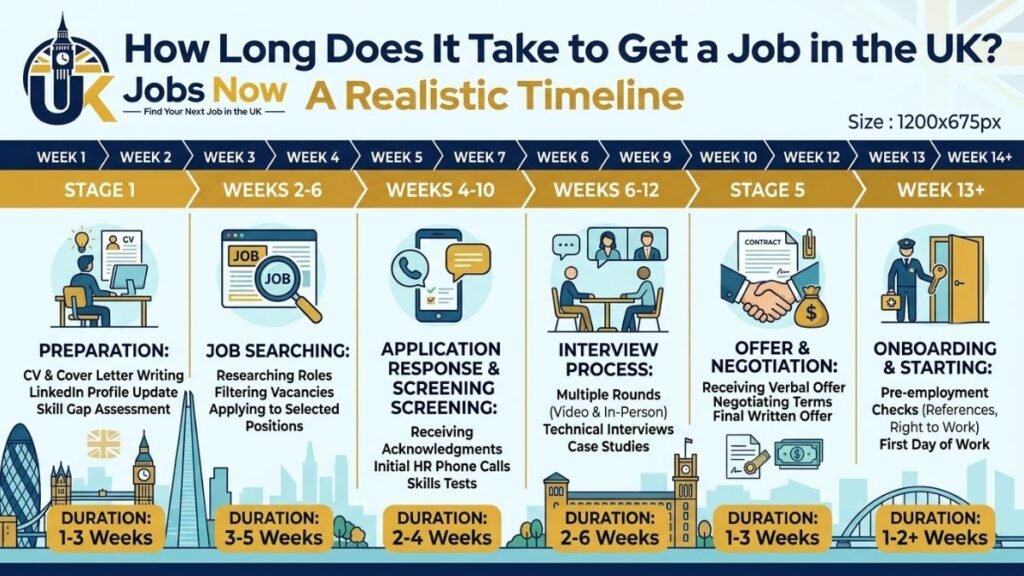
What’s genuinely more useful than a single average figure is understanding the stages a typical job search process moves through, and what a normal pace looks like at each stage — that way you can judge your own search against a realistic process, rather than an abstract total number that might not reflect your specific situation at all.
The stages of a typical UK hiring process
Application to first response
For a well-targeted application to a role you’re genuinely qualified for, a reasonable range for hearing back — whether that’s an interview invitation or a rejection — is typically somewhere between one and three weeks, though this varies significantly by employer and sector. Larger organisations with formal recruitment processes and higher application volumes tend to take longer at this stage than smaller employers who can move faster on individual decisions. It’s entirely normal to hear nothing at all from some applications — many employers, unfortunately, don’t reliably respond to unsuccessful candidates, which is frustrating but common enough that it’s not a signal anything is wrong with your specific application.
First interview to next stage or decision
This varies enormously by role seniority and process complexity. A straightforward single-interview process for an entry-level or less senior role might move to a decision within a week or two. More senior roles, or processes involving multiple interview stages, panel interviews, technical assessments, or presentations, can reasonably stretch to four to six weeks or more between first contact and a final decision, particularly if multiple candidates are being progressed in parallel and the employer wants to complete the full process before deciding.
Offer to start date
Once an offer is made, UK notice periods commonly range from one week (common in more junior or newer roles) up to three months (typical for more senior positions, particularly where a role involves ongoing client or project responsibilities that need a proper handover). This means the gap between accepting an offer and actually starting a new role can itself add a meaningful chunk of time to your overall timeline if you’re currently employed and factoring in your own notice period.
Realistic overall ranges, and why they’re wide
Given the stages above, a full search — from starting to actively apply through to accepting an offer — commonly spans anywhere from a few weeks for a strong candidate applying into a role with a fast-moving, less formal process, up to several months for more senior, specialist, or competitive roles, particularly in sectors experiencing a genuinely tighter hiring market at a given time. Neither end of that range is abnormal on its own — what actually matters more than hitting a specific number is whether your search is progressing through the stages described above at a reasonable pace, or stalling at a specific point, which is a much more useful diagnostic than comparing your total elapsed time against an average.
What actually speeds up a job search — and what doesn’t
A few factors genuinely correlate with a faster process, based on what tends to distinguish a smoother search from a stalled one:
Targeted applications beat volume
Sending a high volume of generic applications to roles you’re only loosely qualified for tends to produce a low response rate that feels discouraging and doesn’t actually speed anything up. A smaller number of carefully tailored applications — a CV and cover letter genuinely adjusted for each specific role, as covered in our CV writing guide — typically produces a meaningfully better response rate, which shortens the overall timeline even though it might feel slower day to day because you’re submitting fewer applications.
Your network matters more than most people initially assume
A significant proportion of roles are filled through referrals, direct approaches, or connections rather than purely through open, advertised applications — this doesn’t mean advertised roles aren’t worth pursuing (they clearly are, and it’s what a job board like this one is built around), but it does mean that letting relevant contacts, former colleagues, and your professional network know you’re looking can genuinely open up opportunities and speed up a process that would otherwise rely purely on cold applications.
Being realistic about the current market in your specific sector
Hiring pace genuinely varies by sector and by broader economic conditions at any given time — some sectors hire quickly and constantly; others move more slowly or have gone through periods of tighter hiring. Recognising which situation applies to your specific field right now — rather than benchmarking your search against a friend’s experience in a completely different sector — helps set realistic expectations and reduces the discouragement of comparing your timeline against the wrong reference point.
Interview preparation reduces stalls at that specific stage
A search that’s producing plenty of interview invitations but few progressions to a next stage or an offer usually points to something fixable in interview performance specifically, rather than a broader market problem. Our guide to common UK interview questions and the STAR method covers how to prepare for the competency-based format that trips a lot of otherwise strong candidates up.
What to do if your search feels stuck
If weeks are passing with limited response to applications, it’s worth diagnosing where specifically the process is stalling, because the right fix depends entirely on that:
- Few or no responses at the application stage — this often points to a CV or targeting problem: either the CV isn’t clearly demonstrating fit for the specific roles you’re applying to, or you’re applying to roles you’re not genuinely well-matched for. Revisit both.
- Interviews happening but not converting to offers — this usually points to interview performance specifically, which is a more fixable, practice-based problem than it can feel like in the moment.
- Offers arriving but at a lower level than expected — this may point to how you’re presenting your experience and negotiating, rather than a fundamental market problem.
Treating a stalled search as a diagnosable process, rather than a vague, discouraging feeling that “nothing’s working,” tends to produce faster genuine improvement than simply applying to more roles in the hope that volume alone will eventually work.
Managing a search that’s taking longer than expected
It’s worth saying plainly: a job search that takes longer than you initially hoped isn’t a reflection of your worth or competence, and the range of “normal” genuinely is wide, for reasons largely outside your control — market conditions, sector-specific hiring pace, timing, and simple variance in how individual hiring processes unfold. What’s within your control is the quality of your applications, your interview preparation, and how deliberately you’re using your network — focusing your energy there tends to be considerably more productive than trying to control the parts of the process, like an individual employer’s internal timeline, that you genuinely can’t influence.
Keeping your search active
Whatever stage your search is at, it’s worth checking active listings regularly rather than in occasional bursts, since new, genuinely well-matched roles are added continuously and closing dates mean timing matters. You can browse current active UK job listings, filtered by category, region, salary, and working arrangement, to keep a consistent pipeline of relevant applications moving while you work through whichever stage of the process is currently the bottleneck.
Frequently Asked Questions
Is it normal to hear nothing back after submitting a job application?
Unfortunately, yes — many employers don’t reliably respond to unsuccessful applicants, particularly for high-volume roles. It’s frustrating but common, and on its own isn’t a reliable signal that something is wrong with your application.
How long is a typical UK notice period?
It varies by role and seniority, commonly ranging from one week for more junior or newer positions up to one to three months for more senior roles. Check your current contract for your specific notice period if you’re employed and planning your job search timeline around it.
Should I keep applying to new jobs while I’m waiting to hear back from others?
Generally yes — waiting to hear back from a small number of applications before continuing to apply elsewhere tends to extend your overall search unnecessarily. Keeping a steady pipeline of applications moving, while managing the process for each, is usually more effective.
Does a longer job search mean I’m doing something wrong?
Not necessarily — search length depends heavily on factors like sector hiring pace, seniority level, and market conditions at the time, many of which are outside your control. It’s more useful to check whether your applications, interview performance, and networking are each working reasonably well, rather than judging yourself purely against total elapsed time.
What’s the fastest way to speed up a stalled job search?
Diagnose specifically where the process is stalling — application stage, interview stage, or offer stage — since each points to a different, more targeted fix, rather than simply increasing the total volume of applications you’re sending out.