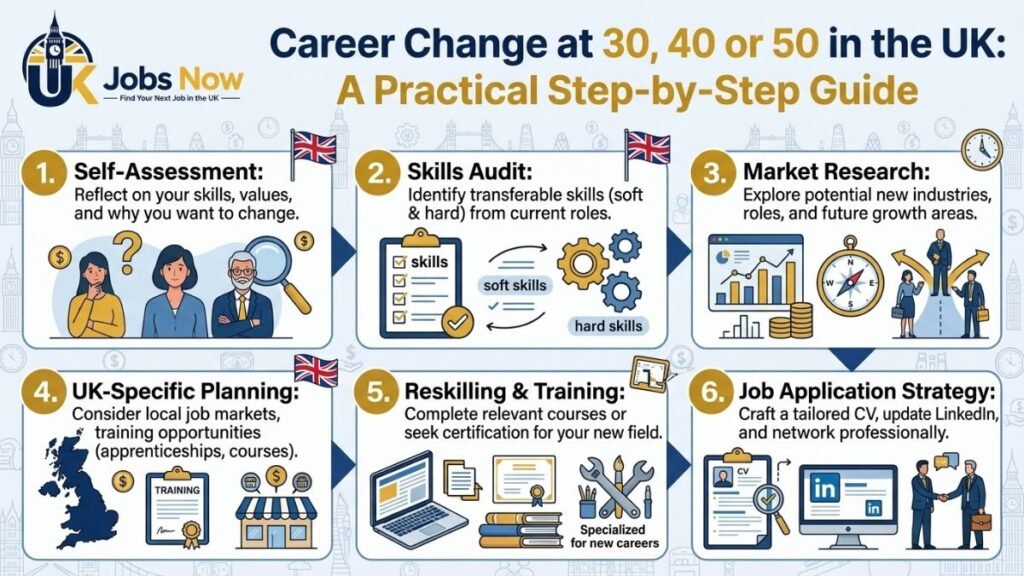
Career Change at 30, 40 or 50 in the UK: A Practical Step-by-Step Guide
Changing career direction in your 30s, 40s, or 50s in the UK is a genuinely different process from job hunting within the same field you’ve always worked in, and treating it the same way — same CV approach, same application strategy, same expectations about timeline — is one of the most common reasons a career change stalls before it really gets going. This is a practical, step-by-step guide to actually making a career change work, based on what tends to separate a successful transition from one that quietly fizzles out.
Why career changes are harder to plan for at different life stages — and why that’s not a reason not to
It’s worth acknowledging honestly that a career change in your 40s or 50s carries different practical considerations than one in your late 20s — you may have a mortgage, dependents, a level of income you’ve become accustomed to, and less appetite for starting again at an entry-level salary. None of that makes a career change impossible or unwise; it means the planning needs to be more deliberate and the transition often needs to be more gradual than “quit and start fresh,” which is the version of career change that gets romanticised but often isn’t the most realistic or sustainable path for most people.
Step one: get specific about what’s actually driving the change
“I want a career change” is too vague to plan around effectively. It’s worth spending real time working out what specifically is driving the desire to move — is it the industry itself that’s the problem, or a specific employer or role type within it? Is it the day-to-day nature of the work, the lack of progression, the pay ceiling, or something about work-life balance or working arrangement? These distinctions matter enormously for what you actually need to change. Someone who’s tired of a specific dysfunctional employer might not need an industry change at all — a different company in the same field might solve the actual problem. Someone whose issue is genuinely with the nature of the work itself needs a more fundamental change, and being clear about which situation you’re actually in prevents wasted effort chasing the wrong solution.
Step two: identify what genuinely transfers, and be honest about what doesn’t
A career change rarely means starting from absolute zero, even when it feels that way. Skills like project management, stakeholder communication, budget management, people management, problem-solving under pressure, and sector-specific regulatory or compliance knowledge often transfer across industries far more directly than people initially assume. The exercise worth doing here is going through your actual experience and explicitly identifying which skills are genuinely transferable to your target field, rather than assuming your experience “doesn’t count” simply because the industry label is different.
At the same time, be honest about genuine skill or knowledge gaps that do exist. If you’re moving into a field with specific technical, regulatory, or qualification requirements, identifying that gap early — rather than discovering it partway through a frustrating application process — lets you plan around it properly, whether that means a course, a certification, or a deliberate transitional role that builds the missing piece.
Step three: research the target field properly, not just the destination
It’s easy to research a career change at the level of “what does this job title actually involve day to day,” which is useful but incomplete. It’s worth also researching the practical entry points into a field — do people typically enter through a specific qualification, through internal transfer from an adjacent role, through a graduate-style scheme regardless of your age, or through direct lateral hire based on transferable experience? Different fields have genuinely different typical entry patterns, and understanding which one applies to your target field shapes your entire strategy, from what to prioritise learning to how to position your application.
Talking directly to people already working in the field — even briefly, through a short informational conversation — is disproportionately useful here compared to research alone, because it surfaces the practical, unwritten reality of how people actually get into a field, which rarely shows up clearly in a job listing or a generic careers guide.
Step four: decide between a direct leap and a bridging strategy
There are broadly two approaches to executing a career change, and being deliberate about which one fits your situation matters:
The direct leap
Applying directly for roles in your target field, leaning entirely on your transferable skills and whatever direct research or self-study you’ve done. This can work well when your existing experience genuinely transfers strongly, or when you’re moving into a field that values diverse backgrounds and doesn’t gate entry behind a specific qualification.
The bridging strategy
Taking an intermediate step — a role that sits between your current field and your target field, a relevant qualification or course completed alongside your current job, freelance or volunteer work in the target area to build a genuine track record — before making the full jump. This is often the more realistic and lower-risk path when there’s a genuine skills or credibility gap, particularly for fields with formal entry requirements, and particularly relevant if your financial situation means you can’t sustain a period of lower income during a direct transition.
Neither approach is inherently better — the right choice depends on how far the jump actually is, how strong your existing transferable experience is, and your personal financial flexibility for a potentially lower-paying transitional period.
Step five: rework your CV around the change, not around your history
A career-change CV needs a different structure from a standard, same-field CV. Rather than a strict reverse-chronological list of roles that makes your unrelated experience the most prominent thing a reader sees, it’s often more effective to lead with a strong, specific personal profile that explicitly frames your transition and the transferable strengths you’re bringing, and to organise your experience bullet points around relevant skills and achievements rather than purely around job titles that might not obviously connect to your target field. Our broader guide to UK CV writing covers general structure and formatting; for a career change specifically, the key adjustment is making the connective tissue between your past experience and your target role explicit, rather than leaving a reader to infer it themselves.
Step six: prepare for the specific interview question you will get asked
Every career-change interview includes some version of “why are you moving into this field, and why now?” This isn’t a trick question, but a vague or purely negative answer (“I was just tired of my old industry”) is a weak one. A strong answer connects your reasoning to something specific and forward-looking — what genuinely draws you to this field, what you’ve done to prepare for the move, and how your existing experience actually strengthens rather than merely doesn’t-disqualify your candidacy. Preparing this answer properly, with specifics rather than generalities, is one of the highest-leverage things you can do before a career-change interview. Our guide to common UK interview questions covers the broader competency-based interview format you’re likely to encounter alongside this specific question.
Being realistic about salary during a transition
It’s worth going in with a genuinely realistic view of compensation during a career change — entering a new field, even with strong transferable skills, sometimes means accepting a salary that doesn’t fully reflect your seniority in your previous field, at least initially, particularly if you’re missing field-specific experience that a direct lateral hire would have. This isn’t universal, and plenty of career changes happen without a pay cut, particularly when the transferable skills are strong and in demand — but going in with an honest expectation, rather than assuming your previous seniority automatically transfers directly to a new field’s pay scale, makes the negotiation and decision-making process considerably less frustrating.
What to do if the transition is taking longer than expected
Career-change job searches often take longer than same-field searches, for straightforward reasons — you’re competing against candidates with more directly obvious relevant experience, and employers sometimes need more convincing that a transferable-skills case is genuinely strong. Our guide on realistic UK job search timelines covers general expectations, but for a career change specifically, it’s worth being patient with a longer timeline while continuing to strengthen your case — through a course, a relevant side project, networking within the target field, or a bridging role — rather than becoming discouraged and reverting to your original field purely out of search fatigue.
Starting the search
Once you’ve done the groundwork — clarity on what’s driving the change, an honest transferable-skills assessment, research into how people actually enter your target field, and a reworked CV — the practical next step is simply starting to apply, while continuing to build your case in parallel. You can browse current active UK job listings by category to get a genuine, current sense of what employers in your target field are actually asking for right now, which is often more useful than generic career-change advice for understanding exactly what to prioritise.
Frequently Asked Questions
Am I too old to change careers in the UK?
No — age discrimination in hiring is illegal in the UK, and career changes at 40, 50, and beyond are genuinely common. The practical challenge is usually less about age itself and more about clearly demonstrating transferable skills and a credible case for the specific transition, which is a solvable problem at any career stage.
Do I need to go back to university or get a new qualification to change careers?
It depends entirely on the target field — some fields have formal qualification requirements that are genuinely necessary, while others value transferable experience and skills more than a specific credential. Research your specific target field’s typical entry patterns before assuming a full qualification is required.
Will I definitely take a pay cut if I change careers?
Not necessarily, but it’s realistic to expect the possibility, particularly if you’re missing field-specific experience relative to a direct lateral hire. Plenty of career changes happen without a significant pay reduction, especially where transferable skills are strong and in demand, but going in with a realistic expectation avoids unnecessary frustration during negotiation.
Should I quit my current job before starting a career change, or make the change gradually?
For most people, a gradual, bridging approach — building relevant experience, qualifications, or a track record while still employed — is lower-risk than resigning first and searching afterward, particularly if you have financial commitments that make an income gap difficult to sustain.
How do I explain a career change in a job interview?
Prepare a specific, forward-looking answer that explains what genuinely draws you to the new field, what you’ve done to prepare for the move, and how your previous experience actually strengthens your candidacy — avoid a vague or purely negative explanation focused only on what you disliked about your previous field.