
Working in the Public Sector: Pay, Benefits and How to Apply
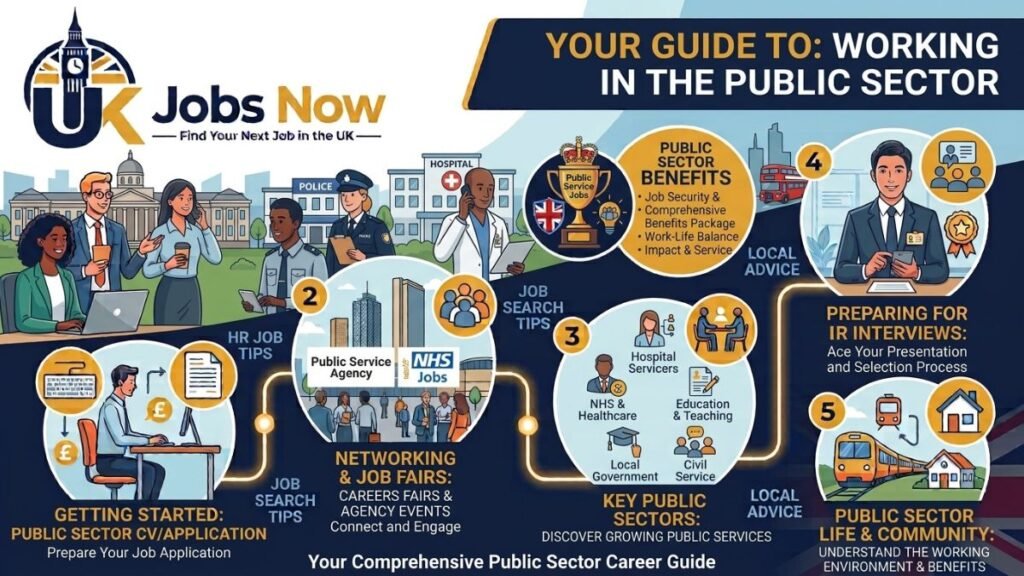
Public sector employment covers a genuinely huge range of UK work — central government departments, local councils, the civil service, education, and public bodies across every policy area — and it operates with a distinct culture, application process, and set of trade-offs compared to private-sector employment. This is a practical guide to what actually differs, how the application process typically works, and how to weigh up whether public sector work genuinely suits what you’re looking for.
What “public sector” actually covers
It’s a broader category than the civil service alone, which is often what people picture first. Public sector employment includes the civil service (central government departments and agencies), local government (councils and their various services), the wider public bodies and arm’s-length organisations delivering specific government functions, and — depending on how broadly you define it — publicly funded education and, as covered in our guide to non-clinical healthcare careers, much of the NHS and wider healthcare system. Each of these has somewhat different application processes, pay structures, and cultures, even though they share some common public sector characteristics.
Genuine trade-offs versus private sector work
It’s worth being honest and specific about how public and private sector employment genuinely differ, rather than relying on stereotypes in either direction.
Pay
Public sector pay is often structured around defined, transparent pay scales or bands, which can mean less individual negotiation flexibility than some private sector roles, but also more predictability and, for many roles, a clearer sense of how pay progresses with experience and grade over time. Whether public or private sector pay is higher for a comparable role varies significantly by specific role, sector, and seniority level — it’s not a uniform pattern in either direction, and it’s worth researching the specific pay band for a role you’re considering directly rather than assuming.
Job security and stability
Public sector employment is often perceived, generally accurately, as offering somewhat greater job stability than many private sector roles, particularly during economic downturns, though this isn’t an absolute guarantee — public sector organisations do go through restructuring and, at times, redundancies, particularly connected to broader government spending decisions.
Pension and benefits
Public sector pension schemes are, for many roles, genuinely more generous than typical private sector equivalents, representing a meaningful part of total compensation that’s easy to underweight when comparing a headline salary figure alone against a private sector offer.
Pace and culture
Public sector organisations, particularly larger ones, often involve more formal governance, process, and stakeholder consultation than a similarly sized private company, which can mean decisions and projects move more slowly. This reflects genuine, necessary accountability requirements for organisations spending public money and serving the public directly, not simple inefficiency — but it’s a real cultural difference worth being prepared for if you’re used to a faster-moving private sector environment.
Mission and purpose
Many people are drawn to public sector work specifically because of a genuine sense of public purpose — working on something that directly serves communities or delivers a public service — which some find more motivating day to day than private sector work focused primarily on commercial outcomes, even in an otherwise similar role type.
How the public sector application process typically differs
Public sector recruitment, particularly civil service roles, commonly uses a structured competency framework for assessing applications and interviews — in the UK civil service, this is built around defined behaviours and success profiles that applications and interview questions are explicitly assessed against. This means public sector applications often benefit from directly and explicitly addressing each specific competency or behaviour listed in the job advertisement, rather than a more general, free-form application — read the listing and any accompanying guidance closely, since public sector job postings frequently specify exactly what criteria your application will be assessed against.
Preparing a competency-based public sector application
| What’s commonly required | How to approach it |
|---|---|
| A statement addressing specific listed behaviours or competencies | Structure your response explicitly around each named behaviour, using a specific example for each — the STAR method works well here |
| Formal, structured interview process | Prepare specific examples for each competency likely to be assessed, based on the job advertisement’s stated criteria |
| Longer overall process than some private sector roles | Build in realistic timeline expectations — public sector processes, particularly for larger organisations, can move slower than a fast-moving private employer |
Our guide to common UK interview questions and the STAR method is directly relevant preparation here, since public sector interviews are often even more explicitly and formally competency-structured than many private sector equivalents.
Career progression within the public sector
Public sector organisations, particularly larger ones like the civil service, often have well-defined grading structures with clear progression criteria between grades, which can offer a genuinely transparent sense of career progression, alongside internal mobility between departments and roles that’s sometimes more structurally supported than equivalent moves within a private company. It’s worth researching the specific grading and progression structure of an organisation you’re considering, since this varies between different parts of the public sector.
Should you consider public sector work?
It’s worth weighing this against your own specific priorities rather than a generic assumption about which sector is “better” — if job stability, structured pension benefits, and a genuine sense of public purpose matter significantly to you, and you’re comfortable with a potentially more process-driven, formally structured working environment, public sector employment is genuinely worth serious consideration. If fast-paced, less formally structured work and maximum individual salary negotiation flexibility matter more to you, private sector roles may suit better — though it’s worth researching the specific role and organisation rather than relying entirely on sector-wide generalisations either way.
Getting started
Public sector roles are advertised through dedicated platforms (the civil service jobs website, individual council recruitment pages) alongside general job boards. You can browse current active UK job listings filtered by the public sector category to see current openings across government, council, and public body roles.
Understanding civil service grades
The UK civil service operates a structured grading system, from more junior administrative grades through to senior civil service positions, with each grade carrying defined pay ranges and typical responsibility levels. Understanding roughly where a role sits within this structure — a listing will typically specify the grade directly — helps you gauge both realistic pay expectations and the likely level of experience and responsibility involved, since grade titles can otherwise be less immediately intuitive than typical private sector job titles for someone new to public sector recruitment.
Local government roles specifically
Beyond the civil service, UK local councils employ a very large and genuinely varied workforce, covering everything from front-line service delivery (social care, waste management, planning) through to typical corporate functions (finance, HR, communications) needed to run any large organisation. Local government roles are advertised directly by individual councils, and it’s worth researching your specific local authority’s current vacancies directly if you’re interested in this route, alongside broader public sector job searching, since local government hiring doesn’t always route through the same central platforms as civil service recruitment.
Public sector graduate schemes
Several structured graduate scheme routes exist specifically within the public sector, including well-established civil service fast stream programmes and various department- or profession-specific schemes, offering formal, accelerated development typically leading toward more senior roles faster than a standard entry-level route. These schemes are often genuinely competitive, similar to prominent private sector graduate schemes, and typically involve a more extensive, multi-stage application and assessment process — worth researching well in advance of any application deadline given the additional preparation this format tends to require.
Frequently Asked Questions
Is public sector pay lower than private sector pay in the UK?
It varies significantly by specific role, sector, and seniority — there’s no uniform pattern in either direction, and it’s worth researching the specific pay band for a role you’re considering rather than assuming based on general reputation.
Why do public sector application processes often ask for a statement against specific behaviours?
Many public sector organisations, particularly the civil service, use structured competency or success profile frameworks to assess candidates consistently and fairly — addressing each named behaviour explicitly, with a specific example, tends to produce a stronger application than a more general, free-form response.
Is public sector work more secure than private sector employment?
Generally perceived as somewhat more stable, particularly during economic downturns, though this isn’t an absolute guarantee — public sector organisations do go through restructuring and redundancies at times, often connected to broader government spending decisions.
Do public sector pensions genuinely make a meaningful difference to total compensation?
Often yes — many public sector pension schemes are genuinely more generous than typical private sector equivalents, and it’s worth factoring this into any direct comparison against a private sector salary offer, rather than comparing headline salary figures alone.
Can I move between different parts of the public sector easily?
Often more easily than moving between unrelated private sector organisations, particularly within larger structures like the civil service, which frequently support internal mobility between departments as part of a defined career progression structure.
