Remote vs Hybrid vs On-Site Jobs in the UK: Which Is Right for You?
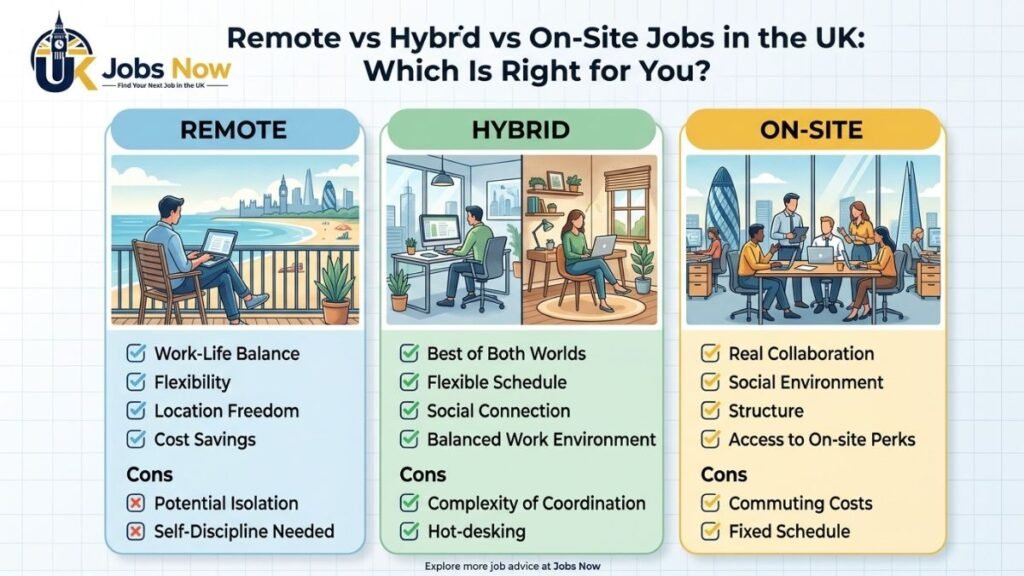
“Remote,” “hybrid,” and “on-site” get used fairly loosely in job listings, and the gap between what a listing says and what the day-to-day reality actually looks like can be bigger than people expect. This guide walks through what each arrangement genuinely tends to mean in the UK job market right now, the real trade-offs of each, and — more usefully — the specific questions to ask during a hiring process so you’re not guessing at how a role will actually work once you’re in it.
What these terms actually mean, and where they get blurry
On-site is the most straightforward: you work from a specific employer location, full stop, for essentially all of your working time. Remote should mean you can work from wherever you’re based, without a regular obligation to attend a physical office. Hybrid sits between the two — some proportion of your time in a shared physical location, some proportion working from home or elsewhere — but “hybrid” alone tells you almost nothing about the actual split, and that’s exactly where the ambiguity causes real problems.
A role advertised simply as “hybrid” could mean one mandatory office day a fortnight, or it could mean four days a week in the office with one flexible day — two extremely different working patterns hiding behind the same single word. This is the single most important thing to clarify before accepting any role labelled hybrid, and it’s a completely reasonable, expected question to ask during the interview process — asking it doesn’t read as presumptuous, it reads as someone who takes the practicalities of the role seriously.
On-site work: the case for it
On-site roles remain the right fit for plenty of people and plenty of jobs, and it’s worth resisting the assumption that remote or hybrid is automatically the superior option. Roles that genuinely require physical presence — hands-on technical work, most healthcare and care roles, hospitality, many manufacturing and logistics roles, and plenty of others — aren’t compromising by being on-site; the work itself requires it. Beyond necessity, some people simply do their best work with a clear physical separation between home and workplace, benefit from spontaneous in-person collaboration, or are earlier in their career and get genuine value from being physically present to learn from colleagues informally, in a way that’s harder to replicate over video calls.
The trade-off is the obvious one: a daily commute, which has both a time cost and a financial cost that’s easy to underestimate when comparing a job offer’s headline salary against a fully remote alternative. If you’re weighing an on-site offer against a remote one, it’s worth actually calculating your realistic commuting cost and time, not just estimating it loosely, because it can meaningfully change which offer is actually better once you account for it properly.
Hybrid work: the flexibility, and the specific questions to ask
Hybrid arrangements have become extremely common across UK professional roles, largely because they attempt to capture some of the benefit of both remote flexibility and in-person collaboration. Done well, this genuinely works. Done badly — with unclear or inconsistently enforced expectations — it can end up delivering the downsides of both arrangements rather than the benefits of either.
Before accepting a hybrid role, get clear, specific answers to:
- How many days per week or month, specifically, is the in-office expectation? “A couple of days” isn’t a specific enough answer to plan your life around.
- Are those days fixed (e.g. always Tuesday and Thursday) or flexible, chosen week to week? Fixed days are easier to plan a commute and childcare around; flexible days offer more autonomy but require more ongoing coordination.
- Is the policy consistently enforced, or does it vary significantly by team or manager? This is worth asking directly, because a formal company-wide policy and the actual lived reality within a specific team can diverge substantially.
- What’s expected of you on your in-office days specifically? Some hybrid roles use office time for deliberate team collaboration and meetings; others simply expect you to be present doing the same solo work you’d otherwise do at home, which is a much weaker justification for the commute.
Remote work: what genuinely full remote looks like, and the questions worth asking
Fully remote roles remove the office entirely from the equation, but “remote” itself has meaningful variations worth understanding before you accept a role:
- UK-wide remote versus location-restricted remote. Some roles are genuinely open to candidates anywhere in the UK; others are labelled remote but still expect occasional in-person attendance (team offsites, client meetings), which functionally requires you to be based within a reasonable distance of a specific location. Clarify this explicitly rather than assuming “remote” means zero in-person requirement.
- Equipment and home working setup. Does the employer provide a laptop, monitor, or a contribution toward home office equipment? This varies significantly between employers and is worth confirming before you start, particularly if setting up a proper home working space would otherwise be a real cost to you.
- Communication and working hours expectations. Remote work removes the implicit structure of a shared office, which means expectations around response times, core working hours, and availability for meetings need to be explicit rather than assumed. Ask how the team actually communicates day to day — this tells you a lot about whether the remote culture is genuinely well-established or something the employer is still figuring out.
- Career progression and visibility. This is a genuine, well-documented concern with remote work — it can be harder to build the kind of organic visibility that leads to promotion opportunities when you’re not physically present. It’s a reasonable question to ask directly: how does the company think about career development and progression for remote employees specifically, as distinct from office-based staff.
Salary and working arrangement: what’s actually connected
It’s worth understanding that working arrangement and salary aren’t independent variables — they’re often linked in ways that aren’t obvious from a job listing alone. As covered in more detail in our guide to UK regional salaries, some employers pay remote roles based on the employee’s actual location (a London-based remote worker earning more than an otherwise identical role based elsewhere), while others use a flat national rate for a given role regardless of location. Neither approach is universal, and assuming one when the employer actually uses the other is a common, avoidable source of disappointment once an offer arrives — ask directly, early in the process, rather than assuming.
How to figure out which arrangement is actually right for you
This is a genuinely personal decision, and the “right” answer varies enormously based on your circumstances, your role, your career stage, and how you personally work best. A few honest questions worth asking yourself, beyond the generic pros and cons:
- Do you have a home working environment that’s actually functional — enough space, minimal distraction, reliable internet — or would remote work mean working from a genuinely difficult setup?
- Are you early enough in your career that in-person mentorship and informal learning matter more to your development than they might later on?
- How much does your current or realistic commute actually cost you, in time and money, calculated properly rather than estimated loosely?
- Do you personally find you’re more productive with structure and separation between work and home, or does that distinction matter less to how you actually work?
There’s no universally correct answer here, and it’s worth being honest with yourself rather than defaulting to whichever arrangement currently has the most cultural momentum, since what works well for one person’s working style and life circumstances can be a genuinely poor fit for someone else’s.
How to filter for the right arrangement when job hunting
Once you’ve got a clearer sense of what you’re looking for, you can filter current active UK job listings by working arrangement — on-site, hybrid, or remote — alongside location, category, and salary, which narrows your search to roles that actually match how you want to work, rather than sorting through listings that turn out to require an arrangement you weren’t looking for at all.
Frequently Asked Questions
What does “hybrid working” actually mean in a UK job listing?
It varies significantly between employers and can mean anything from one office day a fortnight to four days a week in the office — the label alone doesn’t tell you the specific split, so it’s worth asking directly during the hiring process.
Are remote workers paid the same as office-based employees for the same role?
It depends on the individual employer’s policy. Some pay remote employees based on their location, others use a flat national rate for the role regardless of where the employee is based. This is worth confirming directly rather than assuming either way.
Is it harder to get promoted if I work remotely?
It can be, since remote work can reduce the organic visibility that sometimes drives promotion decisions in an office-based culture. It’s a reasonable and useful question to ask a prospective employer directly about how they specifically approach career development for remote staff.
Can I negotiate a hybrid or remote arrangement even if a job is listed as on-site?
Sometimes, though it depends heavily on the role and the employer — some roles genuinely require physical presence and aren’t negotiable, while others list on-site as a default that may have some flexibility if you ask. It’s worth raising during the process rather than assuming the listing is completely fixed.
What questions should I ask before accepting a hybrid role?
Specifically: how many days per week or month are expected in the office, whether those days are fixed or flexible, how consistently the policy is actually enforced across teams, and what’s specifically expected of you during your in-office time.