
Temporary and Contract Work: Pros, Cons and What to Expect
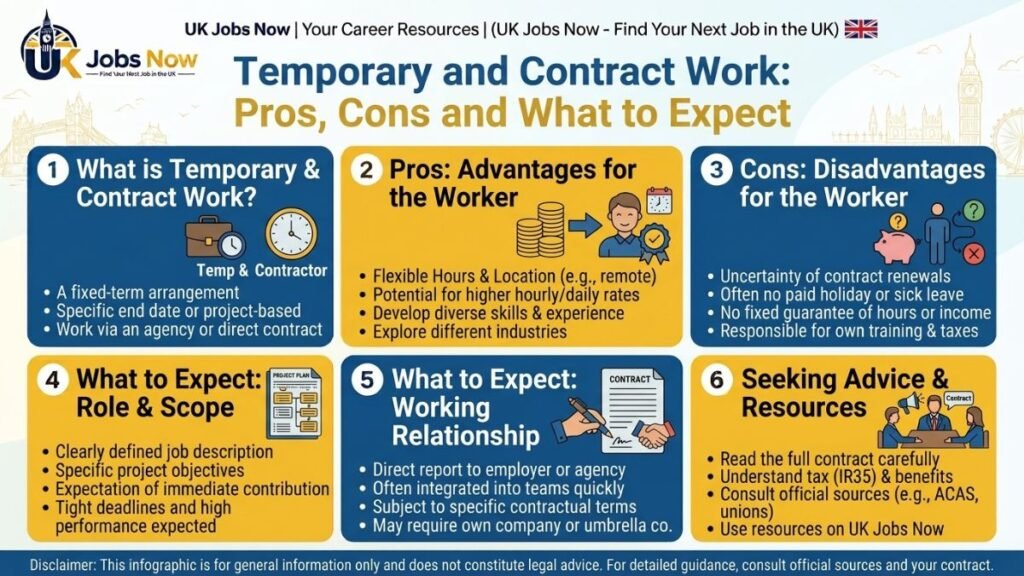
Temporary and contract work sits in an odd spot in how it’s usually discussed — sometimes framed as precarious or second-best compared to a “proper” permanent job, and sometimes, particularly at the more senior contractor end, framed as a deliberate, lucrative career strategy in its own right. The honest picture depends heavily on which specific type of temporary or contract arrangement you’re actually looking at, since the term covers genuinely different working patterns with different rights, pay structures, and practical trade-offs. This is a practical guide to what temp and contract work actually involves in the UK, and how to decide whether it’s worth pursuing.
The different types of temporary and contract work
It’s worth distinguishing between several genuinely different arrangements that all get loosely described as “temporary” or “contract” work. Agency temp work involves being placed by a recruitment agency into short-term roles with various client employers, often on relatively short notice, and is common across administrative, industrial, and hospitality roles. Fixed-term contracts are direct employment with a specific employer for a defined period, carrying most of the same employment rights as a permanent role during that period. Freelance or self-employed contracting involves working independently, often for multiple clients simultaneously, typically at a higher day rate but without the employment protections that come with employee status. Each of these carries meaningfully different practical implications, so it’s worth being clear about which specific arrangement a role actually involves before assuming they’re interchangeable.
Your employment rights on a fixed-term contract
UK law specifically protects fixed-term employees from being treated less favourably than comparable permanent employees purely because of their fixed-term status, under the Fixed-term Employees Regulations — this covers pay, access to training, and other core terms, calculated proportionally where relevant. Fixed-term employees also build up continuous service rights the same way permanent employees do, which matters for things like statutory redundancy entitlement if you’ve been on a series of fixed-term contracts with the same employer over an extended period.
Agency temp work: how it actually functions
When working through a recruitment agency on a temporary basis, you’re typically employed by the agency itself, not the client business you’re actually working for day to day, which has specific practical implications — the agency handles your pay and, in many cases, your statutory rights and entitlements, while the client business directs your actual day-to-day work. It’s worth understanding this three-way relationship clearly, and our guide to working with recruitment agencies covers the broader agency relationship in more depth, much of which applies directly to temp work specifically.
Self-employed contracting: a genuinely different proposition
Working as a self-employed contractor is meaningfully different from either agency temp work or a fixed-term contract, since you’re not an employee at all in the traditional sense — you’re running your own business, invoicing clients directly, and responsible for your own tax and National Insurance through self-assessment, without statutory employment rights like holiday pay or notice periods that apply to employees. This arrangement can offer genuinely higher day rates and considerably more control over which work you take on, but it comes with real trade-offs — no guaranteed income between contracts, and the full administrative and financial responsibility of running your own small business.
Weighing the pros and cons
| Factor | Genuine advantage | Genuine trade-off |
|---|---|---|
| Pay | Contract and freelance day rates are often higher than equivalent permanent salaries | No guaranteed income between contracts; day rate needs to cover gaps |
| Flexibility | Greater control over which projects and clients you take on, particularly as a self-employed contractor | Less predictability and structure than permanent employment |
| Variety | Exposure to different employers, projects, and industries over time | Less deep, long-term embedding within a single organisation |
| Employment rights | Fixed-term employees retain most permanent employee protections | Self-employed contractors have minimal statutory employment protection |
Is temp or contract work worth it?
This depends heavily on your specific field, career stage, and personal financial circumstances. In some sectors — particularly IT, engineering, and certain specialist professional fields — experienced contractors can earn substantially more than permanent equivalents, making it a genuinely attractive deliberate career strategy for those with in-demand skills and the financial resilience to manage income gaps between contracts. For others, particularly earlier in a career or in fields where contract work doesn’t command a significant premium, temporary work is more often a practical stepping stone — a way to gain experience, build a network, and sometimes convert into a permanent role, rather than a long-term deliberate strategy in itself.
Temp-to-permanent conversion
It’s genuinely common for temporary roles, particularly agency-placed ones, to convert into permanent offers if both the worker and the client business are happy with the arrangement after an initial period — this is worth treating as a real, deliberate strategy if you’re using temp work partly as a way into a specific employer or industry, since performing well during a temporary placement is a genuine, demonstrated audition that a standard interview process can’t fully replicate.
IR35 and why it matters for self-employed contractors
If you’re considering self-employed contracting, particularly through your own limited company, it’s worth being aware of IR35 legislation, which determines whether a contractor working for a client is genuinely operating as an independent business or is, in HMRC’s assessment, functionally working as an employee despite the contracting arrangement — with meaningfully different tax implications depending on which status applies. This is a genuinely complex area of UK tax law, and it’s worth seeking specific professional advice, either from an accountant experienced with contractor arrangements or directly through HMRC’s own guidance, rather than relying on general assumptions, since getting this wrong can have real financial consequences.
Managing the financial reality of contract work
Beyond the headline day rate, it’s worth planning realistically for the practical financial rhythm of contract or freelance work — periods without active contracts, the administrative cost of running as self-employed or through a limited company, and the fact that a contractor’s day rate needs to cover holiday time, sick time, and pension contributions that a permanent role’s salary and benefits package would otherwise include automatically. Building a genuine financial buffer before transitioning fully into contract work, rather than assuming every month will match your best month’s earnings, is a practical, important part of making this kind of work sustainable long-term.
Building continuity between contracts
Experienced contractors and freelancers often maintain a genuine pipeline of prospective next contracts well before a current one ends, rather than waiting until a contract concludes to start searching again — this typically means maintaining relationships with a few trusted recruitment agencies specialising in contract placements, and staying visible within your specific professional network, since a significant proportion of contract renewals and new placements happen through existing relationships rather than cold applications. Treating your professional network as an ongoing, active part of a contracting career, not just something to activate when actively searching, tends to smooth out the gaps between contracts considerably.
Getting started
You can browse current active UK job listings filtered by the temporary and contract job type to see current openings across sectors, whether you’re considering this as a deliberate strategy or a practical stepping stone toward permanent work.
Frequently Asked Questions
Do temporary workers have the same employment rights as permanent staff?
Fixed-term employees retain most of the same statutory rights as comparable permanent employees, calculated proportionally where relevant. Self-employed contractors have considerably fewer statutory protections, since they’re not classed as employees in the traditional sense.
Can a temporary role turn into a permanent job?
Yes, this is genuinely common, particularly for agency-placed temporary roles, and it’s worth treating strong performance during a temporary placement as a real opportunity to demonstrate your value ahead of a potential permanent offer.
Is contract work more lucrative than permanent employment?
Often, yes, particularly in fields like IT, engineering, and certain specialist professional areas, where experienced contractors can command a genuine premium — though this needs to be weighed against the lack of guaranteed income between contracts.
Who employs me if I’m working through a recruitment agency on a temporary basis?
Typically the agency itself, not the client business you’re actually working for day to day — the agency generally handles your pay and statutory entitlements, while the client directs your daily work.
Do I need to register as self-employed to do freelance contract work?
Yes — as a self-employed contractor, you’re responsible for registering with HMRC for self-assessment and managing your own tax and National Insurance, which is worth understanding and setting up correctly before starting this kind of work.
