
UK-Wide Remote Jobs: How to Compete When Location Doesn’t Matter
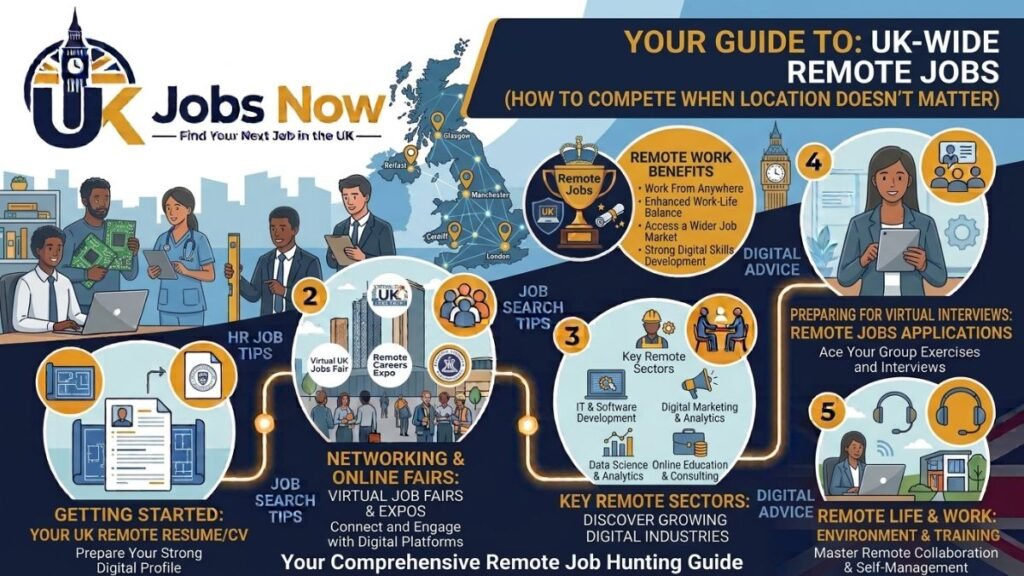
A genuinely UK-wide remote role removes geography from the hiring equation in one sense, but it doesn’t remove competition — it often increases it, since a fully remote listing is open to every qualified candidate in the country rather than just those within a reasonable commute. This is a practical guide to how to actually compete effectively for UK-wide remote roles, and the specific things worth understanding about how this category of job genuinely works.
Why UK-wide remote roles are more competitive, not less
It’s worth understanding this dynamic clearly before diving into strategy: a role restricted to commuting distance of a specific office might draw a candidate pool of a few hundred; the same role opened up UK-wide can draw applications from every qualified candidate in the country, since there’s no geographic barrier limiting who can realistically apply. This means the fundamentals — a genuinely well-tailored CV and cover letter, covered in our CV writing guide and cover letter guide — matter even more for remote roles than for a typical local application, since you’re competing against a considerably larger and more geographically diverse pool.
What “UK-wide remote” actually means in practice
It’s worth checking specific listings carefully, since “remote” can mean genuinely different things between employers, as covered in more depth in our guide to remote, hybrid, and on-site working. Some UK-wide remote roles are genuinely location-independent with zero in-person requirement; others expect occasional attendance at a specific office or event, which functionally requires you to be based within a reasonable travelling distance of that location despite being labelled remote. Clarifying this distinction directly during the application process avoids a genuine mismatch discovered only after accepting an offer.
How to make your application stand out in a larger candidate pool
Lean into genuinely specific, quantified achievements
With a larger pool of candidates, generic claims blend together even more than usual — specific, quantified achievements (covered in more depth in our guide to common CV mistakes) become proportionally more important as a differentiator when you’re one of a genuinely large number of applicants rather than one of a smaller local pool.
Demonstrate genuine remote-work competence directly
Employers hiring for remote roles are often specifically assessing whether you can work effectively without the natural structure and oversight of a shared office — demonstrating genuine experience with remote or distributed collaboration, strong written communication, and self-directed time management, with specific examples, gives you a real edge over candidates who simply assume remote work will suit them without evidence to back that assumption up.
Address the “why remote, why this role” question directly
Given the scale of competition, a personal statement or cover letter that genuinely explains why remote work specifically suits your circumstances and working style — not just that you’d prefer it — helps you stand out from candidates applying to every remote listing indiscriminately without genuine reflection on fit.
Salary considerations specific to UK-wide remote roles
As covered in more depth in our guide to UK regional salaries, employers handle remote pay differently — some use a single national rate regardless of where you’re based, others adjust pay based on your specific location, similar to how they might treat a location-based hire. It’s worth clarifying this directly and early in the process, since assuming one approach when an employer actually uses the other is a common, avoidable source of disappointment once a specific offer finally arrives on the table.
Building a remote-ready home working setup
Beyond the application itself, it’s worth genuinely preparing your home working environment before starting a remote role — a reasonably quiet, functional space, reliable internet, and appropriate equipment all matter more for remote work than they might for an office-based role where the employer provides this infrastructure by default. Some employers provide equipment or a home office contribution; it’s worth asking directly during the offer stage rather than assuming this is included.
A practical summary
| Factor | What to know |
|---|---|
| Competition level | Often higher than local roles, given the nationwide candidate pool |
| What “remote” actually means | Varies by employer — clarify any in-person expectations directly before assuming zero requirement |
| Salary approach | Some employers use a flat national rate, others adjust by location — worth confirming directly |
| Differentiation strategy | Specific, quantified achievements and genuine demonstrated remote-work competence matter more than in a smaller local pool |
Networking for remote roles specifically
It’s worth knowing that networking remains genuinely valuable even for remote roles, and in some ways matters more, since a personal connection or referral can meaningfully cut through a very large, geographically dispersed application pool in a way that’s harder to achieve through a cold application alone. Our guide to using LinkedIn effectively and guide to networking for introverts both remain directly relevant, and are arguably even more valuable given how geographically unconstrained remote hiring genuinely is.
Interview preparation specific to remote hiring processes
UK-wide remote hiring processes are almost always conducted entirely via video call, from first interview through to any final stage, which means format-specific preparation genuinely matters — our guide to video interview preparation is directly relevant here, since technical issues or poor camera presence can disproportionately affect a remote-only hiring process where there’s no in-person stage to offset a weaker video impression.
Time zone and working hours expectations
Even within a single country, UK-wide remote roles sometimes involve specific working hours expectations tied to core collaboration windows, particularly for roles working closely with a team based in a specific office location or serving customers with defined business hours. It’s worth clarifying expected working hours directly during the hiring process, since “remote” doesn’t automatically mean fully flexible hours, and assuming otherwise can lead to a genuine, avoidable mismatch once you’re actually settled into the role.
Career progression concerns specific to remote roles
It’s worth being aware of a genuine, well-documented concern with remote work — reduced organic visibility that can sometimes affect promotion opportunities compared to office-based colleagues, a topic covered in more depth in our guide to remote, hybrid, and on-site working. If long-term career progression matters significantly to you, it’s a reasonable and genuinely useful question to ask directly during a remote hiring process: how does this specific employer approach career development and promotion for remote staff, as distinct from any office-based colleagues.
Getting started
You can browse current active UK job listings filtered specifically to remote and UK-wide roles, across every category and sector, to see current genuinely location-independent opportunities.
Frequently Asked Questions
Is it harder to get a UK-wide remote job than a local one?
Often yes, in terms of raw competition — a fully remote listing draws from the entire UK candidate pool rather than just those within commuting distance, which makes a genuinely tailored, differentiated application more important than for a typical local role.
Do UK-wide remote roles always pay the same regardless of where I live?
It depends entirely on the individual employer’s policy — some use a flat national rate, others adjust pay based on location. It’s worth confirming this directly during the hiring process rather than assuming either approach.
What does “UK-wide remote” actually guarantee about in-person requirements?
Less than you might expect — some genuinely remote roles still involve occasional in-person attendance at a specific office or event, which can functionally require you to live within a reasonable distance of that location. Always clarify this directly.
How can I stand out when applying for a highly competitive remote role?
Specific, quantified achievements, genuine demonstrated evidence of remote-work competence, and a clear, personal explanation of why remote work specifically suits your circumstances all help differentiate your application within a larger candidate pool.
Does networking still matter if I’m only applying for remote roles?
Yes, arguably more than for local roles — a personal connection or referral can meaningfully cut through a very large, geographically dispersed applicant pool in a way that’s genuinely harder to achieve through a cold application alone.
Should I prepare differently for a remote job interview than an in-person one?
Yes — remote hiring processes are almost always conducted entirely via video call, so format-specific preparation (technical setup, camera presence, environment) genuinely matters more than it would for a process that includes an in-person stage to offset it.
Will I have less career progression opportunity in a fully remote role?
It’s a genuine, documented risk with remote work generally, though it varies significantly by employer — it’s a reasonable and useful question to ask directly during the hiring process about how a specific company approaches development and promotion for remote staff.
